
At first glance, Miso Robotics appears to be another of the countless pie-in-the-sky tech startups hoping to revolutionise the world as we know it, only to descend into a bottomless private equity money pit of empty promises and failed prototypes.
Robotic automation for quick-service restaurants (QSRs)?
Deep-frying robotic arms that take frozen French fries out of a freezer, dip them into hot oil, then slap them right on a serving tray? Autonomous kitchen assistants that can make and even season tortilla chips?
It either sounds like the Jetsons-inspired utopia we all crave, or the Black Mirror-inspired dystopia we all fear, depending on what side of the automation argument you sit on.
But unlike the Silicon Valley electric car companies that get billion-dollar valuations without producing a single vehicle, or the groundbreaking heathtechs that turn out to be US$10bn scams (and excellent Hulu fodder), Miso’s robotic army of fast food worker bees can already be found out in the field.
The California-based (where else?) tech startup’s products have been sent to work across the US, in major QSRs including Jack in the Box, White Castle, Chipotle and Panera.
And, as we’ll discuss shortly, they could be coming to a European city near you.
They come armed with cute names: Flippy Lite; the frying and finishing robot; Flippy 2, the modular frying robot; Sippy, the automatic beverage dispenser; and CookRight, the AI-powered sensor system which I assume is the more taciturn of the bunch.
To explain how they work would be a disservice; it truly does have the air of science fiction.
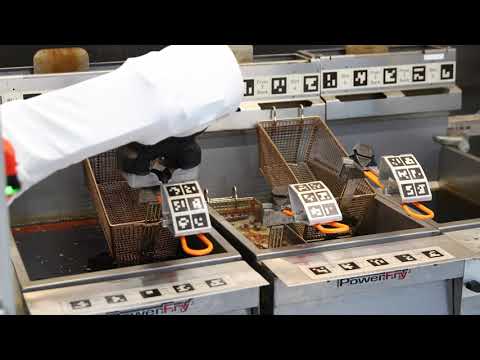
But as a neutral observer (I’m more of a home-cooking kinda guy), I was curious to hear from the boffins at Miso Robotics about the ethics of their technology potentially replacing swathes of entry-level jobs.
Speaking to Proactive, Miso’s chief strategy officer Jake Brewer said: “Our products do not replace people – they help them. Take Flippy for example. While the unit does take over the fry station in the back-of-house, human workers still need to pick up and bag the cooked food.
“It also allows those humans to be redeployed and focus on other tasks in the kitchen and restaurant that are more fulfilling, such as interacting with customers in the drive-thru or at the register.”
Brewer also makes a pragmatic point about the US employment market.
“The other element is the ongoing labour shortage in the industry, where QSRs are short-staffed and simply cannot fill all of the positions necessary to keep up with demand,” said Brewer.
That is certainly something the UK can relate to, given the crippling staff shortages plaguing the UK hospitality sector.
Funnily enough, Miso has struggled with its own labour shortages. “One of our biggest risk factors is training enough skilled installation crews to set ourselves up for success and take advantage of the full opportunity at hand,” noted Brewer, adding: “We are actively solving this and it won’t be a risk in 2023.”
European Vacation
Miso is no small fry in the US, but robotic French fryers have yet to cotton on in Europe and the UK, despite QSR wages being as much as 50% higher than in the US, according to Miso’s research.
Yet “Europe is at the top of our list for deploying our robots,” said Brewer, and that includes the UK.
As part of Miso’s Robotics’ plans for continental domination, the start-up has launched a Series E funding round with a target raise amount of US$15mln at US$11.06 per share and a minimum investment of US$995.40.
Crowdfunding has always seen Miso’s preferred route: To date, the startup has raised US$75mln in crowdfunding from over 25,000 individual investors.
Should you jump on board? The tech, developed in partnership with Ally Robotics, is no doubt impressive and has proven test cases across the US.
But can it scale globally? Or will the fear of robotic self awareness be too great for the wider world?
On a more serious note, the issue of labour shortages is only temporary, and the debate around automation in any industry is heated. Miso is going to have to navigate this.
That said, here in the UK, Ocado successfully transitioned from a grocery delivery service to a tech company with specialised robotic arms at its core. Automation is clearly going to be a greater part of the services industry in the future.
Lastly, Miso is beginning to see competition heat up, with Karakuri and Lab2Fab joining the robotic kitchen arms race in the US, but “they are earlier in their journey than we are from a development perspective”, reckons Brewer.
Let the robot wars begin!
Note: Proactive Investors is in no way affiliated with Miso Robotics and this is not a paid promotion. This article is purely for informational purposes. Make sure to do your own research on the business if you are considering an investment.
Edit: This article previously described flippy as a burger flipper. While Flippy was originally developed as a burger flipper, Flippy now focuses on the frying station.