
Strickland Metals Ltd (ASX:STK) continues to showcase the excellent potential of Wanamaker prospect at its flagship Millrose Gold Project in Western Australia's Yandal Greenstone Belt, with the latest assays confirming the high-grade lode as 300 metres in strike length and remaining open at depth.
Highlights from the Wanamaker lode, which lies 250 metres north of the 346,000 ounce-Millrose resource include:
- 7.7 metres at 6.6 g/t gold from 179 metres;
- 20.2 metres at 2.8 g/t from 143 metres;
- 5.4 metres at 5.9 g/t from 154.6 metres;
- 6.6 metres at 4.9 g/t from 141.6 metres; and
- 6.2 metres at 3.6 g/t from 151.9 metres.
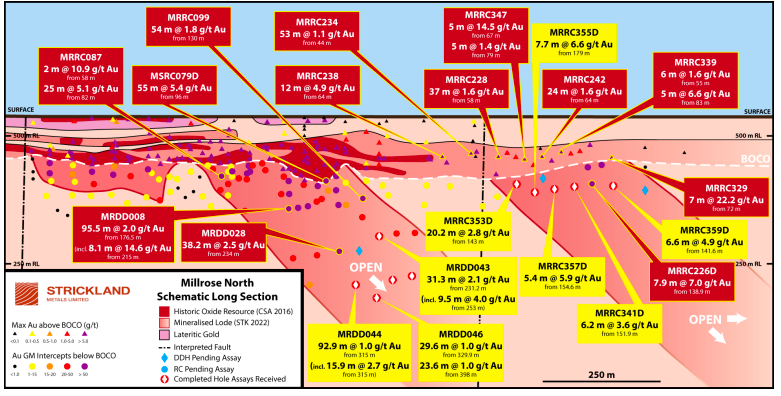
Long section of Millrose and Wanamaker.
Excellent results
“Wanamaker is continuing to deliver excellent results for shareholders, with all holes intersecting primary fresh rock mineralisation as modelled,” Strickland Metals chief executive officer Andrew Bray said.
“Having been initially discovered in July 2022 and subsequently confirmed by further diamond drilling, the high-grade lode is now confirmed as approximately 300 metres in length and entirely open at depth.
“Looking back over historical data, an old RAB line of drilling was drilled over the top of the Wanamaker lode. The old RAB hole directly above Wanamaker pulled up only three metres short of the lode.
"It’s a great credit to the thoroughness of our team, led by Richard Pugh and the staff at Omni GeoX, to have delivered this discovery.”
Combined strike of 3.2 kilometres
Wanamaker discovery is a distinct primary high-grade mineralised lode, consisting of silica-chlorite alteration, as opposed to the silica-carbonate alteration observed at Millrose North and the hematite-carbonate-silica alteration present at Millrose Central.
The presence of lamprophyre intrusives, associated with high-grade gold mineralisation, is a unique geological characteristic associated with Wanamaker.
These latest results were from drilling targeting further primary mineralisation on 50-metre step-outs from the previously-announced discovery holes MRRC130, which intersected 8 metres at 4.0 g/t gold from 104 metres and MRRC226D, which hit 7.9 metres at 7.0 g/t from 138.9 metres.
The drilling completed by Strickland over the last nine months has expanded the oxide gold mineralisation at Millrose, which is now defined over 3.2 kilometres in length and remains open to the north and will feed into an updated mineral resource planned for next year.
Other discoveries
The explorer also revealed results from the deeper diamond drilling undertaken beneath the current Millrose resource.
Some of the best intercepts include:
- 31.3 metres at 2.1 g/t gold from 231.2 metres, including 9.5 metres at 4.0 g/t from 253 metres;
- 92.9 metres at 1.0 g/t from 315 metres, including 15.9 metres at 2.7 g/t from 315 metres;
- 29.6 metres at 1.0 g/t from 329.9 metres and 23.6 metres at 1.0 g/t from 398 metres;
- 11.3 metres at 1.2 g/t from 298.2 metres, including 5.6 metres at 2 g/t from 298.2 metres, and 5.3 metres at 1.7 g/t gold from 326.2 metres; and
- 34 metres at 1.4 g/t from 292 metres.
These holes conclude the deeper drilling program around the Millrose mineral resource for the time being, with mineralisation remaining open at depth.