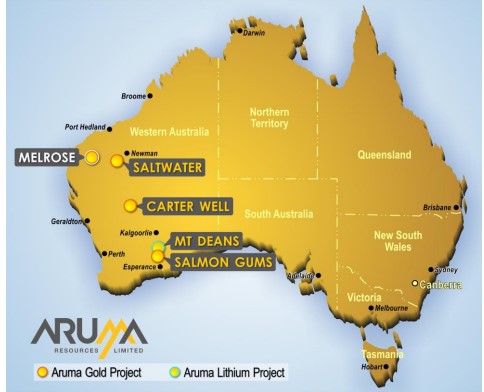
Aruma Resources Ltd (ASX:AAJ) has now finished its maiden reverse circulation (RC) drilling program at the Melrose Gold Project in the Pilbara region of Western Australia.
The company drilled 48 holes to depths of around 100 metres for 4,784 metres, on 10 lines of drilling, which tested all priority Gossan Hill targets.
Core from the first two holes is at the assay laboratory and the remaining holes will be submitted for assay in the coming week, with results to be released when available.
Defining gold grades
Aruma’s drilling was designed to define gold grades and controls on mineralisation along with lithology, mineralisation types, metallurgy and stratigraphy.
Drilling investigated gold and structural targets from historic drilling similar to the nearby Paulsens gold mine. These highly anomalous historic drill results are in a strong 50ppb gold anomaly, within a favourable structural setting.
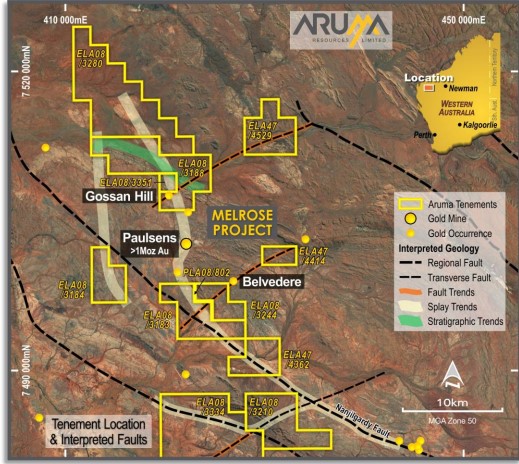
Melrose Gold Project showing multiple targets – drilling underway at Gossan Hill.
The target zone was an east-west structure in a folded carbonate-shale-greywacke sequence interpreted as being similar to Paulsens.
Historic RC drilling at Gossan Hill returned significant, thick gold intersections in limonite after carbonate including:
- 27 metres at 0.3 g/t gold from surface in hole PGHRC22;
- 18 metres at 0.26 g/t from 63 metres including 1-metre at 1.44 g/t from 63 metres; and
- 11 metres at 0.42 g/t from 8 metres including 1-metre at 2.74 g/t from 14 metres.
Aruma’s drilling intersected ironstones in the west and intermittent quartz veins and tourmaline-sulphides in the southeast holes on the boundary of the geochemical anomaly.
AAJ’s research-driven project acquisition strategy has delivered an active portfolio of three prospective gold exploration projects and one strategic lithium-tantalum project, all of which demonstrate the potential to host new discoveries.