
OPEC has increased its outlook for global oil demand in the medium and longer term, according to the group’s 2022 World Oil Outlook (WOO) released last week.
The group now sees oil demand reaching 103 million barrels per day (bpd) in 2023 and rising to 108.3 million bpd in 2030, with OPEC’s market share increasing over that time.
In the longer term, OPEC sees 2045 global oil demand reaching 109.8 million bpd, up from the 108.2 million bpd that the group forecasted last year.
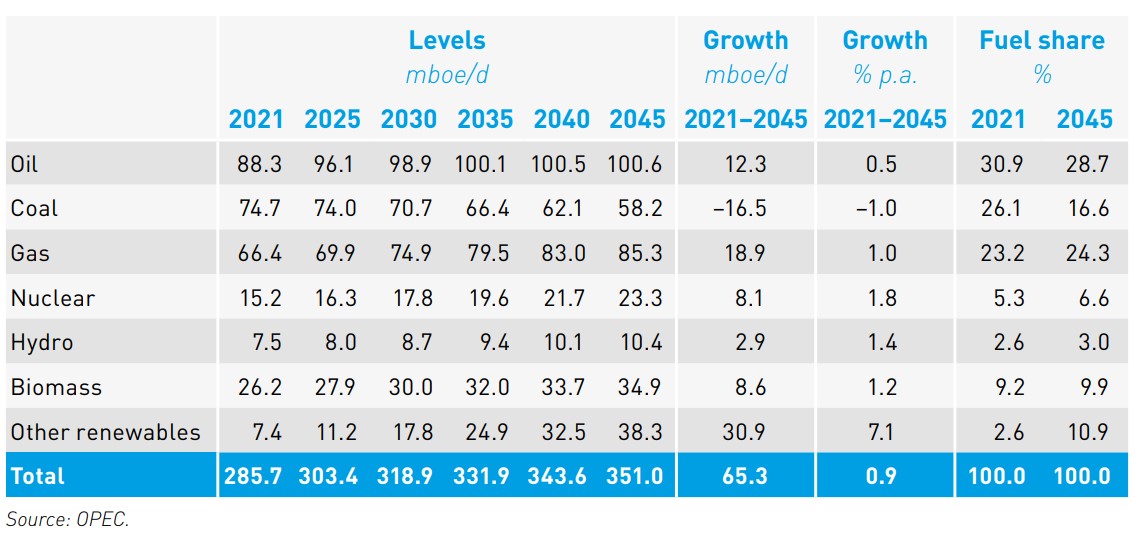
World primary energy demand by fuel type, 2021–2045.
In this article:
- Oil set to retain the highest share in the global energy mix
- Long-term demand growth to be driven by India, Africa and Other Asia
- Sectors contributing to growth in oil demand
- US$12.1 trillion investment needed until 2045
- Energy transition is inevitable
- Plateauing demand at the global level
Oil set to retain the highest share in the global energy mix
Oil is expected to remain the number one fuel in the global primary energy mix.
Demand for oil as a primary fuel is anticipated to increase from 88 mboe/d (million barrels of oil equivalent per day) in 2021 to 101 mboe/d in 2045, with its share in the energy mix dropping from 31% to just below 29%.
Despite decelerating oil demand growth, oil is set to retain the highest share in the global energy mix during the entire forecast period.
Global oil demand is projected to reach almost 107 million barrels a day (mb/d) in 2027, representing a robust increase of 10 mb/d compared to 2021.
The combined market share of oil and gas in the global primary energy mix is expected to remain above 50% to 2045.
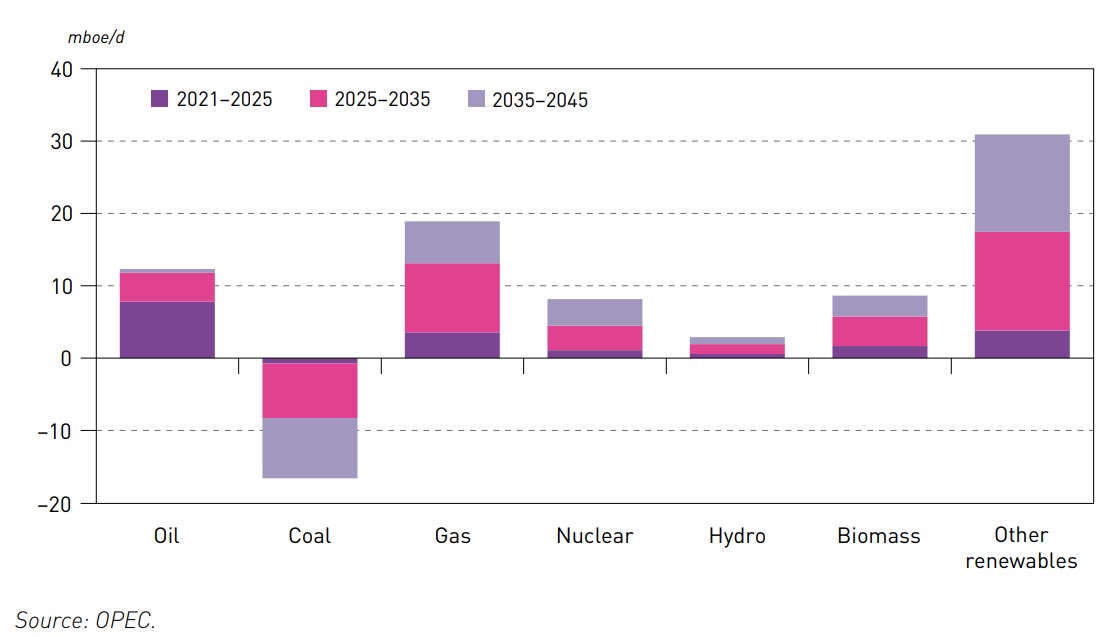
Growth in primary energy demand by fuel type, 2021–2045.
Long-term demand growth to be driven by India, Africa and Other Asia
Non-OECD (OECD is an organisation of developed economies) demand prospects are marked by strong demand growth.
In the initial years of the forecast period, this growth will be driven by China.
In the later period, India will take the leading role with demand growth in China slowing significantly and even turning to a marginal decline over the last five years of the forecast period.
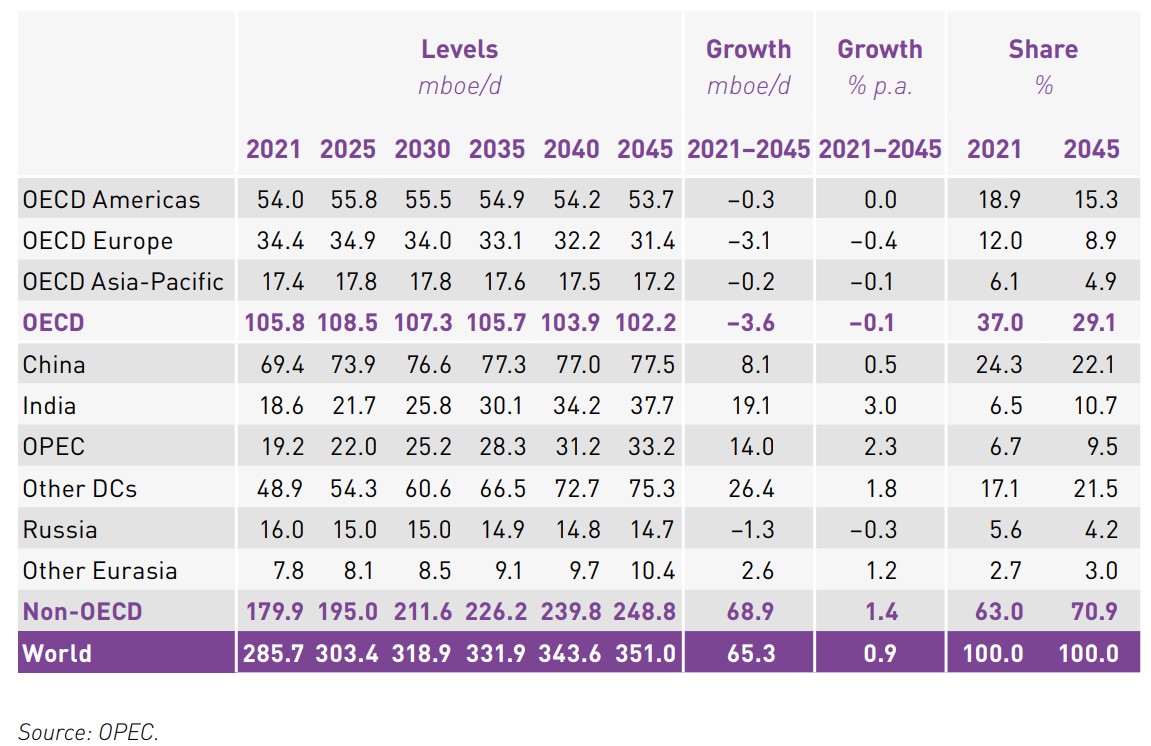
Total primary energy demand by region, 2021–2045.
Besides India, fairly robust growth during this period is also projected for Africa and Other Asia where economic progress, urbanisation, industrialisation and vehicle fleet expansion will be fastest among all regions.
This will result in respective demand increases of around 1.4 mb/d, 0.8 mb/d and 0.7 mb/d, for India, Africa and Other Asia, during the 2040–2045 period.
Even by 2045, oil demand will still grow at a rate of more than 2% p.a. in India and Africa and 1% p.a. in Other Asia.
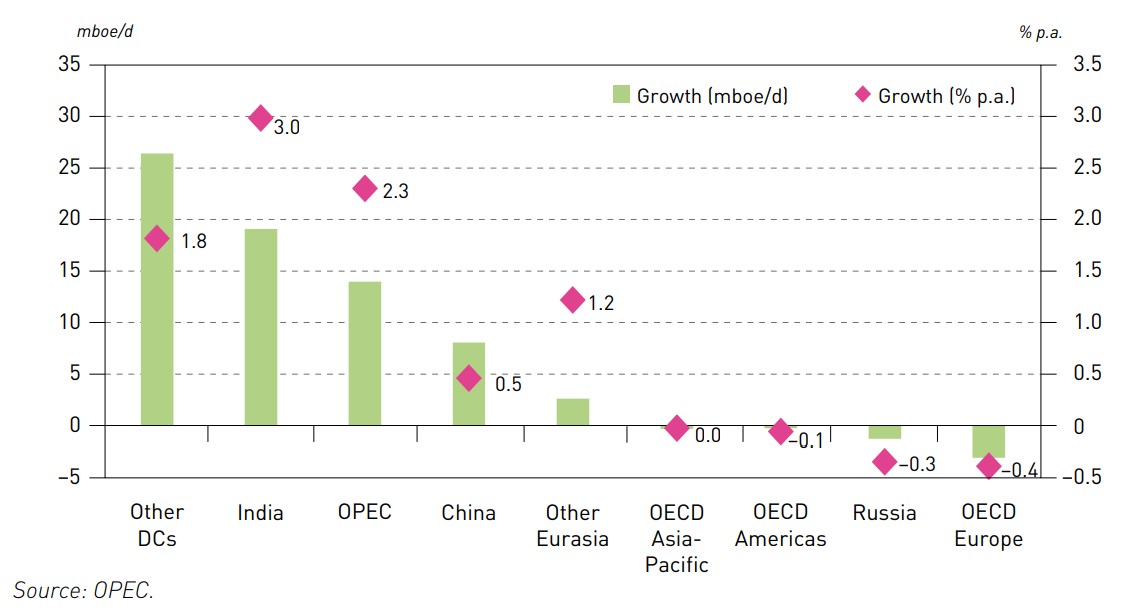
Growth in primary energy demand by region, 2021–2045.
Sectors contributing to growth in oil demand
Aviation, road transportation and petrochemical sectors will each see oil demand grow by around 4 mb/d between 2021 and 2045.
The largest demand increase, estimated at 4.1 mb/d between 2021 and 2045, comes from the aviation sector.
Considering 2021 as a basis for comparison, however, more than 1 mb/d of this expansion is needed to just reach pre-pandemic levels, which will likely not be achieved before 2024.
After an initial few years of growth, oil demand in the road transportation sector is expected to stay in a very narrow range of just below 47 mb/d as developments in the passenger car segment offset impacts on the commercial vehicles segment.
The EV fleet is projected to approach 540 million vehicles by 2045, representing more than 22% of the global fleet.
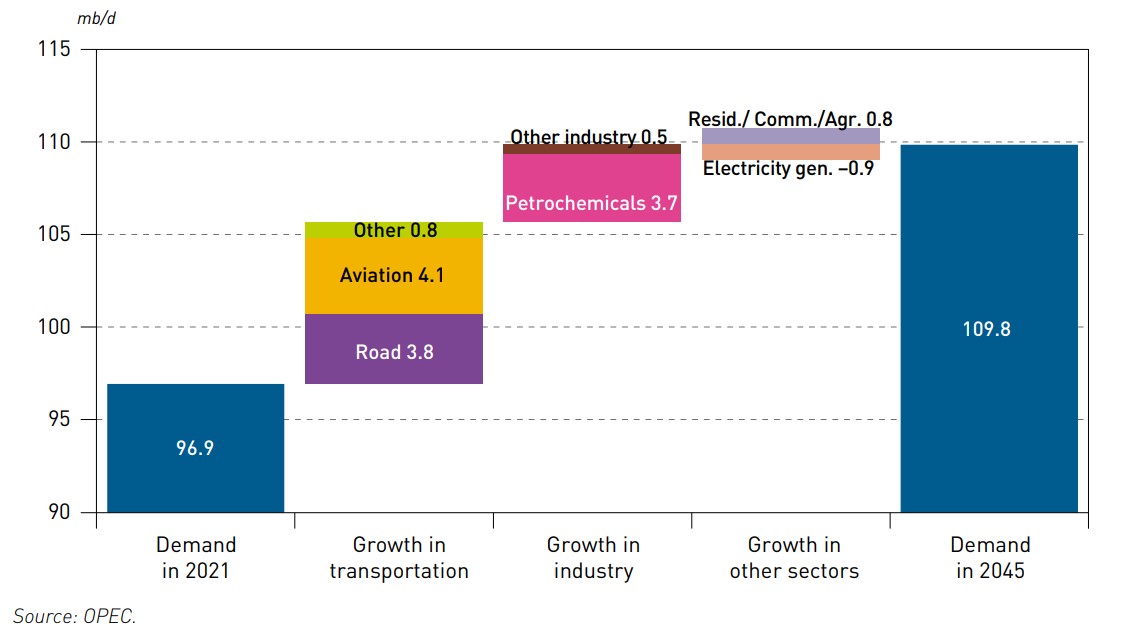
Oil demand growth by sector, 2021–2045.
US$12.1 trillion investment needed until 2045
To place expected future energy demand in some context, the World Oil Outlook sees the need to annually add on average 2.7 million barrels of oil equivalent a day in the period to 2045.
The oil industry needs to add 5 million barrels of oil a day (mb/d) every year to just maintain current production at around 100 mb/d, given an average annual industry decline rate of around 5%.
The overall investment number for the oil sector is US$12.1 trillion out to 2045.
However, chronic underinvestment into the global oil industry in recent years, due to industry downturns, the COVID-19 pandemic, as well as policies centred on ending financing in fossil fuel projects, is a major cause of concern.
Energy transition is inevitable
The momentum towards energy transition will not be reversed, with trends such as the push for renewable energy and the continued electrification of road transport fast progressing in several markets, supported by both policy and consumer choices.
Technology advances will continue to enable both improved energy efficiency across all sectors of consumption and fuel substitution towards cleaner energy sources.
Moreover, energy-saving measures implemented in response to high end-user prices, as well as political calls for solidarity and savings, may in some cases become entrenched.
Plateauing demand at the global level
In the long term, OPEC’s outlook assumes that oil demand growth will likely slow in the 2030s, hinting at a relatively long period of plateauing demand at the global level.
This will be a phase in which non-OECD growth will offset declining OECD demand.
This will be driven by energy policies and technology development that both play an increasing role in diversifying the future energy mix.
Still, global oil demand will increase by close to 13 mb/d in the period 2021–2045, rising to nearly 110 mb/d in the long term.