
- FTSE 100 closes up 44 points
- BoE hikes rates
- BT under pressure
4.48pm: FTSE closes ahead
FTSE 100 managed a positive finish on Thursday, having been lower earlier, as the weaker pound benefitted the big-cap index's dollar-earning constituents.
The UK blue-chip benchmark closed up around 44 points, or 0.62%, at 7,188 on the day the Bank of England followed in the footsteps of the US Fed by hiking interest rates 0.75 percentage points.
It means that the UK base rate currently stands at 3% and the central bank also gave an alarming assessment of what may lie ahead, namely the longest recession since records began.
"The Bank of England’s latest rhetoric is worrying. Inflation must be tamed, but interest rate hikes take time to feed through to the real economy, and there is a risk of making things worse than they need to be," noted Lee Wild, head of equity strategy at investment platform interactive investor.
"Any business that relies on a strong consumer is at risk when household finances get squeezed. The retail industry is already competing with housebuilders for the title of worst performing sector in 2022, and a lot of bad news is already priced in," he added.
"However, if conditions do deteriorate further, there could be more pain to come. We’ve already seen profit warnings from ASOS, Boohoo, and others, and investors would do well to monitor the health of these ‘at risk’ sectors as higher borrowing costs begin to bite."
3.55pm: FTSE recovers but mid-cap index falls on recession fears
Despite the Bank of England's rate hike to 3% and a warning of a prolonged recession, leading shares remain in positive territory heading into the close.
The FTSE 100 is up 26.94 points or 0.38% at 7171.08, with its host of overseas earners benefiting from a weaker pound after the Bank hinted that interest rates may not climb as high as previously expected.
Michael Hewson, chief market analyst at CMC Markets UK, said: "After yesterday’s sharp declines in the US, European markets have followed suit, falling back sharply across the board, although the FTSE 100 has outperformed with this afternoon’s sterling weakness appearing to offer a degree of support."
But the more domestically focused FTSE 250 has been spooked by the recession talk, and is down 0.76% at 18,078.93.
Among the leading risers in the blue chip index, positive reaction to their latest updates has seen J Sainsbury PLC (LSE:SBRY) climb 6.95%, Harbour Energy PLC (LSE:HBR) move 5.67% higher and Smith & Nephew PLC (LSE:SN) add 2.69%. Tesco PLC (LSE:TSCO) is up 2.45% in the wake of the Sainsbury update.
But BT Group PLC (LSE:BT.A) is down 9.35% and Rolls-Royce Holdings PLC (LSE:RR.) off 3.14% following their figures.
And RS Group PLC (LSE:RS1) is down 7.91% as news that its chief executive was taking a leave of absence for personal reasons outweight a positive update.
As for the mid-cap index, Susannah Streeter, senior investment and markets analyst at Hargreaves Lansdown, said: "After opening sharply lower, the sell-off accelerated on the domestically focused FTSE 250 as the harsh reality about the impact of a squeeze on discretionary spending became clear.
"Bootmaker Dr Martens and shopping centre owner Hammerson, card retailer Moonpig and Trixtax EuroBox which services e-commerce operations, were among the biggest fallers. With borrowing costs ramping up again, consumers will be looking long and hard about where they can cut costs to keep paying for their mortgage or rent as other cost-of-living pressures also mount."
3.25pm: Markets may be ahead of themselves on interest rates
Are we really approaching the top of the interest rate cycle?
AJ Bell says: "“It’s shocking to think that only a year ago, interest rates stood at just 0.1%, and that even after eight consecutive rate hikes from the Bank of England, markets still think we’re only part of the way to the top of the tightening cycle. We’re entering a brave new world of higher interest rates, and that has huge ramifications for consumers, businesses, governments, and investors, especially after such an extended period of ultra-loose monetary policy, which has lulled everyone into a false sense of security.
“But today’s report contained some nuggets of information which may be seized upon as a ray of hope by debt-laden businesses and consumers. The market is currently expecting interest rates to peak at 5.25% next year, but on that assumption the Bank of England says inflation will fall to 0% in 2025, 2% below its target. Even assuming interest rates remain at 3%, CPI comes in around 1% below target in 2025.
"The implication is that markets have got ahead of themselves, have priced in too many interest rate hikes, and actually we are now approaching the top of the cycle. In its commentary the Bank says its rate-setters think rates will peak at a lower level than expected, though they still threaten to act forcefully if inflation proves sticky."
Whatever the case, and despite predictions of a long recession, the FTSE 100 has rebounded and is now up 21.64 points or 0.3% at 7165.78, having earlier fallen to 7076.
The pound however remains in the doldrums after the Bank's hint on a lower than expected interest rate peak, and is now down 1.34% against the dollar at US$1.1227.
2.25pm: Bank "flying blind"
Back with the latest UK rate rise, and the Bank of England has been forced to act without knowing what is in the forthcoming autumn statement.
Dr Maria Rana, macroeconomic expert from the University of Salford Business School, said: “Despite being largely anticipated, the decision taken by the Monetary Policy Committee today has been challenging, or as the BoE’s Governor, Andrew Bailey, put it, the Bank had to “fly blind” since the Government has delayed the autumn statement.
“The BoE has been left blind not knowing how tight (contractionary) the fiscal policy will be. The U-turns on the catastrophic mini-budget of Truss and Kwarteng announced by the new Chancellor Jeremy Hunt have been well received by the markets and the interest rate did not have to rise as much as it would have had if there had not been a change in fiscal policy and Prime Minister.
“However the uncertainty on how far the Government will now go with its spending cuts and increase in taxes, has made the decision of the BoE even more difficult . Given that the BoE has also forecasted the longest period of recession, with prediction that the GDP will fall for eight consecutive quarters, it seems that such an increase in the cost of borrowing to cool the economy was not needed. There is now the risk to make recession even deeper.
“The Governor has justified today’s decision by explaining that inflation might increase even higher than the 40-year high (10.1 %) in September, due to the disruptions in supply chains post pandemic, the war in Ukraine and decrease in the labour force. Bailey has also announced that there is a ”tough road ahead” but the Bank also does not expect interest rates to raise as much as markets expect.
“Let’s now wait for the autumn statement and spending review later this month to see how tough the road ahead will be.”
1.57pm: Wall Street lower after Fed rate comments
US stocks opened lower following the Federal Reserve's 75 basis point interest rate hike yesterday, and accompanying comments from Fed chair Jerome Powell that it would be “very premature to talk about pausing rate hikes.”
Shortly after the market opened, the tech-laden Nasdaq Composite had shed 108 points or 1.1% at 10,417 points, with big tech stocks struggling to make gains following the Fed’s decision, adding to pressure from a slew of disappointing quarterly results from the likes of Alphabet, Meta, and Amazon.
The S&P 500 was down 40 points or 1% at 3,720 points and the Dow Jones Industrial Average had slipped 224 points or 0.7% at 31,924 points.
In terms of major movers, Moderna Inc plunged 3.9% at the open after the pharmaceutical company missed on both revenue and earnings expectations for 3Q and lowered its 2022 sales outlook.
Fitness equipment maker Peloton Interactive Inc (NASDAQ:PTON) also sunk about 15.2% on another weak outlook.
Streaming provider Roku tumbled 15.5% as the softer advertising market impacted the company’s 3Q earnings, with it downgrading its 4Q forecast.
Back in the UK, the FTSE 100 is off its worst levels but still in negative territory, down 19.54 points or 0.27% at 7124.6.
Meanwhile the pound is down 1.825% against the dollar at US$1.1173 despite the Bank of England's rate rise.
In that context, the risk is that Jeremy Hunt does a contractionary autumn statement - meaning taking more money out of the economy than putting in (through spending cuts or tax rises) on a false premise - that the government has no choice.
— Andy Verity (@andyverity) November 3, 2022
1.25pm: US jobless claims dip
Over in the US, weekly jobless claims have come in better than expected.
The number of Americans seeking unemployment benefit for the first time was 217,000 last week, compared to forecasts of a figure of 220,000.
The previous week's figure was revised up by 1,000 to 218,000.
1.22pm: Base rate peak could be below 5%
The Bank has indicated rates may not rise as much as the market expects.
David Goebel, associate director of investment strategy at UK wealth manager Evelyn Partners, said: "Markets had been pricing in continued rate hikes up to as much as 5.25% next year, but the Bank made clear in its statement today that this was not a likely path, saying that the peak in rates will be “lower than priced into financial markets”
"It forecast that following the market path would result in a long recession – two years from Q3 2022 to Q3 2024 - and reducing inflation to near-zero, far below the Bank’s 2% target.
"This implies that the peak for bank rate will be below 5.0%."
1.17pm: Variable rate mortgage holders face hefty rises - NIESR
Up to two and a half million households with variable mortgages will be hit by today's rate rise, according to the National Institute of Economic and Social Research.
It said variable rate mortgage repayments are set to double if the bank rate hits its projected peak of around 5%.
On average, the monthly repayment on a typical variable rate will rise from around £500 to over £1,000, it said, with more than 30 thousand households potentially seeing monthly mortgage repayments greater than their monthly incomes.
Max Mosley, NIESR Economist, said: “We now have evidence of what is potentially on the horizon for millions of households. Those most vulnerable to mortgage rate rises could see their real incomes decimated if interest rates surpass 5%. This shock to mortgage repayments, in combination with a decade of stagnant real incomes, the impact of Covid-19, inflation and a cost-of-living crisis, presents an unprecedented assault on the country’s living standards.”
Meanwhile Bank governor Andrew Bailey said he understood the challenges faced by mortgage holders, but believed the Bank had to take action to bring inflation down.
He also reckons fixed-rate mortgage deals should come down from the levels seen in the immediate aftermath of the mini-budget, which caused turmoil in the bond markets and pushed yields sharply higher.
People who remortgaged during this period faced paying the much higher rate.
Bailey said: "It is very unfortunate that those who had to take out mortgages during this period have faced a much more difficult situation."
12.44pm: Autumn statement now key
The Bank points out its forecasts incorporate measures announced by the chancellor up until 17 October, but clearly not any measures which will come in this month's autumn statement which will surely have an impact one way or another.
It said: "The Committee intends to condition its next forecast in February 2023 on announced fiscal policy."
Meanwhile the Bank may still be seen to be behind the curve despite today's rate rise.
Joshua Raymond, director at online investment platform XTB.com said: "Investors are disappointed not necessarily in this hike alone but the guidance from the central bank that rates won't need to rise much further to contain higher inflation.
"We should remember that the market has long deemed the Bank of England's response to inflation and far too slow and too weak. The new guidance is likely to be seen as a return to that interpretation. And the troubling part is, should the BoE be correct and not need to hike rates much further, it's more likely to do with the severity of the recession the Bank itself says the UK is already in. That's also bad news for the pound. ”
The recent turmoil under the Truss government shattered the UK's reputation for financial stability, and this must be restored said Alpesh Paleja, CBI lead economist:
“The Bank has deployed a bumper rate rise, underscoring the scale of the UK’s inflation challenge. A weakening economy and tighter fiscal policy is set against volatility in global energy prices, stubbornly high inflation expectations and persistent wage pressures.
“With monetary policy focused on tackling inflation, the government’s immediate priority should be to reinforce markets’ faith in the UK’s hard-won reputation for stability – but fiscal sustainability and growth shouldn’t be an either or choice.
“The Autumn Statement must learn the lessons of the 2010s: fiscal sustainability and lifting trend growth are both priorities. Alongside protecting the most vulnerable, the government should safeguard capital spending and investment allowances to enable private sector investment to drive future growth.”
contractionary Autumn Statement on 17 November. This is really shocking, especially given the hopes for a post Covid bounce
— Robert Peston (@Peston) November 3, 2022
12.21pm: Bank warns of prolonged recession
The UK economy is already in recession and will be for a prolonged period, the Bank of England has warned.
It estimates GDP contracted by 0.5% in the third quarter - 0.9 percentage points weaker than it expected in August - and to decline by around ¾% during the second half of 2022 "in part reflecting the squeeze on real incomes from higher global energy and tradable goods prices."
It said the economy is expected to remain in recession throughout 2023 and the first half of 2024, with GDP expected to recover only gradually after that.
It said: "The MPC’s latest projections described a very challenging outlook for the UK economy.
"It was expected to be in recession for a prolonged period and CPI inflation would remain elevated at over 10% in the near term. From mid-2023, inflation was expected to fall sharply, conditioned on the elevated path of market interest rates, and as previous increases in energy prices dropped out of the annual comparison. It was then expected to decline to some way below the 2% target in years two and three of the projection.
"This reflected a negative contribution from energy prices, as well as the emergence of an increasing degree of economic slack and a steadily rising unemployment rate.
"The risks around that declining path for inflation were judged to be to the upside."
12.11pm: Markets react to rate rise
Sterling has worsened but leading shares have recovered some of their losses following the Bank's rate rise.
Against the dollar the pound was down 1.088% before the announcement, but is now down 1.2% at US$1.1244.
It is a similar story with the euro, with sterling down 0.34% before the news, but now 0.58% lower at €1.1526.
But the FTSE 100, down 54.95 points shortly before midday, is now off 34.56 or 0.48% at 7109.58.
12.07pm: More rises on the way, but perhaps fewer than market expects
The Bank's monetary policy committee voted 7-2 for a rate rise to 3%.
One member wanted a 50 basis point rise, one a 25 basis point increase.
The Bank warned more rises were on the way, but perhaps the peak will be less than the market has priced in.
It said: "The majority of the Committee judges that, should the economy evolve broadly in line with the latest Monetary Policy Report projections, further increases in Bank Rate may be required for a sustainable return of inflation to target, albeit to a peak lower than priced into financial markets.
"There are, however, considerable uncertainties around the outlook. The Committee continues to judge that, if the outlook suggests more persistent inflationary pressures, it will respond forcefully, as necessary."
It said the consumer price index measure of inflation was projected to rise from the current 10.1%, to around 11% in the fourth quarter of 2022, lower than was expected in August, reflecting the impact of the government's energy price guarantee.
12.00pm: Bank bets on 75 basis point rise
The Bank of England has raised interest rates by 75 basis points to 3%, their highest level since 2008 at the start of the global financial crisis, as it attempts to tackle soaring inflation while also aware that the move could prolong an economic downturn.
With the consumer price index at a 40 year high of 10.1%, the Bank has decided on the biggest rate increase since 1989 (excluding Black Wednesday in 1992 when rates jumped from 10% to 12% to 15% amid the Exchange Rate Mechanism crisis).
The Bank had previously been criticised for being behind the curve by only agreeing a 50 basis point move at its last meeting in September, a day ahead of the controversial mini-budget from the Truss government which has subsequently been effectively reversed.
11.34am: Crude prices slide
Oil prices are lower on demand concerns and fading hopes of China easing its pandemic restrictions.
Brent crude is down 1.46% at US$94.76 a barrel while West Texas Intermediate is off 1.68% at US$88.49.
Craig Erlam at Oanda said: "Oil prices are softening a little on Thursday after nudging higher again a day earlier. Brent appears to be settling around the mid-point of the $90-$100 range as traders weigh up the impact of the OPEC+ cut against a bleak global economic outlook.
"The zero-Covid rumours in recent days may have given oil another bump higher, as will the crude inventory data that showed a large drawdown. But with those rumours not confirmed and recession talk growing louder, it may be a little premature to be suddenly optimistic."
10.52am: Wall Street's decline after Fed news expected to continue
US stocks were seen opening lower, extending the previous session's drop which followed mixed signals from the Federal Reserve on future interest rate hikes following Wednesday's, as expected, 75 basis point increase.
Futures for the Dow Jones Industrial Average were down 0.4% in pre-market trading on Thursday, while contracts for the S&P 50 and the Nasdaq-100 were both 0.5% lower.
On Wednesday, the Dow Jones dropped by more than 500 points, or 1.6%, while the S&P 500 finished down 2.5% and the Nasdaq Composite shed more than 3.3% as traders digested the Fed's accompanying statement and then comments at a press conference by its governor, Jerome Powell.
Neil Wilson, senior analyst at Markets.com said: "Market reaction was initially positive for risk, with the following line in statement regarded as dovish: “In determining the pace of future increases in the target range, the Committee will take into account the cumulative tightening of monetary policy, the lags with which monetary policy affects economic activity and inflation, and economic and financial developments.” It very clearly [indicated] that the Fed wants to slow down a bit to see what it’s done so far.
"In the presser, Powell said that at some point it will become appropriate to slow pace of hikes, and that point may come as soon as December. But then he started to sound hawkish. There was a very clear reaction in the market to Powell saying “data since our last meeting suggests that the ultimate level of interest rates will be higher than expected”.
"So, a higher terminal rate, and higher for longer seemed to be the message. In other words, we will down slow but no pivot, Powell stressing the “need for ongoing rate increases...ground left to cover ... it is very premature to be thinking about pausing". Markets ultimately took it as hawkish and risk took a hit."
With the rate move out of the way, traders will now focus back on economic fundamentals, notably Friday's US October non-farm payrolls report, with the ADP private payroll numbers yesterday surprisingly good.
Ahead of that comes the latest weekly unemployment claims data today, plus the latest US ISM services PMI survey.
10.29am: Mixed response to trading updates
Shares in RS Group PLC (LSE:RS1) have fallen 8.33% after a positive trading update has been overshadowed by news that chief executive Lindsley Ruth would be taking a leave of absence from the business for personal reasons with immediate effect.
Chief financial officer David Egan will become action chief executive, supported by the rest of the group's senior management team.
Analysts at UBS said: "Egan will assume Lindsley's duties (after similarly assuming the role when Lindsley took a temporary leave of absence for treatment for a medical condition from Nov'19 to Feb'20)."
Meanwhile the electronic components group said half year revenues rose 21% and pretax profit climbed 34% to £182.5mln.
It added: "Notwithstanding the tougher global economic environment, trading remains in line with our and consensus expectations for the full year."
Elsewhere there were mixed responses to trading updates.
Smith & Nephew PLC (LSE:SN) is up 3.68%, while J Sainsbury PLC (LSE:SBRY) has added 3.41%.
Harbour Energy PLC (LSE:HBR) was 2.58% higher as the UK’s largest independent oil and gas operator reported increased revenues and output, but said a windfall tax would cost it US$400mln.
On the downside following their latest reports, BT Group PLC (LSE:BT.A) is down 6.85% and Rolls-Royce Holdings PLC (LSE:RR.) has lost 4.68%.
Overall the FTSE 100 is currently down 26.52 points or 0.37% at 7117.62.
AJ Bell investment director Russ Mould said: "The scale of the fall on the FTSE is less than that seen on Wall Street overnight as the index’s collection of high dividend-paying, relatively lowly valued, old world economy stocks is less vulnerable to higher rate expectations.”
9.37am: UK service sector output weakest since January 2021, as mini-budget turmoil hits sentiment
Ahead of the Bank of England decision come more signs of weakness in the UK economy.
The S&P Global/CIPS services purchasing managers index fell from 50 in September to 48.8, signalling contraction. This is the lowest reading since January 2021.
Lower volumes of service sector output were mostly linked to cautious spending patterns among businesses and consumers, said S&P
A number of firms noted that political uncertainty since the mini-Budget had adversely impacted business investment and encouraged a wait-and-see approach to new projects.
There were also signs that higher energy bills had led to reduced spending on non-essential services.
October data revealed the first decline in UK service sector activity for 20 months with the #PMI at 48.8 (Sep: 50.0). Concerns over high inflation, the macroeconomy and the political environment hit client demand. Read more: https://t.co/MCNTCTktk6 pic.twitter.com/Fcfyqsqefn
— S&P Global PMI™ (@SPGlobalPMI) November 3, 2022
Business confidence has also been hit.
Tim Moore, economics director at S&P Global Market Intelligence, said: "Stubbornly high inflation, increased borrowing costs and worries about the UK economic outlook all contributed to weaker business optimism in October. Aside from the slump at the start of the pandemic, the degree of confidence across the service economy is now the lowest since December 2008."
The composite index - services and manufacturing - fell from 49.1 to 48.2.
This is the third month running the index has been below the 50.0 no-change mark. Manufacturing production fell at a much faster pace than service sector activity, said S&P.
The pound is under pressure, with sterling down 0.96% against the dollar to US$1.1271 and off 0.39% against the euro to €1.1548. Investors are betting the weakness in the UK economy means the Bank will not hike rates as much as the Fed.
8.55am: Super-size Bank hike expected
The Bank of England is widely expected to raise interest rates by 75 basis points later.
A smaller hike of 50 basis points cannot be ruled out, but last time round the market took issue with a similar increase, fearing the Bank was behind the curve on tackling inflation. A day after its last meeting, of course, came the contentious mini-budget which sent things spiralling out of control and led to the Bank stepping in to steady the gilt market.
Craig Erlam at Oanda said: "The Bank of England will likely join the Fed in raising rates by 75bps later today. The central bank has had the unenviable job of fighting soaring inflation amid enormous economic and political uncertainty. In recent months the country has had three Prime Ministers, three very different economic agendas, and no budgets outlining them. Not ideal for a central bank that's fighting double-digit inflation.
"It hasn't handled things perfectly this year either, that's clear. It's taken a far more cautious approach than others leaving it in the situation now that it must raise rates aggressively and publish economic forecasts with little insight into government spending and tax plans. The outlook is uncertain enough without that."
Victoria Scholar at interactive investor said: “It is far from certain, but the Bank of England could be set to carry out its biggest rate hike since 1989 raising interest rates by 75 basis points to 3%. This would be the eight consecutive interest rate increase lifting rates to the highest level since 2008 at the start of the global financial crisis. The Monetary Policy Committee’s vote is likely to be divided with the potential for a less aggressive 50 basis point hike instead. The size of the increase will signal how concerned Bank of England policymakers are about inflation versus a recession as it looks to curtail further price rises without inadvertently causing unnecessary economic pain.
"Looking further ahead, the markets are pricing in another 50-basis point increase from the Bank of England in December after which the pace of tightening may slow, depending on the path of inflation."
Jim Reid at Deutsche Bank points out that the recent market turmoil saw investors expecting a much bigger rise from the Bank at one point.
He said: "Since the BoE’s last meeting in September, an awful lot has happened in the UK, including a mini-budget that triggered market turmoil, a temporary BoE intervention to buy longer-dated gilts, a policy reversal on most of that mini-budget, and then Liz Truss’ replacement as PM by Rishi Sunak. That volatility has been reflected in market pricing for today’s decision as well.
"Straight after the last meeting, overnight index swaps were pricing in a 75bps hike, but at the height of the mini-budget turmoil they went as far as pricing in more than 200bps worth by today, including a decent chance of an intermeeting hike. However, as the situation has calmed down, pricing has returned to its original starting point of a 75bps hike again."
Susannah Streeter, senior investment and markets analyst at Hargreaves Lansdown, said: "Inflation is proving a tough opponent to beat so another super-size hike is widely expected. Bank of England policymakers may not be equipped with an aide memoire of a fiscal statement to work out how much corrector pen it needs to try and erase inflation, but they have a pretty clear timetable laid out about the course the economy is set to take. There will be a close eye trained on accompanying comments, especially policymakers’ expectations for just how high the price spiral will go, and the shrinking effect on output of this sharp tightening of policy."
8.25am: Rolls down to earth after trading update
Rolls-Royce Holdings PLC (LSE:RR.) is also proving a drag on the market.
The aero engine maker maintained its guidance for 2022 despite supply chain issues, rising energy and raw material costs, and the recent turmoil in the financial markets.
But its shares are down 4.42% as investors were hoping for more.
Sophie Lund-Yates, lead equity analyst at Hargreaves Lansdown, said: “Rolls Royce is doing all it can within its control. Costs are being managed by inflation-linked clauses in its customer contracts, debt’s being repaid, and crucial Engine Flying Hours are edging upwards. The trouble is, and which has been the case since the pandemic struck, the group’s grappling against a multitude of headwinds from external forces.
"Engine Flying Hours, which are used to calculate how often Rolls Royce’s engines are serviced, will never take off completely while restrictions remain in China. At the same time, while the debt pile is coming down, and is on a fixed interest rate, it is still suffocatingly large. The group’s carrying £4bn of drawn credit around, and that will limit growth for a while yet because lightening that load takes priority over anything more exciting."
8.13am: Footsie falters as Fed suggests US rates will go higher than expected
Leading shares have opened lower after the Federal Reserve indicated US interest rates would have to go higher than previously expected, and ahead of a forecast 75 basis point rise in UK rates at midday.
Victoria Scholar, head of investment at interactive investor, said: "The Fed’s latest interest rate hike has sent global markets lower with the Nasdaq closing down more than 3% after the central bank suggested that it is prepared to go further to tackle inflation. Fed Chair Jay Powell warned that US rates will peak above expectations, dashing hopes that the rate hiking cycle was beginning to wind down and that inflation was under control in the eyes of the Fed."
With Wall Street lower and Asia markets under pressure, the FTSE 100 is down 44.23 points or 0.62% at 7099.91.
BT Group PLC (LSE:BT.A) is down 4.09% despite first half earnings rising 3% and the company saying it was on track to meet its full year guidance as it increased its cost savings target.
Scholar said: "The telecoms giant is grappling with pressures from rising inflation and fears of a recession, which is why BT is raising its cost savings target as a way to provision for the macroeconomic headwinds and to pay for the build of its fibre network.
"BT has also been dealing with a series of challenges from rising interest rates given its heavy debt levels as well as an unhappy workforce resulting in a series of strikes amid a dispute over pay. Earlier this month, BT also reduced its group revenue guidance after the creation of its Warner Bros Discovery sports joint venture."
But J Sainsbury PLC (LSE:SBRY) is up 3.11% despite an 8% fall in interim profits to £340mln. As analyst Nick Bubb said, it could have been worse given the challenging environment.
The supermarket group also stuck with its full year forecast of underlying profits of between £630mln and £690mln.
7.49am: Dollar leaps ahead following jumbo hike, euro gathers support against Sterling
As expected, the US Federal Reserve raised interest rates by 75 bps yesterday, marking the fourth straight jumbo hike in a row.
The market is starting to price in a looser policy, i.e. 25 to 50 bps, according to Daniele Antonucci, chief economist at Quintet Private Bank.
Antonucci said: “The important bit was that the central bank acknowledged the substantial cumulative monetary policy tightening and the likely further impact on the economy. These changes in the statement suggest that the Committee is probably leaning towards slowing the pace of rate hiking to 50 bps at the December meeting.”
Unsurprisingly, this propelled the greenback forward. The GBP/USD pair is currently at nine-day lows of US$1.136.
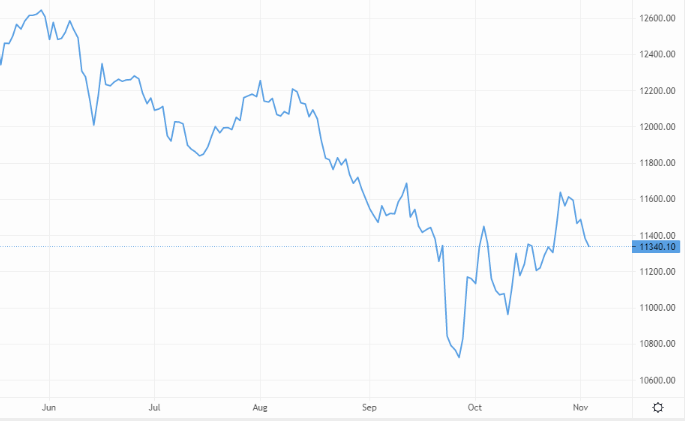
Cable gears up for today’s BoE rate decision – Source: capital.com
But it was the euro that took the hardest beating, having closed the Tuesday session 64 pips lower and dipping another 26 pip in this morning’s Asia session so far.
At US$0.978, the EUR/USD pair has returned to two-week lows.
EUR/GBP is finding more support; the pair is currently changing hands at 86.18p having closed higher yesterday.
That could change when the Bank of England announces its interest rate decision later today.
Expectation is for another jumbo 75 bps hike, and anything softer could see a cooling off for the British pound.
7.00am: FTSE seen lower as Fed signals further rate rises are on the way
The FTSE 100 is expected to be marked down in early trading after the Federal Reserve raised US interest rates by 75bp and indicated more increases were on the way sending US stocks sharply lower.
Spread betting companies are calling the lead index down by around 45 points.
The Dow closed Wednesday down 505 points, 1.6%, at 32,148, the Nasdaq Composite slipped 366, 3.4%, to 10,525 and the S&P 500 lost 97 points, 2.5%, to 3,760.
The 75bp rise was expected but US markets fell back sharply after Fed chair Jerome Powell signalled further hikes were on the way: "We have a way to go," before rate hikes could be paused.
Michael Hewson chief market analyst at CMC Markets said: “While Powell acknowledged that a slowdown in the size of rate rises was likely, it didn’t alter the fact that rates would probably still need to go much higher in order to get inflation back to target of 2% over time.”
In London, the Bank of England will announce its interest rate decision at noon with expectations of a 75bp increase to match the Fed although some analysts suggest the recent poor economic data may prompt a lower increase.
Energy stocks will be in focus once more after a report in The Times suggesting the windfall tax on oil and gas companies will be extended by the government.
A busy day of corporate news kicks off with results from BT Group PLC (LSE:BT.A), Rolls Royce PLC and J Sainsbury PLC (LSE:SBRY) amongst others.