
- FTSE 100 closes up on last day of October
- Banking sector gains on reports it will avoid a windfall tax
- Easyjet boosted by BA bid speculation
4.50pm: FTSE closes ahead
FTSE 100 closed firmly higher on Monday, while Wall Street shares stumbled, as traders await interest rate decisions this week from central banks in the US and UK.
The UK's top share index closed up nearly 47 points, or 0.66%, at 7,094.
Meanwhile, on Wall Street, the Dow Jones was off 0.42% and the Nasdaq dropped 0.98%.
"While Wall Street edges lower in early trading, the FTSE 100 has managed to rise to a one-month high. Banks have been a major player here, as expectations of tighter interest rates boost income forecasts for the sector, a point highlighted by several major players in their results," said Chris Beauchamp, analyst at online trading platform IG.
"Meanwhile, the pound’s drop today back below $1.15 has provided another tailwind for the index, but the modest losses in the US might be a harbinger of things to come if the Fed is more hawkish than expected this week," he added.
Fawad Razaqzada, of City Index and FOREX.com, said: "If the Fed decides to pivot to a more dovish stance, this should provide at least a short-term boost to stocks and reduce the appeal of the US dollar against currencies where the central bank is having a hard time controlling inflation."
The analyst added: "However, I very much doubt the Fed will want to ease off the gas just yet, with employment remaining quite strong. In the event the central bank appears more hawkish than the markets hope, this could put renewed upward pressure on the dollar, especially against the likes of the yen and yuan, while cause more pains for the global stock markets, including the FTSE."
3.45pm: FTSE looks set to end October in buoyant fashion
The FTSE 100 looked set to end the month in buoyant fashion, shrugging aside falls in the US, as mining companies reversed their earlier losses to swing into positive territory.
By 3.45pm London’s blue chip index was up 84 points at 7,132 while the FTSE 250 firmed 18 points to 17,935.
After being index laggards for most of the day, following disappointing Chinese manufacturing data, mining stocks pushed higher following the US open boosted by a combination of dollar strength against the pound and the earlier report in the FT that Tesla had held talks about taking a stake in Glencore PLC (LSE:GLEN).
Michael Hewson chief market analyst at CMC Markets UK suggested “The growing popularity of electric cars is likely to mean that automakers will want to secure sources of lithium and cobalt so what better way than to sign a deal with a producer who has expertise in that area.”
Further M&A speculation saw easyJet PLC fly high with shares up 7.6% on reports that British Airways owner, International Consolidated Airlines Group SA (LSE:IAG), was eyeing up a bid for the budget airline.
International Distributions Services PLC (LSE:IDS), the owner of Royal Mail, delivered a double boost to its shares with news that strike action had been called off and after the government signalled it wouldn’t take any action after Czech billionaire Daniel Kretinsky who increased his stake in the business to 22% earlier this year.
The government suggested that they probably wouldn’t block further increases in that stake and shares rose 6.7%.
Banks also recovered some of the ground lost last week following reports the sector may avoid a windfall tax.
NatWest Group PLC (LSE:NWG) bounced 5% after Friday’s heavy losses while Lloyds Banking Group PLC (LSE:LLOY) rose 2% and Barclays PLC (LSE:BARC) advanced 1.75%.
3.15pm: Boomin to bust - reports suggest online property portal has gone under
Online property portal Boomin has reportedly called in liquidators after failing to secure new funding.
A report on Sky News said the company - which was founded by the former boss of Purplebricks and counted Channel 4 among its investors - called in accountancy firm BK Plus to handle its insolvency on Monday.
Boomin was launched by Michael Bruce in an effort to challenge established property players such as Rightmove and Zoopla.
It attracted investment from blue-chip backers including Foxtons and DN Capital, but was unable to raise about £6mln of additional equity.
According to Sky, the company's 65 employees were notified about the plan to put it into liquidation on Monday afternoon.
2.50pm: Pound slips as investors take bets ahead of rate calls
The pound slipped back on Monday against the dollar ahead of a key week of central bank announcements.
The pound fell 1% to $1.15, as the dollar strengthened ahead of the US Federal Reserve’s meeting on Tuesday and Wednesday.
A 75 basis point rate hike is widely expected, and investors will be looking for any clues in the statement as to whether the central bank is looking to slow the pace of rate rises in the coming months.
The Bank of England is expected to announce a 75bps hike to 3% (or possibly 50bps) on Thursday.
But with the economy slowing, and rising energy costs some analysts think markets may be overestimating what the BoE might do and that the scope for a dovish surprise was larger than is currently priced in.
"The market firmly prices 75 bp, but we think the risk of a softer 50 bp is under-priced as the BoE prepares for the coming recession," ING strategist Chris Turner said.
The fall in sterling gave the dollar earners in the FTSE 100 a boost with the lead index spiking higher with companies such as Rio Tinto moving from negative to positive territory.
2.25pm: Field narrows for HSBC's Canadian arm
Two leading Canadian banks have pulled out of the race to buy the Canadian arm of HSBC Holding PLC according to The Globe and Mail.
National Bank of Canada (TSX:NA) and Canadian Imperial Bank of Commerce are no longer in the running a report said citing sources familiar with the process.
Bank of Montreal (CSE:BMO) is touted as a possible suitor for HSBC Canada, the report said, which could fetch more than £6bn in a sale.
HSBC confirmed in early October that it was considering selling its Canadian unit, a profitable business with strong roots in commercial banking and a large presence in British Columbia and Ontario.
The Globe reported that first-round bids were due late last week.
1.48pm: FTSE at session highs
FTSE 100 pushed to session highs supported by a strong banking sector although US markets made a weak start to the day.
At 1.45pm London’s blue-chip index was up 30 points at 7,077 while the FTSE 250 was flat at 17,915.
US stocks fell on Monday morning following solid gains amid a slew of corporate earnings last week, as investors await the release of key data, including OPEC’s outlook report today, the Fed’s next policy announcement on Wednesday, and October’s monthly employment report due Friday.
Shortly after the market opened, the Dow Jones Industrial Average had fallen 113 points or 0.3% at 32,749 points, the S&P 500 was down 22 points or 0.6% at 3,879 points, and the Nasdaq Composite had shed 77 points or 0.7% at 11,025 points.
1.00pm: Hospitality industry under threat
More than a third of UK hospitality businesses – bars, pubs, restaurants and hotels – could go bust early next year due to a triple whammy of soaring energy costs, rising inflation and declining consumer spending, the industry warns.
The survey by UKHospitality, the British Beer and Pub Association, the British Institute of Innkeeping and Hospitality Ulster, shows that 35% of businesses were expecting to be operating at a loss or to be unviable by the end of this year.
The report found that 775 of operators are seeing a drop in people eating and drinking out; 85% expect this situation to worsen, and 89% are pessimistic that the current levels of support offered by the government (for example discounts on energy bills) are not enough to protect the industry.
In a joint statement they said: “If urgent action isn’t taken, it is looking incredibly likely that we will lose a significant chunk of Britain’s iconic hospitality sector in the coming weeks and months.”
12.30pm: OIl price slides on Chinese concerns
Oil prices fell nearly 2% on Monday after weaker than expected factory activity data out in China and on concerns that the country's widening COVID-19 curbs will curtail demand.
Brent crude futures declined 1.76% to $92.168 a barrel by midday, extending Friday's 1.2% decline, while US West Texas Intermediate crude slipped 1.88% to $85.111.
Factory activity in China, the world's largest crude importer, fell unexpectedly in October, an official survey showed on Monday, weighed down by softening global demand and strict COVID-19 restrictions that hit production.
Chinese cities are stepping up zero-COVID curbs as outbreaks widen, dampening hopes of a rebound in demand.
Shares in Shell PLC (LSE:SHEL, NYSE:SHEL) were a prominent faller in the FTSE 100, down 1.4%.
12.00pm: Britishvolt near collapse - Guardian/FT
The government-backed battery startup Britishvolt is considering entering administration with the potential loss of nearly 300 jobs after struggling to find investors willing to fund its effort to build a giant £3.8bn “gigafactory” in north-east England, according to reports in the Guardian and the Financial Times.
The company could announce an administration as soon as Monday, with the accountancy firm EY lined up to carry it out if it goes ahead, two sources with knowledge of Britishvolt’s operations told the Guardian.
However, the report said one other source cautioned that Britishvolt was also still examining other options.
A Britishvolt spokesperson said: “Company policy is to not comment on market speculation.”

11.30am: FTSE 100 holds narrow gains, US markets seen lower
FTSE 100 remained slightly higher heading to midday looking ahead to the restart in the US where markets are expected to fall back at the open, retreating after all three major indexes ended last week with strong gains.
Investors focus will switch from corporate earnings to Wednesday's Federal Reserve policy decision and then Friday's October non-farm payrolls report.
Futures for the Dow Jones Industrial Average were 0.5% lower in pre-market trading, while those for the S&P 500 were down 0.5%, and contracts for the Nasdaq-100 shed 0.7%.
Despite broadly disappointing Big Tech earnings and a heavy sell-off in their stocks, US equities ended last week on a positive note, thanks to record profits from US Big Oil companies, and a much better-than-expected reaction to Apple results, noted Ipek Ozkardeskaya, senior analyst at Swissquote Bank.
Also a positive last Friday, the US PCE index, which is a gauge of inflation closely monitored by the Federal Reserve, remained flat at 6.2% over the year, while the core PCE continued increasing, but happily less than expected.
Ozkardeskaya noted, however: "The US core PCE now stands at 5.1% - that’s more than twice the Fed’s 2% policy target. Therefore, even though the data was less scary than many feared, it will hardly change the Fed’s plan to hike the rates by another 75bp this week, which is given some 80% probability at the start of this week."
10.51am: Centrica boosted as Citi, Barclays up price targets
Shares in Centrica PLC (LSE:CNA) received a boost this morning as brokers Citi and Barclays increased their price targets for the group.
In a note this morning Citi analyst Jenny Ping said the share price already reflects a punitive power generation windfall tax in the form of a revenue cap and an extension of the tax on oil and gas.
But it does not reflect the upside risk from optionality and growth potential offered by a very profitable Rough storage asset, its core cash generative retail business and the prospect for earnings clarity once there is visibility on any government intervention, she commented.
Ping thought a windfall tax would provide a “much needed clearing event for the shares.”
“Furthermore, in a rising rate environment, we prefer companies with little debt and robust balance sheets, qualities which Centrica already possesses” she said.
Citi reierated a buy rating and raised its price target for Centrica to 93p from 81p.
Barclays reiterated its overweight rating and raised its price target to 144p from 121p.
The broker pointed out “markets hate uncertainty.”
“We see clarity on price caps and windfall taxes by year end with government prioritising a targeted support mechanism vs mass support schemes.”
Mid-morning and shares in Centrica are up 4.5% at 76.50p.
10.26am: Eurozone inflation hits fresh high
Two pieces of economic news from Europe.
Annual Inflation in the Eurozone hit a fresh record high of 10.7% in October, ahead of analyst expectations of 10.3% according to official statistics from Eurostat.
This was up from 9.9% in September and reflected soaring energy costs which rose 41.9% from 40.7%, followed by food, alcohol and tobacco (13.1%, up from 11.8% in September), while industrial goods inflation picked up to 6% and services to 4.4%.
In a seperate announcement real GDP in the Eurozone rose by 0.2% quarter-on-quarter in quarter three, after a 0.8% increase in quarter two, in line with the consensus forecasts.
The year-over-year rate slowed to 2.1%, from 4.3% in Q2, also in line with the consensus.
Euro area #inflation up to 10.7% in October 2022: energy +41.9%, food, alcohol & tobacco +13.1%, other goods +6.0%, services +4.4% - flash estimate https://t.co/b9t9sOMDLM pic.twitter.com/NbsakF4eVe
— EU_Eurostat (@EU_Eurostat) October 31, 2022
10.00am: Mortgage approvals fall 10% in September
UK mortgage approvals fell by 10% last month and consumer credit also declined, as people borrowed less on their credit cards amid the cost of living crisis.
Bank of England figures showed that mortgage approvals for house purchases "decreased significantly” to 66,800 in September from 74,400 in August, adding to other evidence that the housing market is slowing.
Mortgage lending was unchanged at £6.1bn.
The actual interest rate paid on newly drawn mortgages climbed by 29 basis points to 2.84%.
Consumers borrowed an additional £700m in consumer credit, down from £1.2bn in August, as credit card borrowing plunged to £100m from £700m. Other forms of credit include car dealership finance and personal loans.
9.20am: Easyjet flies on bid speculation
Shares in budget airline operator, EasyJet PLC, surged 5.2% today on reports that the group could be a takeover target for International Consolidated Airlines Group SA (LSE:IAG).
The Times reported that British Airways-owner is eyeing a potential acquisition as part of renewed plans to consolidate the European airline industry.
AJ Bell investment director Russ Mould said the reports “make perfect sense.”
He explained that the pandemic has “created concerns about the future of business travel.”
“It’s far easier, cheaper and more environmentally friendly to hold many conversations over Teams or Zoom than get on a plane” he pointed out.
“Therefore, companies like International Consolidated Airlines need to rethink their future sources of revenue” adding “owning EasyJet would significantly boost International Consolidated Airlines’ position in the leisure market and give it access to many prized airport landing slots.”
Mould suggested “Many airlines will have been watching EasyJet’s share price collapse and weighing up their options.”
“An opportunistic takeover bid now could net them a bargain in the long term, but equally it’s a bold move to take given the gloomier economic outlook which could cause further disruption to earnings over the coming year.”
“Wizz Air has been linked as a potential suitor for EasyJet in the past and there is also logic behind a tie-up of those two companies” and Mould suggested that International Consolidated Airlines could face competition from other parties should it decide to make a move on the low-cost airline operator.”
Shares in Wizz Air Holdings PLC (AIM:WIZZ) also rose, up 4.6%.
9.05am: FTSE 100 slips as weak Chinese data dents mood
FTSE 100 fell back in early trading with weak factory activity data in China pushing mining stocks lower and offsetting gains in the banking sector.
At 9.00am the FTSE 100 was down 13 points at 7,035 with the FTSE 250 down 35 points at 17,882.
China's factory activity shrank in October after industries were hit by strict Covid lockdowns with the PMI coming in at 49.2 points, down from September's 50.1 and below the 50-point mark separating growth from contraction.
Susannah Streeter, senior investment and markets analyst, Hargreaves Lansdown said: “Concerns are growing that China’s Covid curbs are upsetting the applecart for manufacturing yet again.”
“There are reports that the production of i Phones could fall by as much as 30% next month at the mega FoxConn factory in Shenzhen after a fresh virus outbreak.”
“It comes after PMI data for October shows that relentless restrictions have been a blight on factory activity across China.”
Concerns of lower demand from the economic super power dragged mining companies lower including Glencore PLC (LSE:GLEN) (down 1.9%) and Anglo American PLC (LSE:AAL) (down 1.1%), whilst oil major and index heavyweight, Shell PLC (LSE:SHEL, NYSE:SHEL), dropped 1.74% as the oil price fell around 0.9% reflecting similar concerns.
On the upside, banking stocks rose following a report in the Sunday Times that the sector would avoid a windfall tax.
Lloyds Banking Group PLC (LSE:LLOY), NatWest Group PLC (LSE:NWG) and Barclays PLC (LSE:BARC) were all higher.
Shares in Royal Mail owner, International Distributions Services PLC (LSE:IDS), also enjoyed a good start to the week, rising 6.55% after Royal Mail workers dropped plans for a series of mass walkouts over the next two weeks after the company reportedly queried the legality of the action.
Around 115,000 members of the Communications Workers Union (CWU) has been planning to strike on 2, 3, 4, 8, 9 and 10 November.
8.30am: Banks rise on reports they may avoid a windfall tax
Shares in the major banks, NatWest Group PLC (LSE:NWG), Lloyds Banking Group PLC (LSE:LLOY) and Barclays PLC (LSE:BARC) rose in early trading following a report in the Sunday Times that a windfall tax on the banking sector to plug a big hole in the government finances was unlikely.
The report stated: "The government last night quashed suggestions that it is considering a windfall tax on banks as one of the measures to plug a hole in its finances at next month’s budget."
"Two senior sources close to prime minister Rishi Sunak and chancellor Jeremy Hunt played down the idea that they were looking at ways to impose additional taxes on banks."
The news will come as a relief to the City, which had feared a raid on bumper profits derived from rises in interest rates.
8.17am: FTSE 100 little changed at the open
FTSE 100 was little changed at the open on Monday ahead of a key week of economic data and central bank announcements with interest rate decisions from the US Federal Reserve on Wednesday and the Bank of England on Thursday.
At 8.15am the FTSE 100 was up 6 points to 7.053 with the FTSE 250 up 7 points at 17,924.
"After last week’s positive finish European markets look set to start the week slightly higher, despite another set of weak Chinese services and manufacturing PMIs, which has prompted a mixed Asia session," said CMC's Michael Hewson.
China's factory activity shrank in October, official data showed, after industries were hit by strict Covid lockdowns. The purchasing managers' index came in at 49.2 points, down from September's 50.1 and below the 50-point mark separating growth from contraction.
There were also concerns of another jolt to inflationary pressures in food prices as wheat and corn futures soared on world markets after Russia pulled out of a deal to allow grain exports from Ukraine through the Black Sea, which is seen as vital for world supplies and bringing high global food costs down.
Corporate news was a little quieter in London ahead of another busy week with shares in TP Group up after it agreed a £17.53mln bid from Science Group PLC (AIM:SAG).
Glencore PLC (LSE:GLEN) was in focus after the Financial Times reported that Tesla held talks with the commodities group as it looked to secure materials needed for the rollout of electric vehicles.
The Financial Times cited people familiar with the matter as saying that preliminary discussions about Elon Musk's electric car and battery maker buying a 10% to 20% stake in Glencore began last year.
They continued in March this year, when Glencore chief executive Gary Nagle visited Tesla's factory in Fremont, California as part of a roadshow for the mining company's annual results.
However, it was understood that the discussions ended with no deal reached.
The impact of the infamous mini-budget has hit the housing market, according to Zoopla, with demand for new homes from first-time buyers in the UK down by a third.
The company suggested that "mortgage rates of 4% to 5% are likely to be the new norm."
Sarah Coles, senior personal finance analyst, Hargreaves Lansdown said: “Buyers have fled the horrors of the housing market in their droves since the mini-budget, thanks to alarming interest rates and predictions that property prices are set to plunge.”
“But this doesn’t necessarily mean sellers are safe to sell up and sit it out in the hope of a cut price deal next year either.”
7.55am: Euro hit by high inflation data as Sterling stabilises against the US dollar
The euro responded poorly to a slew of higher-than-expected inflation data emerging from Germany, France and Italy last Friday.
Italy in particular surged, with the harmonised HICP rate rising 3.4 percentage points to 12.6% year on year.
EUR/USD dove sharply and continued to move south over the weekend, hitting US$0.994 come Monday morning.
EUR/GBP was similarly bearish, falling to seven-week lows of 85.8p, as Europe’s scary mix of high inflation and softer economic data started to bite.
EU-wide inflation data is due at 11am and is expected to show record highs of 10.4%; anything higher could cause added drag on the euro.
Sterling has stabilised somewhat against the US dollar, even as the US Dollar Index (DXY) entered the week unexpectedly high at 110.94.
At US$1.158, the GBP/USD pair is around 2.5% higher week on week.
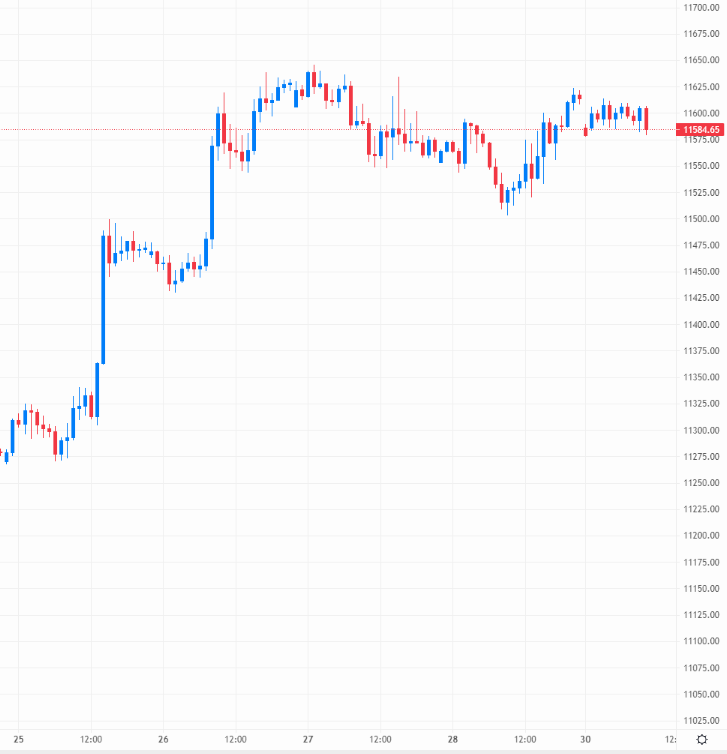
Cable’s relative stability can be seen on the one-hour chart – Source: capital.com
The US Federal Reserve’s interest rate decision on Wednesday will undoubtedly set the tone in the forex markets this week.
Given FOMC’s joint agreement in October that hiking rates is necessary to “prevent the far greater economic pain associated with entrenched high inflation, including the even tighter policy and more severe restraint on economic activity that would then be needed to restore price stability,” the hawks seem firmly in charge.
Anything softer could allow the pound to add pips.
7.25am: First-time buyers swerve the housing market
Demand for new homes from first-time buyers has slumped by a third since the former chancellor, Kwasi Kwarteng’s infamous mini-budget, according to a report from property company Zoopla.
As mortgage rates soared to highs of 6%, it put the biggest squeeze on new buyers since the late 1980s with Zoopla suggesting that "mortgage rates of 4% to 5% are likely to be the new norm."
Zoopla said there have been big drops in new buyer interest in the South East where demand was 40% lower and the West Midlands –38% lower.
Zoopla reporting a 33% drop in new buyer enquiries since the mini budget pic.twitter.com/3BfC8GJmQ2
— Neal Hudson (@resi_analyst) October 31, 2022
Falls were less pronounced but still significant in Scotland (down 24%) and the North East of England (down 20%).
"New buyer demand has dropped quickly in the face of higher borrowing costs, it's like the Christmas slowdown has come a month early," said Zoopla executive director Richard Donnell.
"We don't expect to see any impact on pricing levels between now and December and this will only start to materialise in early 2023. It takes several months for pricing to adjust in the face of weaker demand."
'Homeowners wanting to sell in 2023 will need to be realistic on price and may have to forgo some of the pandemic price gains to achieve a sale in 2023,' says Zoopla's research director, Richard Donnell.
7.00am: FTSE seen slightly higher
FTSE 100 expected to open slightly firmer on Monday as investors look ahead to a busy week of central bank interest rate announcements with the Bank of England and US Federal Reserve set to make their latest moves.
Spread betting companies are calling the lead index up by around 7 points.
London should take some enthusiasm from a strong performance in the US on Friday where stocks ended the week in a buoyant mood.
The Dow closed Friday up 828 points, 2.6%, at 32,861, the Nasdaq Composite added 310 points, 2.9%, to 11, 102 and the S&P 500 jumped 94 points, 2.5%, to 3,901.
In the UK, the latest mortgage and credit card lending data is expected to show further weakness in September
Mortgage approvals are expected to slow to 63.7k, from 74.3k in August, ahead of the next increase in the energy price cap in October.
Net lending on mortgages is expected to slow to £5.2bn from £6.1bn.
EU gross domestic product and consumer inflation figures are also due today.