
NickelSearch Ltd (ASX:NIS) continued its exploration targeting process during the September quarter and expanded its portfolio of nickel sulphide targets at the Carlingup Nickel Project with two additional high-priority exploration sites.
The Sprint and Relay targets have been classified as highly prospective greenfield exploration sites while the John Ellis West target has been upgraded and added to the extensive portfolio of exploration targets.
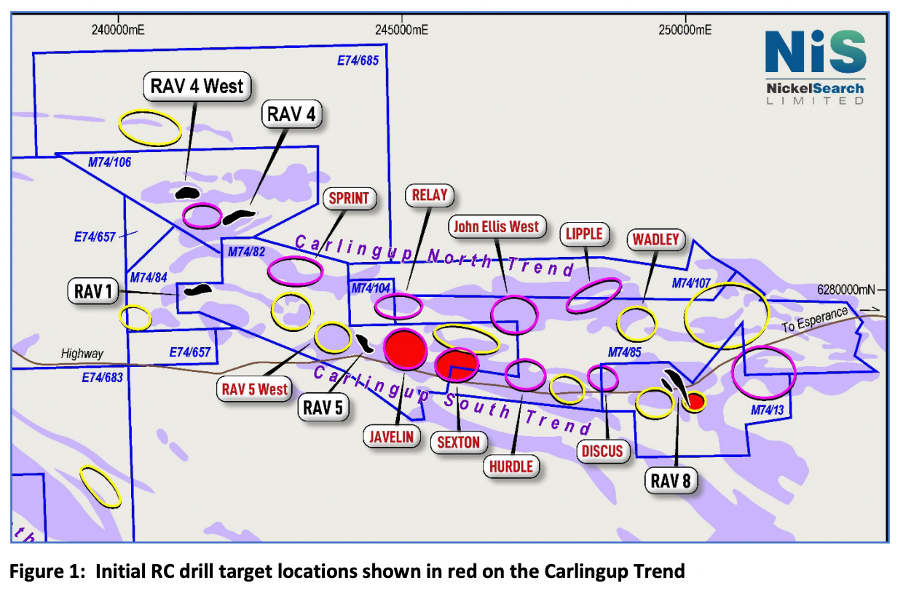
NickelSearch has also recently started reverse circulation (RC) drilling to test a selection of well-defined high-priority nickel sulphide targets at RAV8, Sexton and Javelin.

New greenfield targets
NickelSearch continued its systematic targeting analysis aimed at the discovery of high-grade Komatiite-hosted nickel sulphide deposits during the September quarter.
The company received the results of 2,715 assays for multi-element, ultra-fine soil geochemical samples recovered from its tenement package, in addition to the results of the recent ground gravity survey.
All new data has been integrated with other primary targeting criteria and has identified two new greenfield exploration targets being Sprint and Relay.
In addition, the analysis has further enhanced an existing known target at John Ellis West.

The three priority greenfields targets occur in the Carlingup North Trend which also hosts the Lipple and Wadley targets (previously called John Ellis North and John Ellis South, respectively).
This highly prospective corridor has a strike extent of 6 kilometres and has the potential for nickel sulphides at depth.
Earlier exploration of the area has been restricted to search for nickel laterite only and the few fences of drill holes that cross parts of the target areas were shallow, generally less than 30m in depth.
Carlingup gravity survey
During the quarter, NickelSearch engaged Atlas Geophysics Pty Ltd to perform a detailed ground gravity survey across the project tenements to better understand the regional geology and fundamental structures controlling nickel sulphide mineralisation.
In total, 2,268 gravity stations were acquired, plus 719 stations from a survey by Traka Resources in 2005 for a total of 2,987 stations covering an area of 14 square kilometres.
Data gathered from the ground survey has been integrated into the results from reprocessing detailed airborne magnetic data.
Analysis of the compiled results has uncovered a striking feature in that several southeast-trending structures interpreted across the area in the ground survey are supported by similar features on the airborne magnetic imagery.
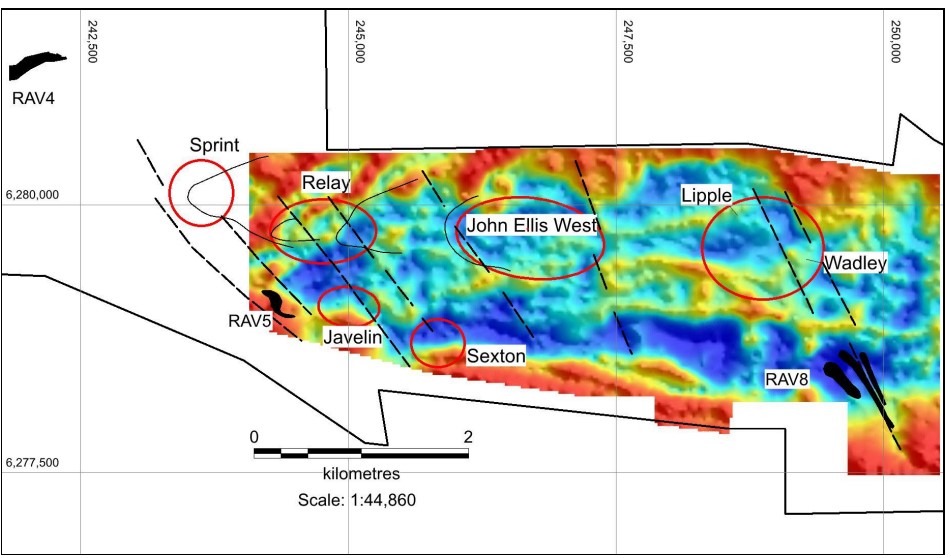
Carlingup Project: new exploration targets on Bouguer gravity image with gravity and magnetic lineaments (dashed black lines) and antiform hinges (thin black lines).
Interestingly, the southeast-plunging nickel sulphide deposit at RAV8 and RAV5 prospect occur closely associated with these structures.
This relationship suggests the southeast structures are fundamentally important for the formation of nickel sulphide orebodies.
Exploration outlook
NickelSearch has started RC drilling to test high-priority nickel sulphide targets defined through geochemical and geophysical programs.
Sexton and Javelin targets are based on coincidental geochemical and geophysical anomalism, while the RAV8 prospect is targeting extensions to high-grade mineralisation based on downhole electromagnetic plates.
Once the initial drilling expedition is complete, NickelSearch will return with an extensive greenfields program before year’s end.
Commenting on the campaign, NickelSearch exploration manager Andy Pearce said earlier this month: “We will remain flexible to ongoing adjustments to the drill program based on field assessment of the drill locations, drill results and assay results when available over the coming weeks.
“At this point, we have applied for more collar locations than we currently plan to drill in this initial program, so we can either move collar locations or have more locations available for quick follow-up drilling upon favourable results.
“We will also be performing DHEM on all drilled holes in this program to aid future targeting.”