
Natural Resources
Comment
18 October 2022
Dollar Strength
You don’t have to be glued to financial market screens or be listening to explanations from UK’s new Prime Minister Liz Truss (or “Daggers” as she has been dubbed – because Dagenham is two stops past Barking on the Tube) to know the world is facing some significant problems.
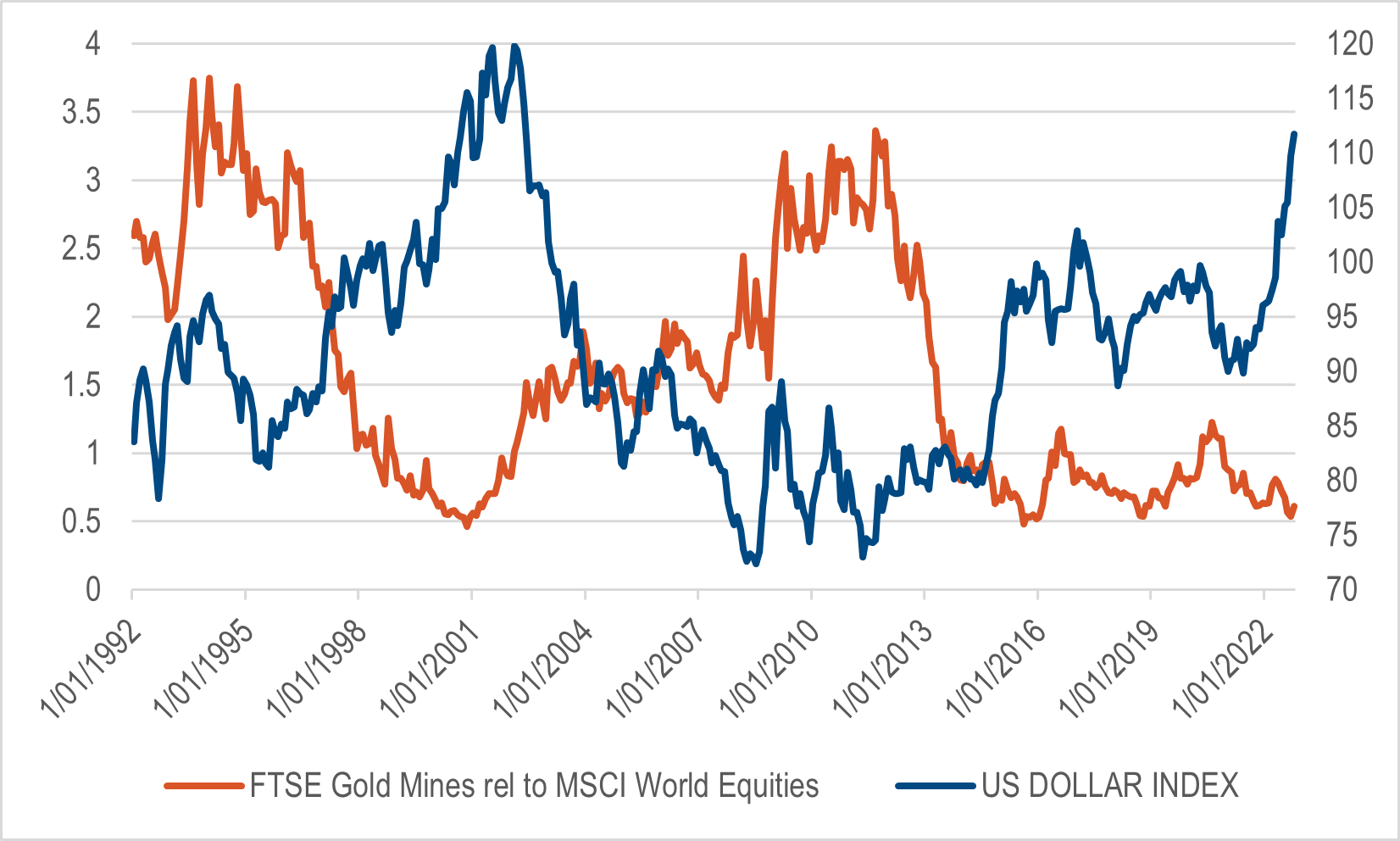
One of the clear symptoms that all is not well has been the surging US dollar. Rising interest rates and it’s “safe haven” status are the oft quoted reasons behind the surge in the dollar seen over the last couple of years. The dollar has risen by ~20% in the last 12 months, similar to rises seen during previous global economic meltdowns and is now near 20-year highs, though still below peaks seen in the early noughties and mid 80’s.
Although a strong dollar has traditionally been seen as everyone else’s problem rather than one for the USA, many analysts and commentators have highlighted that the greenback is fundamentally significantly overvalued despite the global turmoil and interest rate differentials and have pointed at the performance of the FED and the deteriorating picture for US corporate performance (Forecasts for S&P 500 profits have been revised down by 6.8% since June, more than twice as big as the average revision in the past decade according to The Economist).
Gold’s inverse relationship with the dollar is a well-rehearsed argument. As bullion is priced in dollars, the higher the dollar the more expensive gold becomes for non-dollar purchasers. Of course this also applies to most globally traded goods, part of the reason a strong dollar has such a significant impact on everyone else, but for gold as a quasi-commodity-currency and ‘safe haven’, it’s amplified.
In an article for the FT Ruchir Sharma points out that belief that dollar strength is useful for the US now as it helps the FED fight inflation is misplaced. Unlike most countries, US Imports only account for ~ 12% of GDP and therefore have a minor effect on inflation, and as mentioned above, most commodities are priced in USD in any case. Sharma suggests that the implications for the US economy of a global recession or financial accident caused by economic pressures transmitted by an overvalued currency, are likely to be more profound than those inflationary impacts transmitted by a weaker dollar.
His suggestion, though he doesn’t think anyone is listening just yet, is that the US government should actively assist, alongside the Japanese Central Bank and others who are reportedly selling USD, in weakening it.
At least some of the uncertainties that are currently pushing the dollar to new highs are also, historically at least, arguments for buying gold and are unlikely to disappear in the short or medium term.
As the chart above shows, gold equities relative to global equities are near a 30-year low point, the same levels as in 2000 (when the dollar was stronger than even today), 2015 and 2018. None of which would have been bad relative points to buy gold equities.
So, whether you think the US government may come to the same conclusion as Mr Sharma or that mean reversion has to kick in at some point or even “It’s different this time” are the four most expensive words in financial markets, then perhaps we should expect to see some US$ gold and gold equity performance soon.
Charlie Cryer
Head of RFC Ambrian London
+44 (0)20 3440 6834
charlie.cryer@rfcambrian.com