
Anson Resources Ltd (ASX:ASN) expects to further boost resources at Paradox Lithium Project in Utah, USA, after discovering multiple new lithium-rich zones in resource definition drilling at Cane Creek 32-1 well.
The recently completed drilling intersected lithium-rich brines in clastic zones 45, 47, 49 and 51 with these being in addition to recently reported lithium-rich brines in Clastic Zone 43 at Cane Creek.
This drilling was undertaken with the aim of extending the well to the Mississippian units, around 500 metres below the clastic zones.
Higher average grade
Assays from clastic zones 43, 45, 47 and 49 returned an average of 100ppm lithium for the four horizons intersected, 17% higher than the average grade of the shallower clastic zones 17, 19, 29 and 33 from drilling at Long Canyon No. 2 well.
These Long Canyon results were included in Anson’s recently reported upgraded JORC resource at the project.
Zone 43 had a thickness of 29.6 metres and assayed 108ppm lithium and 2,709ppm bromine; zone 45 returned 3.6 metres at 103ppm lithium and 3,471ppm bromine; zone 47 had 5.2 metres at 94ppm lithium and 3,739ppm bromine and zone 49 returned 6.1 metres at 93ppm lithium and 3,342ppm bromine.
The newly discovered clastic zones have as lithium-rich supersaturated brines that are chemically similar to those of the previously sampled clastic zones in other wells and have the potential to add tonnes to the indicated and inferred resources.
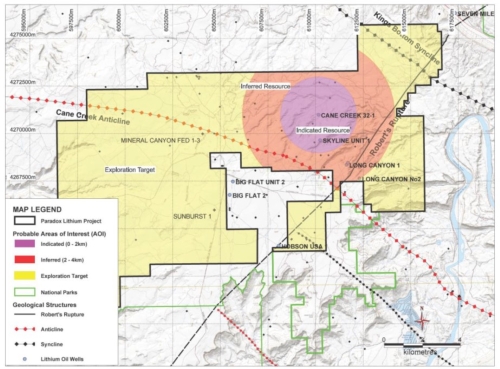
Plan showing the probable Area of Influence (AOI) for the four clastic zones drilled at Cane Creek 32-1 well.
This new discovery provides significant upside to convert existing Exploration Targets (yellow shade area above) to indicated and inferred JORC estimates.
Potential for resource increase
A number of the additional clastic zones are much thicker than the zones previously sampled and the extra thickness has the potential to deliver a large increase in a further planned mineral resource upgrade.
Drilling is now complete at Cane Creek and assays from the new clastic zones plus pending assays from the 121-metre-thick Mississippian units will be used in the JORC resource upgrade.
Data and samples collected from the new horizons, including drill chips collected during the drilling program, will also provide additional geological information on the brine horizons in the project area which can be used in future JORC resource estimates and form targets for future exploration programs.