
Natural Resources
Comment
21 September 2022
Words and Deeds
Ahead of Novembers G20 meeting in Bali, the Indonesian hosts asked the IEA to produce a report on the challenges of maintaining energy security in the context of clean energy transition on the path to net zero. The report, “Security of Clean Energy Transitions”, and its recommendations was published last week.
The chapter titled “Establishing a Secure and Diverse Supply of Critical Minerals” concludes with four recommendations for governments to follow:
- Send clear, unconditioned signals to markets that clean energy transitions are irreversible policy principles, to ensure that clean technologies based on critical minerals develop according to the best standards and are deployed more quickly.
- Create an environment that is conducive to large-scale investment in new projects to increase the supply of critical minerals along value chains, including by reducing and shortening permitting procedures, offering public assistance and financing, and committing to binding offtake wherever appropriate to support new capacity.
- Apply a new systemic approach, including the stockholding of critical minerals, to ensure security of supply. ESG standards are all the more important as meeting the exponential growth in demand for critical minerals will require a significant increase in mining and mineral processing.
- Ensure that G20 countries participate in the international efforts aimed at developing a well organised, standardised, and stable market for critical minerals globally, including through the IEA Critical Minerals Working Party
All eminently sensible but one can’t help thinking that although the chances of the G20 agreeing on the words are reasonable, the chances of timely execution are pretty small.
Governments aren’t the only culprits here of course, but the gap between arm waving statements for some point in the politically distant future and action in the short and medium is starkly illustrated by the chart (from the same report) below:
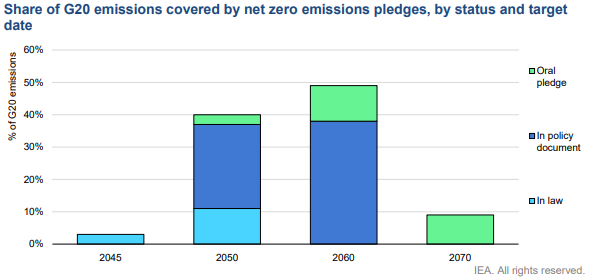
Development capex for new mining projects has often been slow to appear not because of market failure per se but due to political uncertainty in the host countries. Strong, public, and perhaps legislated, commitments from governments to the energy transition alongside financial incentives to get there are imperative, as are streamlining red tape and expediting permitting processes. Both would be a huge boost to miners and investor’s confidence in putting high risk capital to work to support multi-decade projects.
But the law of unintended consequences surely applies here. Given how fraught the mining development process can be with a myriad of, by their very nature, unforeseen events, in addition to the changing requirements of technological solutions, the idea of governments picking the winning projects for tax-payer’s to cough up to secure the offtake or indeed purchasing stockpiles of critical metals to secure supply, hints more at future market distortions, hindering innovation and national self- interest than a solution to a global problem.
Government offtakes could crowd out private sector buyers, many of whom are already struggling to secure critical mineral offtake and setting up “strategic reserves” will likely result in further price distortions serving to exacerbate price peaks and troughs already caused by the investment cycle.
It is already beginning to happen but the logical “so what” for consumers of critical minerals could be for downstream users to establish relationships with a variety of upstream producers/developers and consider supporting earlier projects to secure a diverse supply from abroad and domestically.
Charlie Cryer
Head of RFC Ambrian London
+44 (0)20 3440 6834
charlie.cryer@rfcambrian.com
Copyright © 2022 RFC Ambrian Limited, All rights reserved.
This document has been approved under section 21(1) of the FMSA 2000 by RFC Ambrian Limited ("RFC Ambrian") for communication only to eligible counterparties and professional clients as those terms are defined by the rules of Financial Conduct Authority. Its contents are not directed at retail clients as RFC Ambrian does not provide investment advisory services to retail clients.
RFC Ambrian publishes this document as non-independent research which is a marketing communication under the Conduct of Business rules. It has not been prepared in accordance with the regulatory rules relating to independent research, nor is it subject to the prohibition on dealing ahead of the dissemination of investment research. It does not constitute a personal recommendation and does not constitute an offer or a solicitation to buy or sell any security. Neither RFC Ambrian nor any of its directors, officers, employees or agents shall have any liability, howsoever arising, for any error or incompleteness of fact or opinion in it or lack of care in its preparation or publication; provided that this shall not exclude liability to the extent that this is impermissible under the law relating to financial services. All statements and opinions are made as of the date on the face of this document and are not held out as applicable thereafter. This document is intended for distribution only in those jurisdictions where RFC Ambrian is permitted to distribute its research. In particular, it is not intended for distribution in and is not directed as persons in the United States.
On the date of this document, RFC Ambrian, RFC Ambrian's holding company, persons connected with it and their respective directors may have a long or short position in any of the investments mentioned in this document. RFC Ambrian is a member of the London Stock Exchange and is regulated and authorised by the Financial Conduct Authority. RFC Ambrian is registered in England and Wales no. 4236075. Its registered office is at Octagon Point, 5 Cheapside, London EC2V 6AA.
NOTICE: The information in this e-mail message is confidential and may also be privileged. It is only intended for the above-named addressee/s. If you are not a named addressee, you must not disclose, copy or take any action in reliance on this e-mail and should delete it from your system. If you have received this e-mail in error, please contact the sender by return e-mail or by telephone +44 (0)20 3440 6800. We believe, but do not warrant that this e-mail and any attachments are virus free. You should take full responsibility for virus checking.