
With the passing of Her Majesty Queen Elizabeth II, the United Kingdom’s new sovereign King Charles III has been handed a vast property portfolio spanning the kingdom’s four corners and surrounding seabed: The Crown Estate.
As ultimate owner of perhaps the UK’s grandest of hand-me-downs, the King’s property portfolio takes in some of the kingdom's most prestigious landmarks.
Some have speculated that King Charles may want to take a more direct approach than his predecessor in the administration of the Estate
As Prince of Wales, the King was noted for his hands-on approach as head of the Duchy of Cornwall, the land holdings that are historically inherited by the eldest son of the reigning monarch.

With his ascension to the throne, King Charles III takes over a vast property portfolio – Source: Alamy
But what is inside the King’s newest inheritance, and what influence will he have over it?
What is The Crown Estate?
The Crown Estate as we know it today dates back to 1760, when the new sovereign King George III surrendered responsibility of the Crown Lands to the exchequer in return for a fixed annual income known as the Civil List.
Today, The Royal Family’s affairs are funded through the profits generated from this vast real estate portfolio in what is known as the Sovereign Grant.
While not the monarchy’s only real estate portfolio – there’s also the Duchies of Cornwall and Lancaster – it is easily the largest, with some £15.6bn in total property value spread across four pillars: London, Regional, Marine and Windsor & Rural.
The Estate’s London property comprises some 10 million square feet, and takes in the vast majority of the West End, Regent’s Street, Regent’s Park, St James and Kensington Palace Gardens.
Through the Marine portfolio, The Crown Estate manages around half of the foreshore – the land between mean high and mean low water mark – around England, Wales and Northern Ireland.
On the passing of Her Majesty Queen Elizabeth II, King Charles III became rightful owner of these Crown Lands.
The Crown Estate officially became a corporate entity under the Act of 1961.
While the Sovereign Grant historically comprised 15% of The Crown Estate’s profits, it was increased to 25% in 2017 for 10 years to fund a £369mln refurbishment of Buckingham Palace.
The remaining 75% (85% until 2027) goes to the public purse.
In real numbers, net expenditure met by the Sovereign Grant in 2021/22 totalled £102.4mln, partially paid through reserves due to a shortfall, while net revenues for the public purse amounted to $312mln.
Just as in politics, the sovereign’s genuine influence over the activities of The Crown Estate is limited, if not by legislation then by tradition.
That honour goes to chair of the Crown Estate Robin Budenberg CBE, who took up the post in 2016 and was reappointed in 2020.
HM Treasury has general oversight of The Crown Estate’s business affairs and as such, quarterly financials, revenue targets and remuneration schemes are required to be filed with the government.
Crown Estate: In numbers
- £312mln in net revenues for the public purse
- 8.3% capital gain on portfolio from March 2021
- £16.5bn in net assets
- £15.6bn in total property value
- 8.3% total return on a three-year rolling basis against a bespoke MSCI benchmark of 2.3%
- 450 team members employed by The Crown Estate
- 85% of profits go to the public purse; 15% to the sovereign (increased to 25% between 2017-2017)
- £3bn generated to public purse over 10 years
(Numbers as of 31 March 2022)
The Crown’s London portfolio is valued at £7.7bn, while the regional portfolio counts for £1.7bn.
But the real feather in the Crown’s gilted cap is its Marine portfolio, which increased 22% to £5bn in the last financial year, predominantly driven by offshore wind investments.
The Crown’s vast marine portfolio makes King Charles III among the UK’s leading wind tycoons, a beneficiary of the fact that almost the entirety of Britain’s seabed out to 12 nautical miles belongs to the Estate.
With this vast monopoly, the Crown runs competitive auctions for seabed leases, with wind farm developers paying top-dollar for land rights.
As such, the Crown raked in £133.3mln in revenues through its Marine portfolio for 2021/22, ahead of Regional revenues of £102.7mln but behind London revenues of £221.2mln.
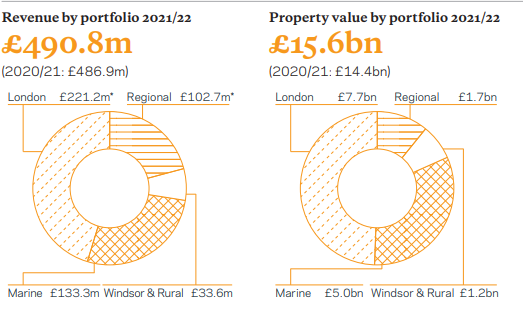
The Crown Estate’s London portfolio generates the most income for the monarchy – Source: thecrownestate.co.uk
The remaining piece of the pigeon pie is the Windsor & Rural portfolio comprising more than 191,000 acres of land extending from The Windsor Estate.
The Crown Estate of Scotland, which was devolved from the monarch in 2016, comprises over 35,000 hectares of land with a total property valuation of over £455mln (as of March 2021).
Despite the King's hands-on philosophy, it remains doubtful whether this complex web of properties will change in structure much.