
Southern Gold Ltd (ASX:SAU) has lodged 71 new licence applications after completing one of its most comprehensive field programs in South Korea focused on generating new exploration targets for next year.
The company’s exploration team spent more than 720 days in the field, mostly in the Haenam Basin, and sampled 1,474 rocks for analysis. The Haenam Basin hosts several of Southern Gold’s projects and is the only currently operating epithermal gold-silver mine in South Korea at Gasado Island.
Limited exploration was also conducted around its existing projects including in Daeam, Dokcheon and Deokon to identify extensions to known mineralised trends and to expand its project footprint across favourable host rocks.
A full geologic interpretation of the assay results will be undertaken after subsequent follow-up work planned for the northern autumn and early winter seasons has been undertaken.
The new applications, which include brownfields and greenfields sites close to or containing historic gold mines and artisanal workings, have raised Southern Gold’s total exploration licences under application and granted to 153, covering an area of 429 square kilometres.
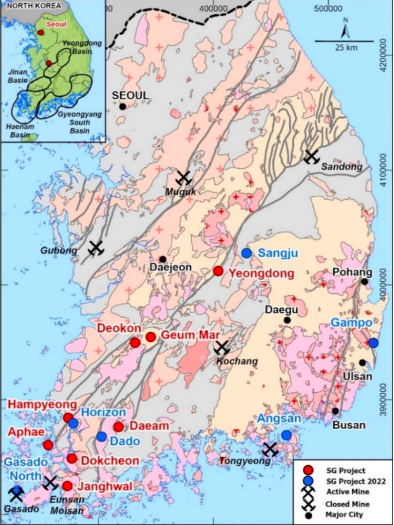
Southern Gold project locations as of July 31, with new projects highlighted in blue. Some licence applications are not shown.
More gold discovery
At Southern Gold’s Angsan Project on Geoje Island, recent sampling at the waste dumps of the Geoje Mine returned gold grades up to 28.2 g/t and underground samples returned copper grades up to 1.26%.
Sampling on coastal outcrops 500 metres west of the mine returned grades of 13.3 g/t gold, 10.55 g/t gold and 0.85% copper in quartz veins up to 5 centimetres wide, including historical Ivanhoe sampling (1998) returning grades of 1.9 g/t gold.
Clasts of mineralised colloform-banded veins suggest multiple phases of mineralisation. Reconnaissance work within the broader project area has highlighted wide-scale alteration and potential for additional polymetallic mineralisation styles.
Follow-up work in the coming months will include a program of regional geochemistry, geologic mapping and sampling.
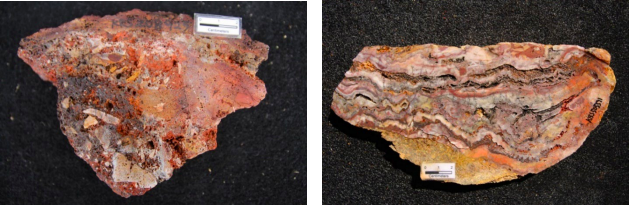
Ore sample (left) and mineralised colloform banded vein clastfrom (right) from Geoje Mine.
Gampo Project, Gyeongsang Basin
This is a high prospectivity area, which will require follow-up exploration including detailed geological mapping and sampling to identify new areas of outcropping mineralisation within the project area.
The area has been the subject of considerable government investigation and research by the Korean Resources Corporation - KORES now known as KOMIR - since the 1970s, including drilling, geophysical and geochemical surveys.
Drilling by KORES at the historical Sokchon Prospect within the Southern Gold licence application to the west of the Geumryong mine returned significant gold and silver mineralisation in one hole with a downhole results (not true width) of 11.2 metres at 10.2 g/t gold and 11.0 g/t silver from 4.4 metres, and 7.1 metres at 2.3 g/t gold and 4.0 g/t silver from 17.4 metres within an interval logged by KORES as “quartz porphyry” with disseminated chalcopyrite and pyrite cross-cutting hornfelsed black shale.
Sangju Project, Yeondong Basin
The Sangju mining district is a cluster of historical gold mines from 1927-1943 with up to 38 identified sheeted quartz veins, of which 27 were mined. Fourteen licence applications have been submitted over the historical mining district, where gold mineralisation is hosted in a series of subparallel north-northwest striking quartz veins, hosted within granite and granodiorite.
Limited sampling of waste dumps at the Darae mine returned grades up to 41.4 g/t gold.
Future work will include locating other historic mines sites, together with mapping and sampling, and sourcing any historical production data.
Gasado North Project, Haenam Basin
The Gasado North Project comprises two licence applications. The applications have an underlying clay mining right and a portion of the Gasado mine licence. Several vein systems have been identified on the island by Ivanhoe geologists in the 1990s, with most undrilled.
Field visits have highlighted the important spatial and temporal association between clay alteration and mineralisation with a pyrophyllite-dickite clay mine located above the Lighthouse Vein discovered on the coastline of Gasado Island by Ivanhoe geologists in 1989.
Close to the historical clay mine, a recently sampled creamy silica-alunite assayed 5.67 g/t gold.
Follow-up work will include a program of detailed geological mapping and sampling to identify additional areas of mineralisation, particularly around coastal areas.
Horizon Project, Haenam Basin
The Horizon project comprises five contiguous licence applications over andesites and rhyolite flow domes hosting a series of narrow quartz veins within a zone 200 metres wide with a sample grading up to 10 g/t gold.
Follow-up work will include geologic mapping and sampling within the Horizon Project and other rhyolite done complexes within the major structure identified from the regional reconnaissance exploration.
Dado Project, Haenam Basin
Two applications have been lodged to the west of the Dado pyrophyllite mine held under licence by a third party. The Dado clay mine is hosted in a flow-banded rhyolite, with elevated gold grades up to 1.0 g/t gold in rhyolite quartz breccia along ridges 500 metres east of the mine. Within the licence application area, a small historic adit along a narrow outcropping quartz vein 1.5 metres wide and 50 metres in length highlighted anomalous geochemistry, with samples assaying up to 0.54 g/t gold, 232 g/t silver, 1.3% copper, 916 parts per million (ppm) lead and 864 ppm zinc.
During a site visit in May, leading epithermal gold expert Jeff Hedenquist confirmed that the relationship between the clay alteration, mined as an industrial mineral source in Korea, and potential magmatic-hydrothermal mineralisation as seen at Gasado Island and Dado, is an important regional targeting vector.
Follow-up work will include geological mapping and sampling within the hills towards the western side of the project area to identify other potential workings, together with channel sampling along roadside outcrops.
Daeam Project, Haenam Basin
Mapping and sampling north along the main structural trend in the Baekdong Valley from previously sampled and mapped mineralised trend at Daeam highlighted anomalous gold with one sample returning 6.1 g/t.
Sheeted to comb-texture veined and brecciated quartz boulders hosted in altered granites and metasediment 1 kilometre to the south was identified. These results effectively double the known north-south strike length of gold mineralisation at Daeam to over 4 kilometres and an application has been submitted over this northern extension for follow-up sampling and mapping to identify potential drill targets.
What’s after this?
Southern Gold is mid-way through the program of identifying new projects and over the remainder of fiscal second and third quarters, it will undertake additional data compilation, targeting, and follow-up reconnaissance exploration work in new areas.
This will include acquisition of Advanced Spaceborne Thermal Emission and Radiometry (ASTER) data for targeting areas of clay alteration and the use of portable ASD TerraSpec mineral spectrometer.
It will also carry out more detailed follow-up work within selected projects, including programs of geologic mapping, geochemical sampling and/or geophysical surveys to generate new targets for drilling, currently scheduled for the third quarter of 2023.