
Apollo Minerals Ltd (ASX:AON) has described the discovery of a new form of mineralisation in drilling at the TP13 regional target of the Kroussou Zinc-Lead Project in Gabon as potentially “game-changing”.
Semi-massive and disseminated style zinc and lead sulphides have been visually identified from near-surface intercepts in multiple drill holes completed at Niambokamba Prospect (Target Prospect 13 -TP13).
As a result, the company is now eagerly awaiting assay results which it believes will confirm its observations.
“Step change in target grade profile”
Managing director Neil Inwood said: “The new style of mineralisation observed at Target Prospect 13 is a game-changing discovery.
“We interpret these new mineralised zones to represent primary feeder structures for high-grade zinc and lead.
“We expect that the assays, when received, will indicate a step change in the target grade profile at Kroussou.
"The discovery complements the recent airborne electromagnetic survey and enables our technical team to generate comprehensive exploration targets across the province scale Kroussou Project.”
TP13 program
Niambokamba is one of 18 target prospects at the province-scale Kroussou Project and is 7 kilometres north of the Dikaki Prospect (TP11) where drilling to date has been focused.
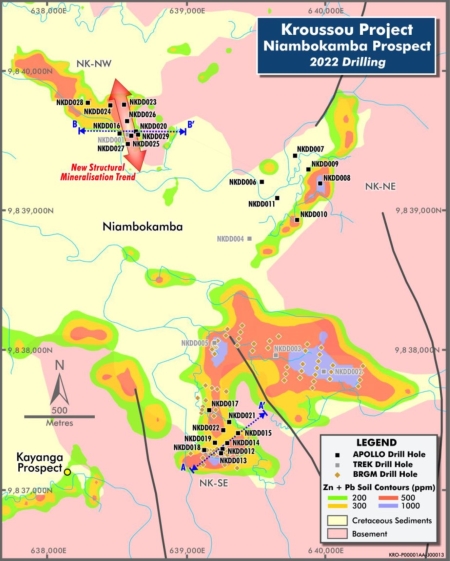
Drill collar locations and surface geochemical anomalies (soils) at TP13.
Drilling at TP13 has recently completed with a total of 24 diamond drill holes for 1,091 metres.
Three discrete areas (or lobes) were targeted, with drill traverses across the channels to test the stratigraphy for base metal mineralisation and Apollo has received assays for 12 of the 24 holes drilled.
Promising observations
Mineralised intercepts over more than 200 metres of strike have been visually identified in five holes drilled at TP13 with downhole thickness between 2 and 18 metres commencing from just 3 metres below surface.
Semi-massive and disseminated sulphides have been identified in multiple holes in the NK-NW area, with a close association with nearby barite veining and shearing, representing a new mineralisation style for Kroussou.
Assay results are expected in the coming quarter for the nine holes drilled in the NK-NW area.
The discovery of a new style of semi-massive sulphide mineralisation at Kroussou indicates a potentially shear-hosted system and possible primary high-grade feeder structures.
This new mineralisation, which opens a new exploration parameter space in Apollo’s targeting of further high-grade mineralisation, remains open to the north and the south.
Targeting of this new style will be complemented further by the recently completed airborne electromagnetic survey and the associated magnetic data, which are both being processed.
NK-SE assays
The company has received assays from six of nine holes drilled in the NK-SE area of TP13, with all holes encountering mineralisation.
This drilling has intersected thicker mineralised zones of sandstone and conglomerate than previously indicated from historical Bureau de Recherches Géologiques et Minières (BRGM) drilling.
Highlights include:
- 15.9 metres at 1.4% zinc + lead from 16.5 metres including 3.7 metres at 3.3% from 17.4 metres;
- 8.0 metres at 3.8% from 5.3 metres including 7.5 metres at 4.1% from 5.8 metres; and
- 23.1 metres at 1.8% from 22.2 metres including 5.3 metres at 3.5% from 35.4 metres.
Results from NK-NE area
In the NK-NE area, assays have been received for all six holes drilled with five of them intersecting mineralisation hosted in sandstone or microconglomerate.
Best results are:
- 20.2 metres at 1.1% zinc + lead from 25.8 metres including 2.0 metres at 3.2% from 34 metres; and
- 6.3 metres at 2.0% from 1.8 metres and 2.4 metres at 3.7% from 5.7 metres
Future exploration activities at Kroussou include a regional structural interpretation based on current surface mapping activities and the final processed AEM magnetic data, which is expected to be available during the coming quarter.
This new style of mineralisation will be incorporated into the company’s targeting model to assist in defining high-grade zinc and lead mineralisation.