
Natural Resources
Comment
30 August 2022
Consensus – What is it good for?
Commodity analysts have somewhat of a reputation for putting forward extreme price forecasts – not always because their analysis fully supports it, but more perhaps because the narrative at the time suggests it’s possible, with no doubt a little self-interest to the fore. $200 oil, $15,000 copper anyone?
The trouble is of course that if those outlandish projections don’t come close to being right, and they rarely do, credibility begins to slip.
In the real world “consensus“ is usually viewed as a positive and implies a general agreement has been reached. Normally a positive outcome. If one believes in the collective wisdom of markets, and in some sense by definition the market is always right, it stands to reason that, over time, consensus predictions should produce better average results than any one individual.
The energy transition has rightfully injected a lot of excitement into metals markets over the last couple of years but those forecasting all-time highs to be reached this year in various battery metals are looking somewhat less than insightful now.
However, the bounce in copper from the almost two-year low reached in July does provide some salve to the wounds as does hints of M&A activity heating up with BHP’s bid for Oz and Rio pushing its Turquoise Hill bid higher, not to mention Twiggy Forrest’s impressive move into Rare Earths, announced late last week.
The recent US Senate approval of the Inflation Reduction Act and its $369bn climate action package has given a high-level boost of momentum to the energy transition agenda. How, other than improved sentiment, that particular legislation and the plethora of “critical minerals” lists actually translates into action and impact on the mining industry remains to be seen.
One of the key constraints on being able to deliver on decarbonisation goals in the timeframe most countries have committed to is the ability of the mining industry to actually fund, develop and construct the mining operations needed to produce the metals that will be required.
Recent dramatic falls in commodity markets and mining equities have not been helpful in that regard and, although it isn’t the consensus yet, we have noticed a rapid increase in the number of voices, spanning the spectrum of metal producers, traders and end-users, questioning exactly from where and how are all those Gigafactories going to get the metals.
So, what’s the consensus saying?
The following charts show how long-term consensus forecasts of various commodities have evolved over the last five years and how accurately the shorter term forecasts (in this case one- and two-year forecasts) have mapped the actual spot price.
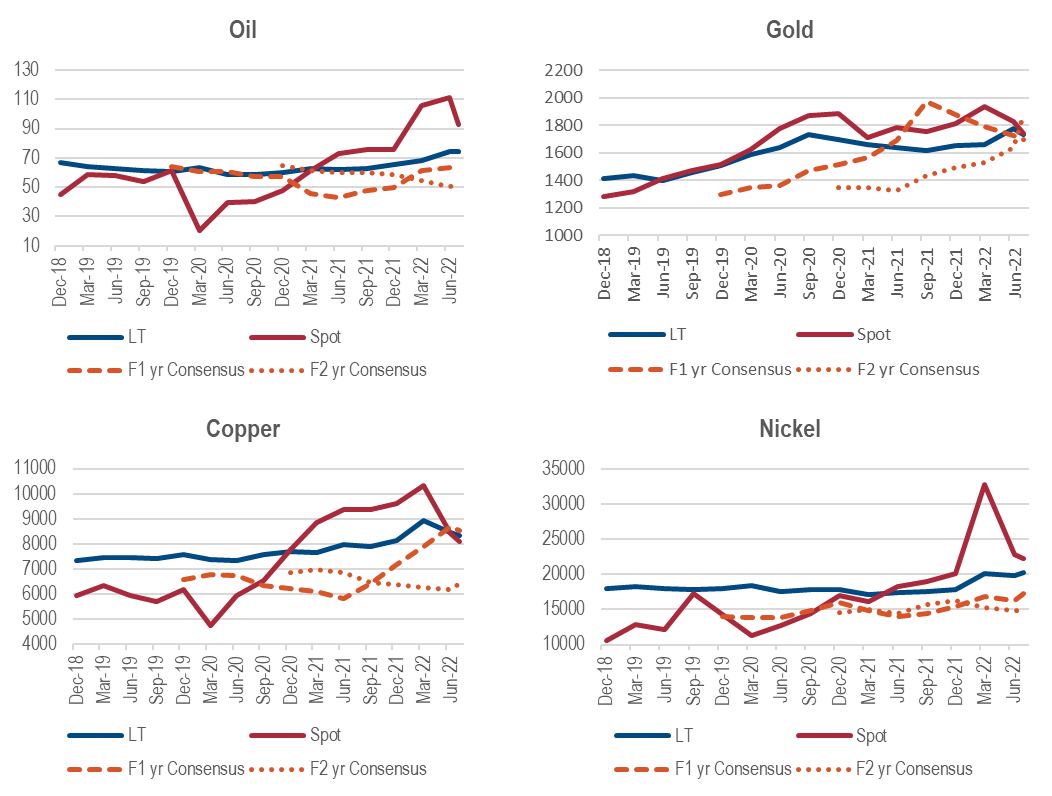
“F1 yr Consensus” is the forecast price made 12 months prior, similarly “F2 yr Consensus” is the forecast price made 24 months prior. (Data from Energy & Metals Consensus Forecasts)
Long term (five years +) prices are predicted to be roughly where current spot prices are.
The obvious conclusion from the graphs is that consensus forecasts aren’t much good and secondly, as you would expect, it is easier to predict what will happen in 12 months than it is in 24, in terms of both accuracy and direction.
Analysis for long-term forecasts is less based on short term market views and more linked to fundamental analysis of the supply development pipeline, on cost curves and marginal costs of production, and therefore – as the graphs show – tend to look through the noise and be considerably less volatile, though, importantly, not necessarily more accurate.
Statistically there are some differences between commodities which are probably related to the complexity of each. Oil affects almost everything and seems the most difficult to predict. Relatively, nickel is a tiny market and its analysts do rather well (recent spike notwithstanding) and copper is somewhere in the middle.
The paradox of “consensus“ is that of course no one is actually putting it forward as a forecast. But you do need to have a number to build your financial model, and using consensus is the least likely to cause controversy despite the unlikelihood of it producing an accurate answer.
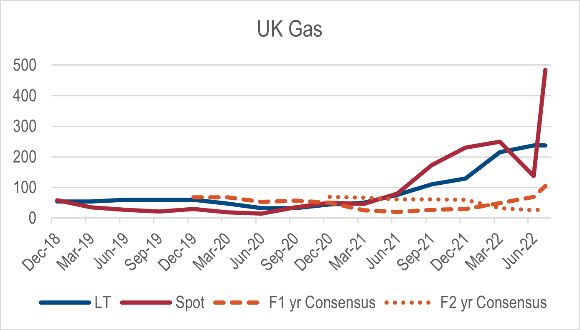
None of that really helps very much but spare a thought for those UK gas analysts who were seemingly smugly cruising along with boring but impressive forecasting accuracy for the last few years and then…
Harold Macmillian probably had it about right when asked what was most testing about being Prime Minister,
”Events dear boy, events”