
Household energy bills will rise by approximately 80% to £3,549 in October, Ofgem, the UK energy regulator revealed on Friday morning and meaning that bills for an average family will hit nearly £300 per month.
Soaring energy prices have been the largest catalyst behind 40-year high inflation, according to analysts, amid Russia’s invasion of Ukraine and the expected turn-off of the Nord Stream pipeline next week.
Jonathan Brearley, Ofgem chief executive, commented on the new threshold: “We know the massive impact this price cap increase will have on households across Britain and the difficult decisions consumers will now have to make.
“We are working with ministers, consumer groups and industry on a set of options for the incoming prime minister that will require urgent action.
“With the right support in place and with regulator, government, industry and consumers working together, we can find a way through this.”
What is an energy price cap?
Theresa May created the cap in January 2019 with the aim of preventing energy suppliers from overcharging customers by asserting a maximum price for each unit of gas in kilowatt-hours (kWh).
It is a cap on how much energy providers can charge for energy usage, as well as a maximum daily standing price.
Households pay a fixed daily amount (standing price) even if no energy is used.
What does the increase mean for households?
The set-to-be hiked level represents a 178% uptick compared to where it was a year ago but Chancellor Nadhim Zahawi insisted to be working hard to alleviate stress for households.
He said: “I know the energy price cap announcement this morning will cause stress and anxiety for many people, but help is coming with £400 off energy bills for all, the second instalment of a £650 payment for vulnerable households and £300 for all pensioners.”
Although there will not be any financial support for homes until Sunak or Truss is appointed as new prime minister, which will take place on 5 September.
One government spokesperson commented: “As part of our £37bn package of help for households, one in four of all UK households will see £1,200 extra support, provided in instalments across the year, and everyone will receive a £400 discount on their energy bills over winter.”
Stephen Millard at think tank NIESR outlined the impact Ofgem’s Friday morning announcement would likely have on inflation.
He insisted it will add 2.7 percentage points (pp) to the consumer price index in October, revising NIESR’s forecast upwards to 12.5% from 11.3%.
Millard added “We expect the overall contribution of gas and electricity prices to CPI inflation in October to be 5.9pp, [with] forecast CPI inflation of 14.2% in January.
US bank Citi, meanwhile, believes that the most commonly used inflation index will peak at over 18% in January.
Following the 80.06% hike, the UK may be sooner plunged into a longer recession than first originally thought, according to leading City economists.
The Bank of England predicted earlier this month that a recession lasting five quarters, starting from October, will further exacerbate people’s problem of squeezed budgets.
Although analysts think this forecast is too optimistic, substantial government intervention required to prevent a devastating impact on consumer confidence and the economy.
Paul Dales, Capital Economics, commented: “We previously thought CPI inflation would rise from 10.1% in July to a peak of 12.5% in October, [but] we now think it will peak at 14.5% in January and won’t fall as quickly during the rest of 2023.
Real household disposable incomes, therefore, may fall by 4% next year rather than by 3%, which could result in GDP falling by 2%, double the 1% presently predicted.
2023 energy price threshold forecasts
Cornwall Insight upped its forecasts for energy prices next year, now predicting that bills will rocket to £6,616 from April.
It must be noted the energy researcher and analyser was only £5 out with its guess for Friday’s price cap.
Beforehand though, Cornwall anticipates the price threshold will reach £5,386 in January next year.
Craig Lowrey, principal consultant at Cornwall, said: “Today should be seen as a wake-up call to policymakers that short-term thinking and triage of the energy system is not enough.
“Without real change to the energy system in this country, it is consumers, suppliers and the economy that will all continue to suffer the consequences.”
Before the announcement, Citi said it expects the cap to hit £3,717 this week before rising to £4,567 in January 2023 and £5,816 in April, but may yet raise these predictions.
Auxilione, one of the providers of the gloomiest outlooks, now expects the cap to leap to £5,405 in January and £7,263 in April.
How is it calculated?
The energy price cap is comprised of a variety of costs that suppliers typically face, including:
Wholesale energy costs – over time, this has become an increasingly larger proportion of the price cap, now representing approximately 55% but set to go much higher
Network costs, which make up the second largest fraction, include the cost of building and running the pipes and wires. This changes depending on location, so there are different price caps for different areas.
Operating costs come in as the third-largest contributor. This is the cost to suppliers of administration – meter readings, for example.
Policy costs – this involves energy-saving and emission-reducing initiatives issued by the government.
Adjustment allowance, EBIT, VAT, headroom allowance and direct debit payment method uplift allowance traditionally make up the remaining few hundred pounds.
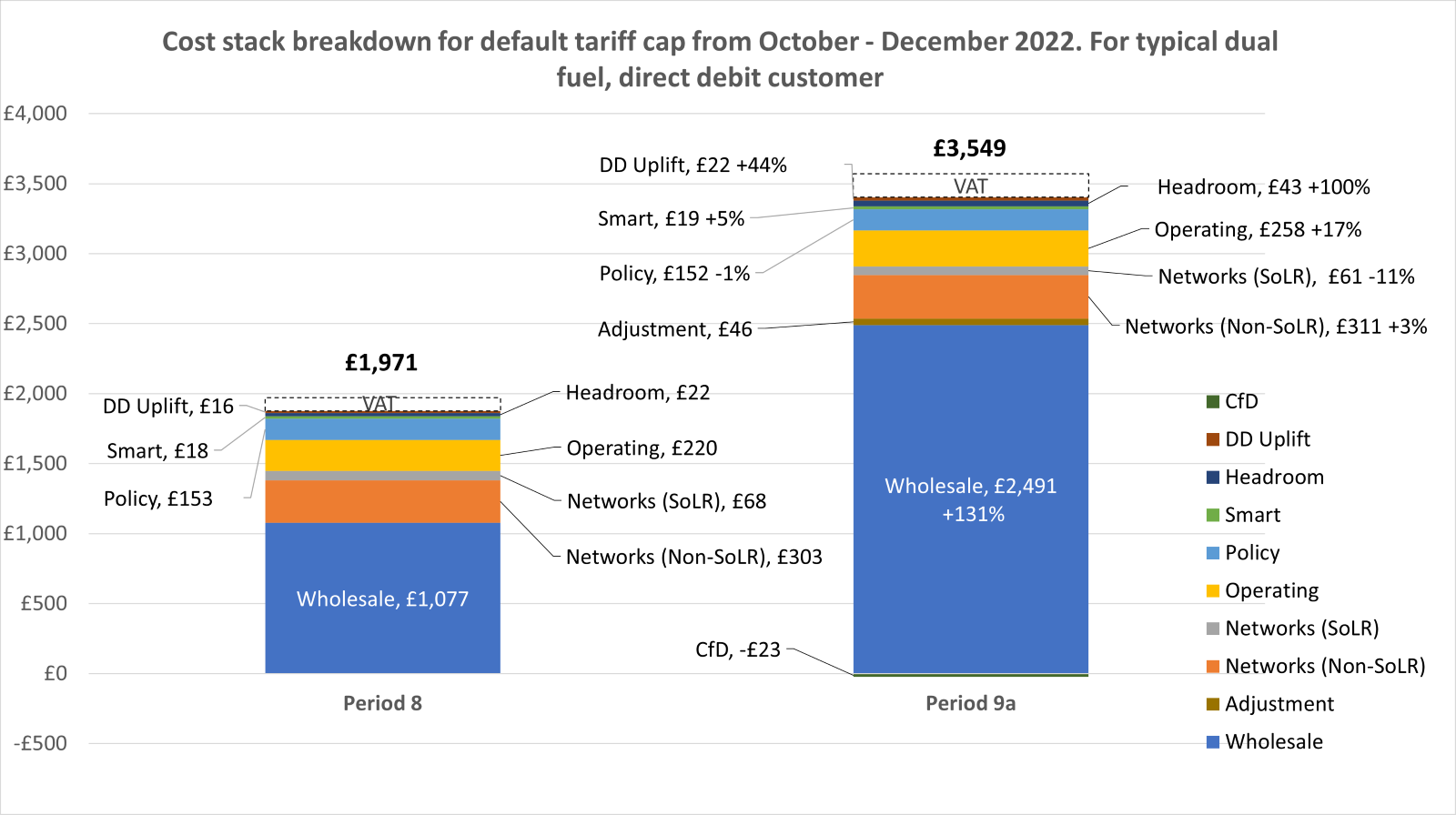
Source: Ofgem