
Emmerson Resources Ltd (ASX:ERM) has started drilling at its Golden Forty Gold Project in Tennant Creek.
The company is undertaking a minimum 4,000 metre reverse circulation (RC) and diamond drilling program to test for extensions to the historic high grade gold mineralisation (around 12g/t gold) at the Golden Forty Mine.
Emmerson will also look at the potential at the nearby Golden Forty East project.
A total of 22 holes will be drill test the Golden Forty area. The first diamond hole started at the Golden Forty East prospect and intersected ironstone which is the typical host to the mineralisation.
The drilling program is expected to be completed in late October 2022.
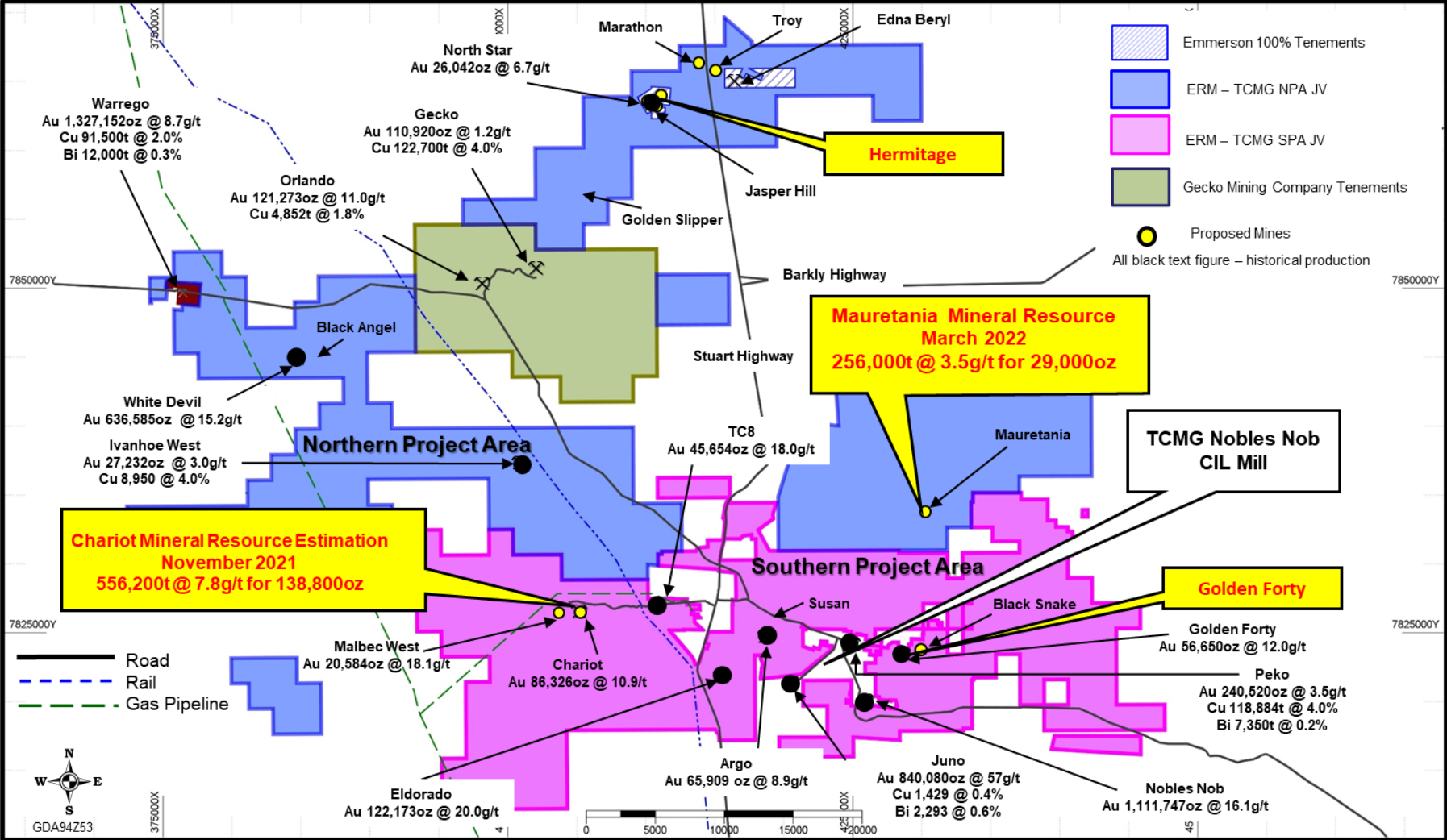
Map of the Emmerson Tennant Creek Project showing the Northern Project Area (NPA), and Southern Project Area (SPA), which is covered by the Exploration (EEJV) and Small Mines (SMJV). Yellow dots are potential small mines and/or remnant resources, noting that Emmerson retains 100% of the Jasper Hills, Hermitage, North and Northern Star and Edna Beryl projects.
Valuable exploration targets
EMR has a strong land position and is exploring the Tennant Creek Mineral Field (TCMF), one of Australia’s highest- grade gold and copper fields that has produced over 5.5 million ounces of gold and 470,000 tonnes of copper from deposits including Warrego, White Devil, Orlando, Gecko, Chariot, and Golden Forty.
These high-grade deposits are highly valuable exploration targets, and to date, Emmerson’s discoveries include high-grade gold at Edna Beryl and Mauretania, plus copper-gold at Goanna and Monitor. These discoveries were found using a new technology and concepts and are the first discoveries in the TCMF for over two decades.
While EMR will operate and manage the program within the 100% owned Southern Project Area, it is funded as part of the $5 million earn-in by Joint Venture (JV) partner Tennant Consolidated Mining Group (TCMG).
Emmerson will receive a free carried 6% gold production royalty from projects within the Mining JV.
Adding further resources
Successful results are expected to advance the project to a scoping study, which may be added to the mining schedule that already contains recently announced resources for both Chariot and Mauretania.
Emmerson managing director Rob Bills states the program could lead to the addition of resources to the existing inventory.
“The Golden Forty mine reportedly produced more than 50,000 ounces of gold at a high grade of ~12g/t gold in the typical high value style of mineralisation seen across Tennant Creek. Drilling at Golden Forty is aimed at adding further resources to the inventory and mine schedule ahead of establishment of the central mill by our partner TCMG,” Bill said.
“We have recently announced JORC resource estimates for Chariot and Mauretania under the Small Mines JV with partner TCMG. Providing this current program is successful, we anticipate resource additions from Golden Forty that may be amenable to future open pit mining.”
About the drill program
The JV partners have identified several drill targets in the vicinity of the historic Golden Forty Mine that have not seen modern exploration. So, with the high-resolution drone magnetic survey now complete, Emmerson has identified several potential extensions to the mineralisation. These include:
- drilling to convert the historic Golden Forty remnants to a JORC-compliant estimate;
- extensions to the mineralisation along strike at Golden Forty East; and
- work with the CSIRO on refining the processing of the drone magnetics to better pinpoint potential targets at Golden Forty South.
The work with the CSIRO could add significant value across the entire Tennant Creek Mineral Field and has been awarded co-funding with the NTGS through the Geophysics and Drilling Collaboration.
While the historic Golden Forty Mine had a brief run in 1938, it wasn’t until 1969 that the mine operated as a productive underground operation.
Mining was via a vertical shaft to a depth of 150 metres and via cross-cut development and open-hole stoping on four east-west levels.
Production ceased abruptly when failing ground conditions and increased water ingress prevented the safe extraction of ore. The mine was decommissioned in 1983 due to these issues – not due to a lack of ore nor declining grades. The Golden Forty Mine produced 144,056 tonnes of ore at a recovered head grade of 11.9g/t gold between 1969 and 1983.