
Magnis Energy Technologies Ltd (ASX:MNS, OTCQX:MNSEF) said the latest results from its Extra Fast Charging (EFC) battery program show a less than 3% loss of initial cell capacity after about 2,600 cycles.
The cells are being developed using bio-mineralised lithium mixed metal phosphate (BMLMP) technology, which delivers superior battery life with fast charge capabilities while containing no nickel or conflict metals such as cobalt. The patent for the technology is held by Charge CCCV (C4V), in which Magnis has a 9.65% stake.
The EFC program using 7Ah commercial graded cells with a 20-minute-charge and 20-minute-discharge time interval commenced in early 2022. Early results from the program prompted C4V to introduce a unique step in the process to enable enhancement of the battery cycle life and a new EFC program was introduced. These subsequent optimised commercial cells exhibited minimal energy density loss even at higher charge-discharge intervals, retaining 95% energy density of a regular cell run at lower rates.
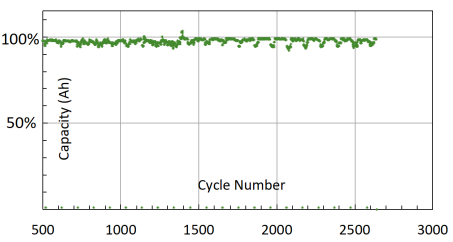
EFC 7Ah cell cycling data with 20 minute-charge and 20 minute-discharge interval.
C4V cells could be game changer
The EFC and Fast Charge (FC) programs could have a major impact on the electrification of the transportation industry.
Traditional batteries used in the EV industry currently have up to 80% retention after approximately 1,000 cycles using lower charging rates. When constant fast charging rates are applied, the battery life decreases dramatically.
C4V’s high-power density, non-LFP cells could be the solution. Their utility comes from the number of cycles, coupled with the charging times, enabling faster turnaround times for customers and greater productivity and efficiency.
With this in mind, Magnis and its partners plan to take the program to over 3,000 cycles and then run new programs at higher charging currents to achieve a 10-minute charge and then onto a six-minute charge.
The new programs are scheduled to start in September 2022, with initial results expected in October 2022.
Exciting phase
C4V president Dr Shailesh Upreti said: “Our EFC results coupled with data received from a market-leading OEM recently have been very exciting. Recent data shared by the OEM showed less than 1.7% capacity loss after 500 cycles under high power performance cycles, which validates a robust design and performance delivery commitment from C4V.
“These results feed a great motivation back to our team to think and deliver beyond boundaries. We continue to make progress to take this program towards next phase of system level demonstration.”
Magnis chairman Frank Poullas, meanwhile, commented: “Today’s game changing results are very exciting for everyone involved. With the iM3NY Lithium-ion battery plant being in commercial production, we have a platform to produce batteries using new technologies once they have been commercialised.”