
Miramar Resources Ltd (ASX:M2R) has kicked off an aircore drilling program at the Whaleshark Copper-Gold Project in the Ashburton region of Western Australia. The program will test a very large area of coincident copper-uranium-REE anomalism uncovered from soil sampling last year.
A track-mounted aircore rig will be used for the program to guide subsequent deeper drilling, and is expected to take four weeks to complete.
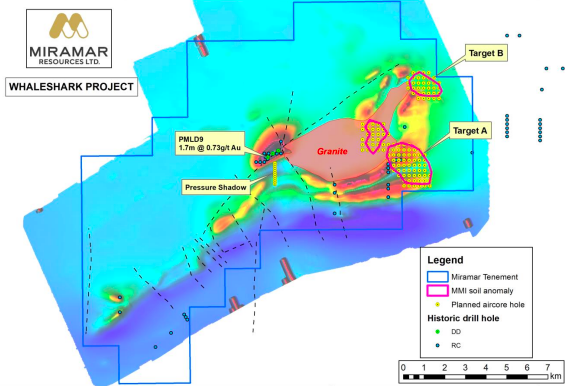
Whaleshark Project showing anomalism and proposed drilling over magnetic image.
Refining targets
Miramar executive chairman Allan Kelly said: “At Whaleshark, we have very large surface geochemical anomalies above a Proterozoic granitoid intrusion at relatively shallow depths when compared with other IOCG prospects.
“The large Ernest Henry IOCG deposit in northern Queensland has a well-developed geochemical anomaly at the unconformity between the cover sediments and the basement rocks.
“If we can outline a similar anomaly with this aircore drilling, and reduce the size of the targets, it will greatly assist in refining potential basement targets for deeper RC and/or diamond drilling.
About Whaleshark
The Whaleshark project is located 40 kilometres east of Onslow in Western Australia, and is characterised by a large, folded banded iron formation (BIF) complex intruded by a granite.
Buried under approximately 100 metres of Carnarvon Basin sediments, the project is located at the northwestern end of the Proterozoic Capricorn Orogen and has potential for IOCG and Proterozoic BIF-hosted gold mineralisation.
Previous work intersected gold mineralisation in the BIF and outlined a low-level surface gold anomaly in an interpreted “pressure shadow” target at the southwest end of the granite.