
Galileo Mining Ltd (ASX:GAL) has kicked off diamond drilling at the Callisto palladium-platinum-gold-rhodium-copper-nickel discovery, part of the company’s 100% owned Norseman Project in Western Australia.
The 2,000-metre diamond drilling program – with the option for extending the drill contract – has been designed to test down dip extensions where mineralisation is open at depth.

Diamond drill plans
The first diamond drill tail ended in mineralisation, uncovering:
- 18 metres @ 1.02 g/t 3E (0.83 g/t palladium, 0.15 g/t platinum, 0.05 g/t gold), 0.20% copper and 0.24% nickel from 214 metres; and
- 3 metres @ 1.62 g/t 3E (1.33 g/t palladium, 0.23 g/t platinum, 0.06 g/t gold), 0.20% copper and 0.21% nickel from 255 metres, with the drill hole ending in mineralisation.
Reverse circulation program
A reverse circulation (RC) drill rig is still turning on site and is a quarter of the way through a 10,000-metre drill program.
A sequence of 12 RC drill holes is planned between 300 metres and 1,000 metres north of the current drilling with the opportunity for additional new discoveries to be made and scope to extend the drill contract if needed.
Each of the eight holes already drilled has intersected sulphides.
The company has also received further assays from the previous RC program with drilled intersections at a 0.5 g/t 3E cut-off including 33 metres @ 1.03 g/t 3E (0.84 g/t palladium, 0.15 g/t platinum, 0.04 g/t gold), 0.16% copper and 0.22% nickel from 192 metres.
Disseminated sulphide zones between 16 and 48 metres thick were logged in completed drill holes.
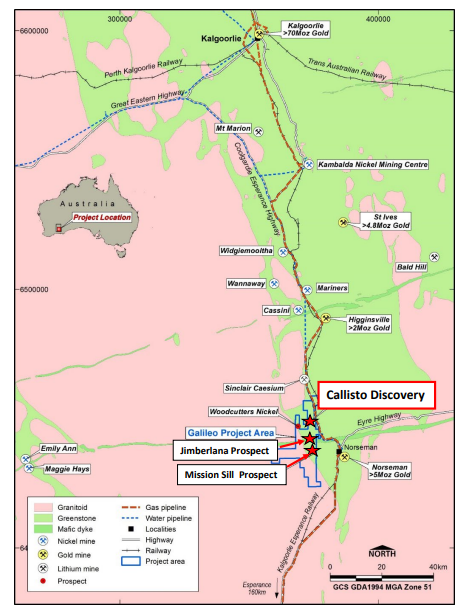
“Open in all directions”
Galileo managing director Brad Underwood said: “Mineralisation at Callisto is open in all directions, and we will be using the diamond drill rig to focus on the down dip potential in particular.
“The diamond drilling is being conducted in conjunction with the ongoing RC drill program. We are one quarter of the way through the planned 10,000-metre program and have the capacity to extend the drill contract or to bring in more drill rigs as required.
“With no known outcrop, and over five kilometres of prospective strike, we consider that a significant opportunity exists for additional discoveries at shallow depths.
“The RC rig will be focusing on both the shallow sections of the known mineralisation as well as the excellent prospectivity for further discoveries along strike.
“We are very excited to be rapidly progressing this new discovery.”