
It’s a prosperous market to be an oil and gas stock.
Amid supply constraints spurred on by war in Eastern Europe and strong energy pricing, Aussie companies are establishing new production wells, staking seismic data acquisitions and fast-tracking their development plans.
On the flipside, however, a large question looms —time is running out for these finite energy sources, so where does that leave the sector?
With the green energy revolution not just on the horizon, but on our doorsteps, Aussie oil and gas stocks need to learn to adapt and bring the world the renewable energy it needs.
With this in mind, we explore how our local players are honing their operations and where this fits in the bigger picture.
Give me the elevator pitch
So just what's the market like for oil and gas companies?
A 2022 report from big four accountant Deloitte indicates energy stocks are entering metamorphosis.
“Many oil and gas companies are looking to reinvent themselves by practising capital discipline, focusing on financial health, committing to climate change, and transforming business models,” the multinational firm stated.
“The journey of transformation has just begun for the industry, and simply managing or riding oil price cycles aren’t options anymore.”
The oil market has remained strong this year, but Deloitte doesn’t believe this will harbour energy transition plans — rather, it will serve as a catalyst.
“Conventional wisdom would suggest that at high oil prices, oil and gas companies display less capital discipline and would focus more on the core business than on new sustainability opportunities,” the firm explained.
“Consequently, it has often been assumed that high oil prices could slow the energy transition.
“However, 76% of surveyed oil and gas executives state that oil prices above $60 per barrel will most likely boost or complement their energy transition in the near term.”
Looking into the future, management consultancy McKinsey & Company says pricing will be heavily impacted by the budding relationship between renewable and finite energy sources.
“Renewable fuels are destined to compete with electric-vehicle batteries, hydrogen, and traditional petroleum fuels for transport-sector demand,” the firm said in a July analysis.
“And supply and demand in renewable fuels will drive prices in the context of similar dynamics in competing sources of energy.
“The degree to which this happens will be a function of shifts in supply and demand, which could be caused by blending regulations, tax credits, investments in production capacity, or price elasticity of competing demand.”
All things considered, how did Aussie oil and gas stocks tackle the June quarter?
In the spotlight: ASX energy stocks
Emperor Energy
The June quarter proved to be a busy season for Emperor Energy Ltd (ASX:EMP), which is focused on achieving its maiden gas sales at the Judith Gas Field in Victoria by 2027.
Once the field is in full swing, Emperor expects to make more than $300 million in revenue every year, but it needs to put in the hard yards now to get there.
All things considered, this quarter saw the energy stock turn its attention to resource increases and assessment across its wholly-owned Vic/P47 permit.

Namely, the company’s total P50 un-risked prospective gas resource increased by 50% to 1.848 trillion cubic feet, while the resource within the Kipper and Golden Beach sands was assessed at 622 billion cubic feet.
Gas resources aside, work continues on schedule to prepare a permitting application for the Judith-2 appraisal well.
Emperor is also holding conversations with potential exploration partners to co-fund the well, slated for drilling next year, to prove gas reserves and economically justify a future gas field and processing plant.
Triangle Energy
Triangle Energy (Global) Ltd's joint venture with fellow ASX-lister Pilot Energy (ASX:PGY) Ltd made more than A$21 million during the quarter thanks to production at the Cliff Head Oil Field in WA’s Perth Basin.
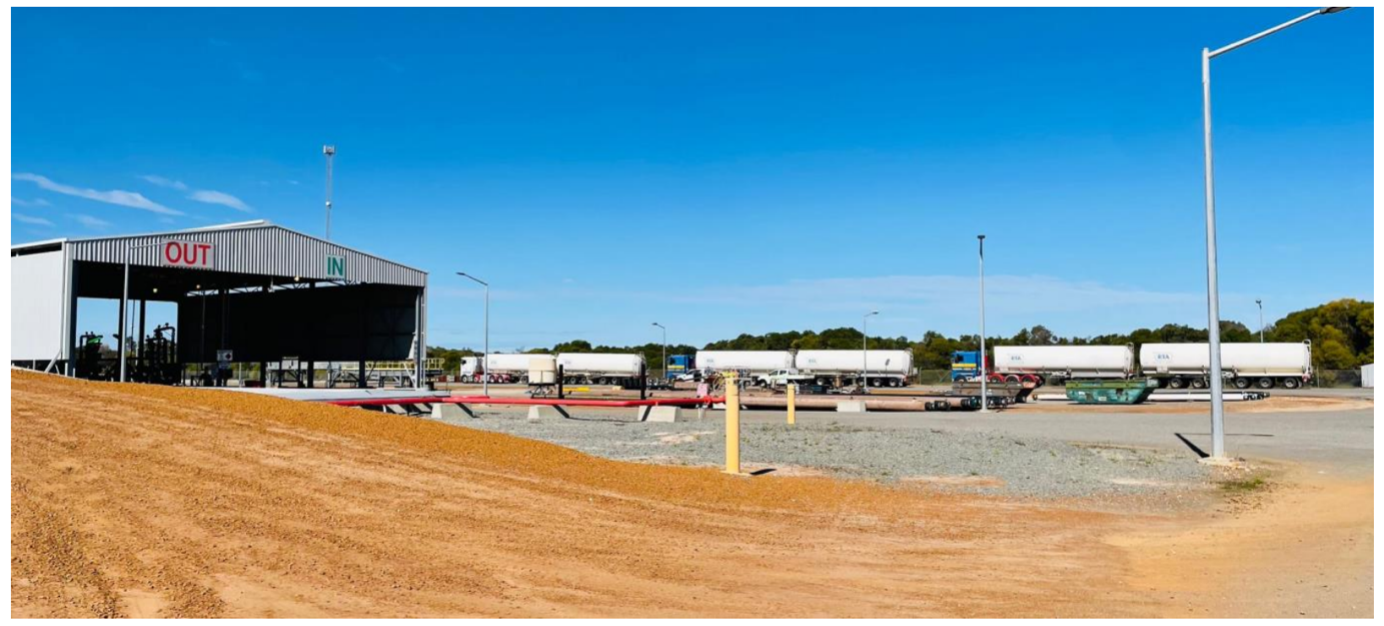
Trucks queuing to load at the Arrowsmith Stabilisation Plant.
In May, the joint venture sold 139,992 barrels of oil at US$105.2 a barrel, while a further 8,287 ’tank bottom’ barrels were sold at US$75.7 each.
The sale marked the final lifting of oil from the joint venture’s Kwinana terminal to BP Singapore, and it netted US$15.36 million (A$21.34 million).
In June, TEG and PGY started a workover to restore production from the Cliff Head 10 well, which was piqued to increase production by 130 barrels of oil per day.
Other key activities included a tank upgrade, a seismic data acquisition, a $3.5 million capital raise and a carbon capture and sequestration agreement.
Triangle ended the quarter with $13.84 million in the bank.
Elixir Energy
Elixir Energy Ltd (ASX:EXR)’s June quarter highlight was a memorandum of understanding it inked with SB Energy for a Mongolian green hydrogen project.
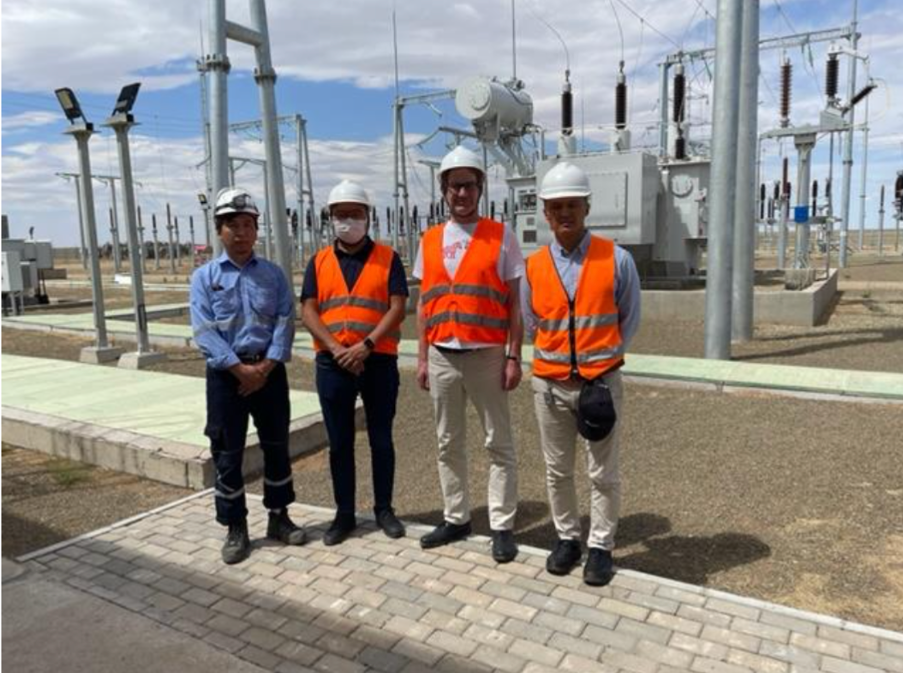
The Elixir team joins SB Energy at its windfarm in South Gobi.
“In our view this is a significant endorsement of the strategic rationale that underpins our Gobi H2green hydrogen project – namely the locational advantages of Southern Mongolia as a future green hydrogen export hub,” managing director Neil Young explained.
“Our view is that China views energy sources derived from Mongolia – coal and crude oil at present (and if our plans are successful, methane and hydrogen in the future) – as coming from a very secure location.”
The Mongolia-focused energy stock also kept focus on the Nomgon coal bed methane production sharing contract, where its first extended production project is underway to demonstrate sustained, commercial gas flow-rates.

“We are on track to spud the two production wells that underpin the pilot in August,” Young concluded.
SRJ Technologies
When the ASX’s oil and gas stocks need performance and technology know-how, they turn to asset integrity company SRJ Technologies Ltd.
Ultimately, the company believes a robust energy market is driving confidence in the businesses’ growth prospects.
“Emerging from two years of Covid disruption and a strong oil price, there is a positive outlook for the energy industry,” the company stated in its June quarter report.
“The oil price is creating more liquidity than at any time in the last 14 years, and SRJ is starting to see significant investment in asset integrity projects.”
On the financial side, SRJ ended the quarter with roughly A$1.36 million in revenue for the year to date — more than double the fully-year revenue result in FY21.
The ASX-lister also completed the execution stage of its phase two asset integrity contract with the Abu Dhabi National Oil Company, bringing in just under $400,000 in revenue.
SRJ is currently working with a number of parties regarding a capital raise as it seeks to relist in the September quarter.
Buru Energy
Buru Energy Ltd (ASX:BRU) spent the June quarter focused on the Ungani Oilfield, where it produced roughly 48,000 barrels of oil (50% of which amounts to the company’s own share).
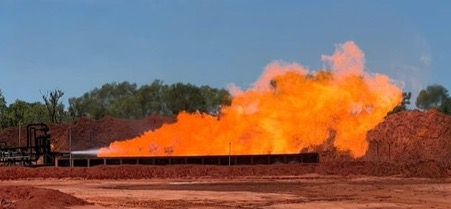
The Rafael 1 condensate-rich gas discovery in the Canning Basin.
Oil lifting amounted to around 76,000 barrels, and Buru’s share of the sale revenue should amount to roughly $5.7 million amid the current strong market.
Given the current environment, the Ungani joint venture will consider the scope to increase production, however, the potential Ungani 9 well has been deferred due to lack of available suitable drilling rigs.
Buru has also worked over the Ungani 5 well and resumed production in late July, bringing Ungani’s field production rate up to between 500 and 550 barrels of oil per day.
Amid capital raising and commercialisation activities, Buru executive chairman Eric Streitberg said this quarter has set the company on a course to add value to its existing assets.

Tamboran Resources
Tamboran Resources Ltd (ASX:TBN) had a clear mission as it rounded out FY22: make headway on commercialisation activities for its low-carbon gas resource in the NT’s core Beetaloo Sub-Basin.
First on the cards was securing a rig to drill the Maverick 1H (M1H) well in the company’s wholly owned and operated EP 136 permit.
Tamboran has a 1.4 million net acreage portfolio in the Beetaloo/McArthur Basin in the Northern Territory.
In tandem, the Tamboran team advanced a civil works and seismic data acquisition, executed a memorandum of understanding with energy infrastructure company Jemena and paid a deposit to secure a ‘best-in-class’ US drilling rig.
Tamboran managing director and CEO Joel Riddle said it was exciting to see work get underway ahead of the company’s first operated drilling campaign within EP 136.
“Our team has done an incredible job in progressing the civil works safely and completing 85 kilometres of 2D seismic acquisition, with no reportable incidents to date,” Riddle explained.
“Securing the Ensign rig to drill the M1H well is a significant milestone and positions the company for an exciting second half of 2022.
Brookside Energy
Brookside Energy Ltd (ASX:BRK) made bank in the June quarter: it turned in a record $11.7 million in second-quarter receipts thanks to oil and natural gas liquid sales.
The cash influx had a positive effect on the company’s bottom line, bringing its net positive operating cashflow up 236% quarter-on-quarter to just shy of $8 million.
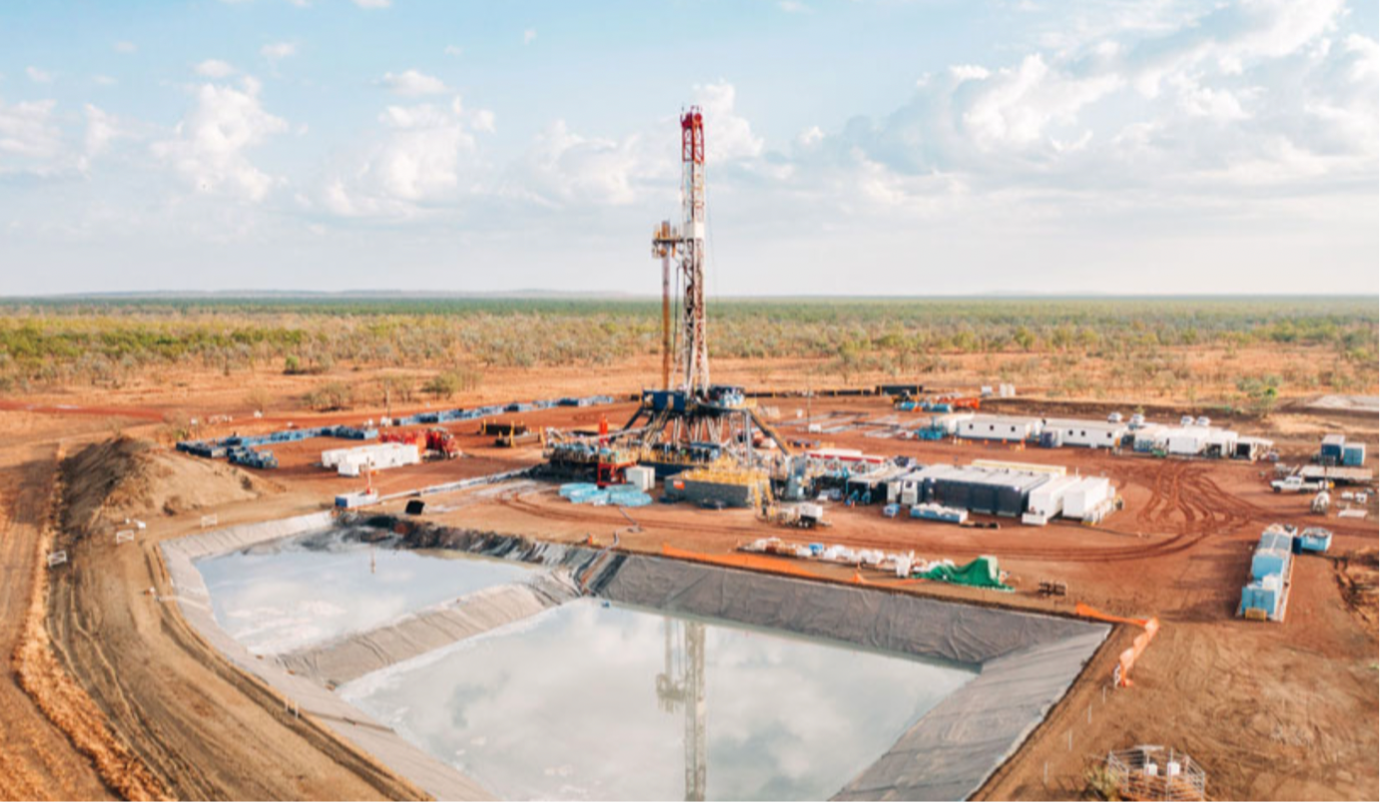
The Kenai Rig 18 drilling the Flames well.
Gross operated production totalled 1,728 barrels of oil per day over the three-month period, with that figure poised to increase after the Flames well entered commercial production post-quarter end.
Flames is now the third well in production in Brookside’s held-by-production program, which established a trifecta of oil and gas assets in Oklahoma’s Anadarko Basin.

Even still, managing director David Prentice said establishing commercial production at Flames “is a fantastic achievement on its own”.
Blue Star Helium
Helium exploration and production stock Blue Star Helium Ltd (ASX:BNL, OTC:BSNLF) made three discoveries over the June quarter at its Galactica and Pegasus prospects.

The breakthrough comes as BNL prepares to drill two new exploration wells this quarter and update the Galactica/Pegasus helium resources.
In other news, the company also completed a workover project at the Enterprise 16#1 well and sent off gas samples for analysis.
Post-quarter end, Blue Star kicked off drilling at the Sammons helium well and applied to develop seven more wells across Galactica and Pegasus.
If the permits come through, they’ll establish a pipeline of exploration wells that’ll keep Blue Star busy through year’s end.