
Biotech companies develop diagnostics and drugs involved in human health, so there will always be lengthy processes to usher assets onto the market, including long-running, rigorous clinical trials and approvals from external regulators like the Food and Drug Administration (FDA).
The common wisdom is that speculative stocks perform badly in tough economic times, as market optimism dries up and investors retreat to safer ground – and for all the many vital services the healthcare sector brings to populations around the world, biotech stocks are still regarded as highly speculative.
Most investors are well aware of these constraints and the need for patience in this sector, and price them into their decisions. If you invest in biotech, you’re in it for the long haul.
What the market tells us
In pre-pandemic 2020, the global biotechnology market stood at US$627.63 billion and since then it has exploded, with TechSci Research projecting it to grow at about a compound annual growth rate of 8.57% over the next five years to 2026.
During the past year, biotech stocks, as represented by the iShares Biotechnology ETF (IBB), have posted a total return of -21.0%, below the Russell 1000's total return of -14.3%.

Source: Commsec.
According to Simply Wall Street, investors are pessimistic about the healthcare industry, anticipating a slowing of long-term growth rates.
This is understandable given the prevailing economic headwinds and the inevitable slowdown following the pandemic years.
So does the hotly forecasted recession mean investors in biotech should be looking to shore up their investment capital? No. David Rodeck, writing in Forbes, thinks that the “relatively inelastic” global demand for healthcare means that the sector is not particularly price sensitive:
“Stable demand for services and technologies acts as a protective barrier for healthcare as a sector, and biopharmaceuticals, in particular.”
Indeed, cost savings from new AI-driven technologies and greater demand for medical solutions to a range of unmet needs of increasingly health-literate populations will no doubt continue to drive growth in the sector.
In the spotlight: ASX biotech stocks
What have some Australian medtechs been up to in the last few months? We look at some of the highlights for a handful of companies targeting indications as diverse as fibrosis, traumatic brain injury, heart disease, COVID-19 and dementia, to name just a few.
AdAlta
The June quarter was a busy one for AdAlta Ltd (ASX:1AD), with the medtech progressing its preclinical program for inhaled AD-214, its flagship asset. Manufacturing and toxicology campaigns for the asset were deferred to optimally align with partner preferences and the different needs of each potential indication.

Meanwhile, in Europe and India, patents were granted protecting the intellectual property underpinning AD-214.
The company continues to progress its partnered immuno-oncology programs.
On the corporate front, the company’s business development campaigns built momentum. Adalta reported an $8.66 million cash position as at June 30, with its cash runway extended via a modification to the AD-214 program.
AdAlta CEO and managing director Dr Tim Oldham said: “The final quarter of FY22 has featured steady progress for inhaled AD-214.
“The pivotal experiments testing the ability to deliver AD-214 to the distant airways of the lungs and its effectiveness against fibrosis in animal models are underway with results expected in the coming quarter.
“Completion of the inhaled pre-clinical program provides key information for the growing partnering interest across multiple indications.”
Anteris Technologies
Anteris Technologies Ltd (ASX:AVR, OTC:AMEUF) had a productive quarter, leading with a six-month follow-up on a first-in-human study of its flagship DurAVR™ Transcatheter Heart Valve System for patients with severe aortic stenosis.
This was a six-month follow-up of the five patients initially implanted in November 2021 at the Tbilisi Heart and Vascular Clinic, Tbilisi, Georgia. Anteris reported that all five patients were doing very well and showed clinically significant improvement since the three-month follow-up.
Clinicians observed exceptional haemodynamics in all patients, with an 86% reduction in peak mean gradient since baseline and 6% since the three-month follow-up. The six-minute walk test, a key marker of patient well-being, improved 46% from baseline and there was a further 21% improvement between three and six months, showing that the patients had become much more fit and active.
During the quarter, the company also successfully wrapped up work with the second cohort in its first-in-human study, with eight more patients implanted.
The company forged ahead with a research partnership with the prestigious Yale University and Yale Cardiovascular Research Group, studying product design impacts on haemodynamic function post- transcatheter aortic valve replacement.
Back in the first quarter of the year, the company welcomed Australian cardiologist Dr Karl Poon to its global Medical Advisory Board.
With the addition of Dr Martin Leon this quarter, who is globally recognised as an early pioneer in the development of minimally invasive approaches to treating coronary and structural heart disease, the company now has the expertise to progress product development and science for its heart valve technology.
Artrya
Artrya Ltd (ASX:AYA) finished off the financial year in a strong cash position, with $35.6 million held at June 30.
The company had an interesting quarter in the US, headed up by the establishment of its first US clinical partnership with the Huntsville Heart Center Alabama, which leads in coronary computed tomography angiography (CCTA), treating more than 80,000 cardiac patients per year.
Heart Center Research, LLC, a division of Artrya’s new partner organisation, is conducting a multi-scanner retrospective study to compare the performance of Artrya’s Salix Coronary Anatomy (SCA) against the interpretation of multiple expert readers.

Results of the study should be in during the second quarter of the financial year. The data will help Artrya to progress further product development, regulatory applications and scientific publications.
The company also established an international clinical advisory board during the quarter, and appointed Dr Jacob Agris M.D. PhD as new Chief Medical Officer.
While Artrya had success registering SCA with NZ Medsafe, paving the way for commercialisation in a neighbouring market, the pathway to FDA approval has been more challenging, though the company has the opportunity to re-apply.
Testing continued at three Australian pilot sites, and an experienced marketing executive was appointed during the quarter to manage the UK National Health Service 2+2-year Framework Agreement that introduces Artrya to 1,250 Trust Hospitals in the United Kingdom.
CardieX
During the quarter, CardieX Ltd (ASX:CDX) made significant progress on regulatory approvals for the CONNEQT Pulse and App. Towards the end of June, it submitted a US FDA clearance application for the CONNEQT Pulse Dual Blood Pressure Monitor with manufacturing partner, Andon, a move which represented a significant milestone for the company.
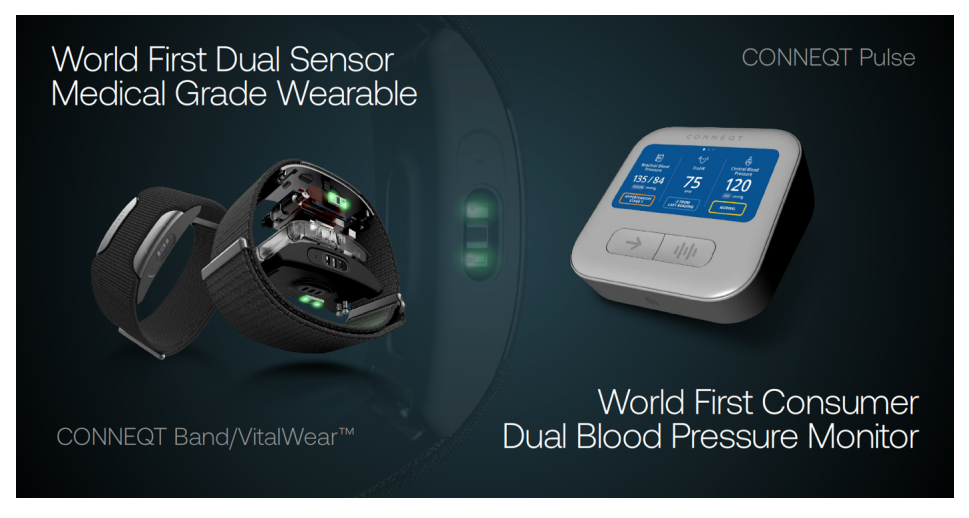
The company now awaits FDA clearance, which will make Pulse the first arterial health monitor to incorporate a full suite of patented and trademarked heart and vascular health parameters beyond traditional blood pressure.
Pulse targets the large and growing home health, remote patient monitoring (RPM) and decentralised clinical trial (DCT) markets, significantly expanding the commercial opportunities for the company. The product is an integral part of a new digital and device ecosystem for both consumers and clinicians built upon CardieX’s existing FDA-cleared SphygmoCor® central blood pressure technology.
CardieX’s revenue in traditional medical markets was $1.06 million, while cash receipts from customers increased by 43% to $1.52 million on the preceding quarter.
The company had cash in the bank totalling AU$1.46 million at June 30. During the quarter the company spent $340,000 on product development and operating costs on new and existing products, an increase of $168,000, which was largely due to ATCOR medical device manufacturing costs.
R&D expenditure increased by $210,000 to $751,000, primarily due to additional costs involved in finalising the CONNEQT Pulse development and in preparation for the FDA clearance application.
Elixinol Wellness
The June quarter saw strong growth for Elixinol Wellness Ltd (ASX:EXL, OTCQB:ELLXF), which reported revenue growth of $1.7 million, up 13% on the previous quarter.
This success was driven by growth across all key markets. Operating cash was $2.1 million, a 36% reduction on the preceding quarter, with annualised cost savings the company identified during its strategic review and other one-off savings delivering the efficiencies.
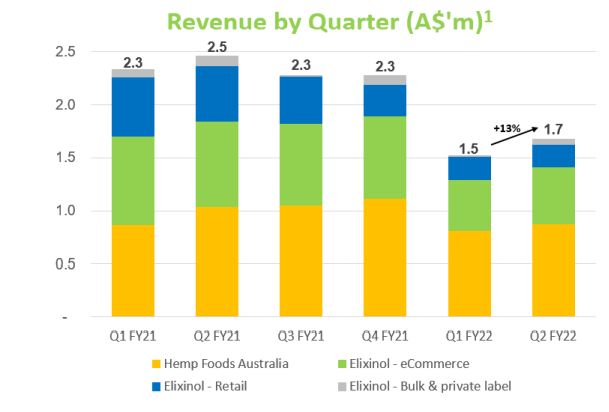
During the quarter, the biotech confirmed Ron Dufficy as global CEO. Of the impressive quarterly figures, Dufficy said: “We are very pleased to report a quarter of growth, thanks to revenue improvements for Elixinol in the US and for Hemp Foods Australia.
“We achieved this with a leaner operating structure and with our costs down 36% compared to the prior quarter. Following the strategic review process, we are also excited to confirm our strategy to further reposition ourselves as a natural wellness business with a heritage in hemp to unlock opportunities in the fast-growing natural and plant-based wellness space.
“I am confident that our continued focus on driving efficiencies will contribute to further improvement in cashflow and business profitability in the coming quarters; and we expect the upcoming launches of new products will help drive further revenue growth.”
The Hemp Foods Australia distribution model continued to build, with Coles agreeing to run its Seed Mix across 830 stores from the end of this month, plus the launch of full HFA product range on the independent pharmacy channel.
A new, innovative Elixinol product line up is expected to drive revenue growth in the Americas in the new financial year.
Incannex Healthcare
Incannex Healthcare Ltd (ASX:IHL, NASDAQ:IXHL) made plenty of clinical headway in June. It welcomed positive Phase 2a clinical trial results for its cannabinoid asset IHL-42X in patients with obstructive sleep apnoea.
The company also had news on the IHL-216A front, with manufacturing of the traumatic brain injury therapy set to scale up following a deal with drug developer Curia Global Inc.

Still in clinical news, the multi-use cannabinoid candidate IHL-675A was observed to outperform CBD in multiple preclinical models of inflammation.
This is the same quarter that saw Incannex snap up APIRx Pharmaceuticals for $93.3 million.
Now-subsidiary APIRx has 22 active clinical and pre-clinical research and development projects underpinned by an intellectual property portfolio that includes 19 granted patents and 23 pending patents – the largest cannabinoid patent portfolio in the world, according to Incannex.
Incannex now holds the key to a diverse portfolio of promising therapeutic candidates targeted at treating an extensive range of conditions including pain disorders, addiction disorders, mental illnesses, gastrointestinal diseases, gum disease, skin conditions and ophthalmic conditions.
MGC Pharmaceuticals
During the June quarter, MGC Pharmaceuticals Ltd (LSE:MXC, OTC:MGCLF, ASX:MXC) reported strong progress across its clinical pipeline, fielding multiple trial results that indicated efficacy across its product range, including positive trial results for leading products CogniCann® for the treatment of dementia, and CimetrA™, targeting COVID-19.
The company enjoyed strong quarterly sales, with A$1.55 million in cash receipts during the quarter and A$6.1 million for the 2022 financial year – up 134% on FY21 to date.
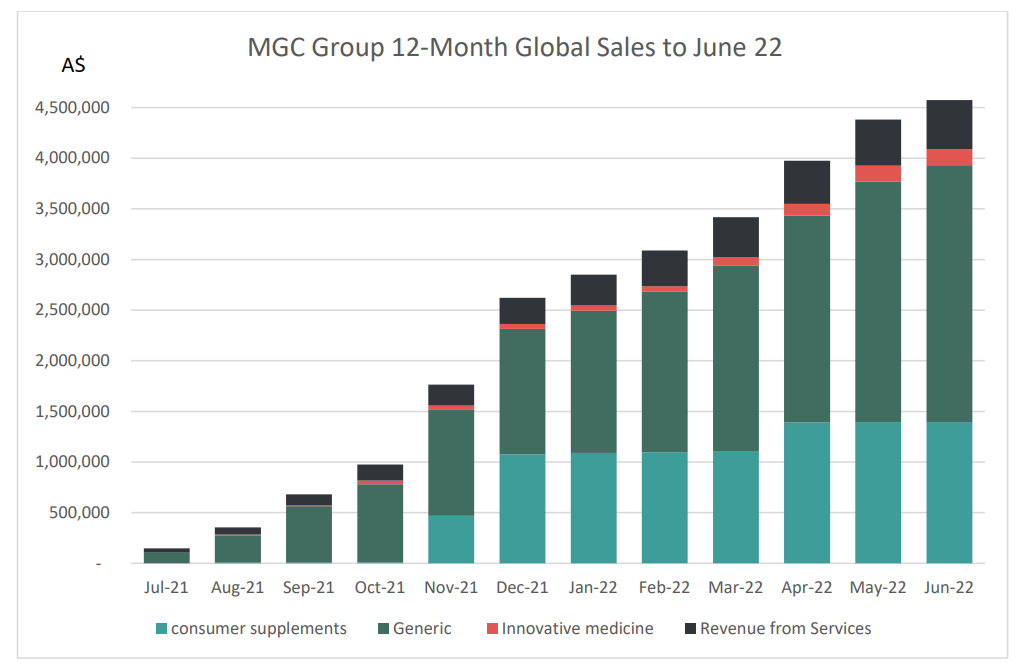
The company implemented a cost-reduction strategy during the quarter, which included a reduction in material R&D costs, and the deferral of future non-core trials, and continued to broker strategic partnerships to further its clinical pipeline across key global jurisdictions.
Co-founder and managing director Roby Zomer said: “MGC Pharma remains resolutely focused on advancing its innovative products through the clinical pipeline of product development and continues to progress a number of products towards regulatory approval.
“This has been supported by strong clinical trial results and partnerships with companies such as Sciensus Rare and AMC Holdings that will help us achieve our goals.
“Getting pharmaceutical products through the regulatory approval process takes time, particularly when the products are phytocannabinoids.
“I am, however, confident in the team and the strategy that has been developed to help ensure and that MGC Pharma’s products will be able to make a difference to patients suffering with debilitating conditions.”
Orthocell
The June quarter for Orthocell Ltd (ASX:OCC) saw the company sign off on global exclusive licence and manufacturing agreements for its Striate+™ asset with BioHorizons Implant Systems Inc. The company received US$14.7 million net of fees as a result of the deal.
Along with a A$2.1 million R&D tax incentive refund the company has received, the coffers are looking pretty full.

To scale up its Striate+ manufacturing capacity to more than 100,000 units per year, the company kicked off a facility upgrade. Construction is expected to wrap up by July 31.
On the clinical front, Orthocell welcomed a data read out of all patients in Orthocell’s nerve reconstruction trial, which showed 85% (23 of 27) of nerve repairs with Rempir™ at 24 months post-treatment, resulting in functional recovery of target muscles closest to the repair site.
The company also lodged an application to include Remplir™ on the Prostheses List to allow for reimbursement by Australian insurers.