
The base metal industry includes copper, zinc, lead and nickel, among others.
Over the last few years, battery-related base metals like copper and nickel and green energy-linked minerals like zinc have experienced a strong uptick in growth, only recently peaking as global inflation applied downward pressure to the commodities market.
Base metal market overview
While base metal prices recently halted their steady rise, the outlook for the industry remains strong.
Russia’s war in Ukraine applied upward pressure to base metals prices, with the Economist Intelligence Unit predicting the price of copper (12-15%), zinc (30-42%) and nickel (57-64%) to rise significantly this year due to both the conflict and continued supply chain disruptions.
The Mineral Council of Australia’s 2030 Commodity Demand Outlook gives a 'Moderately Strong' or 'Very Strong' outlook for copper, nickel, and zinc for the next decade at least.

The Gordan Brothers anticipate global copper demand will grow 1% to 5.3% annually through 2025, driven by a dearth of new copper-producing projects and high expected growth in the renewable energy, housing and automotive sectors.
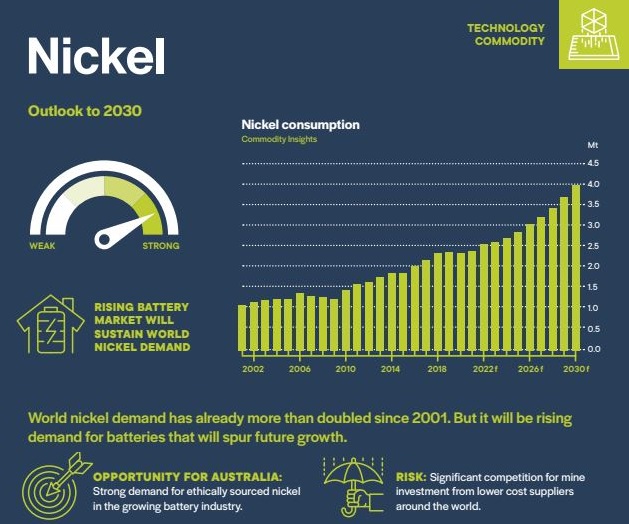
Nickel prices soarded to dizzying heights when the Russia-Ukraine conflict first broke out but fell on the back of Chinese lockdowns and poor downstream demand for the metal – dozens of lithium battery factories are being built all over Europe but are not yet operational.
Fitch Solutions predicts the nickel price will move even higher as China’s stimulus measures improve the demand outlook and the war in Ukraine continues to apply supply pressures.
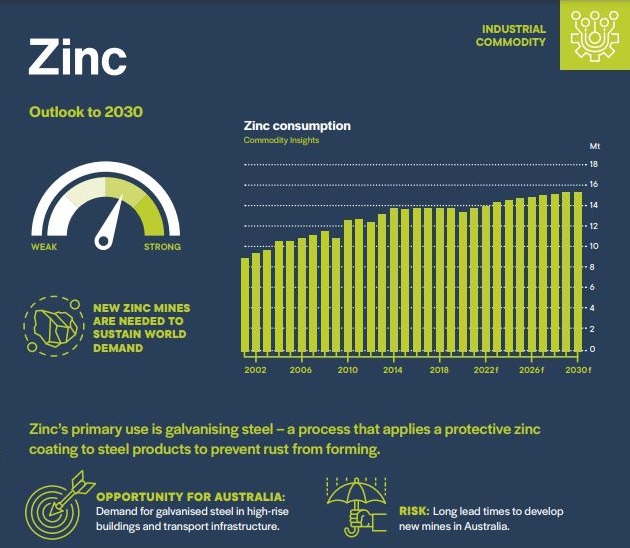
The zinc story mirrors that of nickel; the commodity has spiked because of supply constraints associated with the war, and was already trending upward due to an uptick in zinc consumption partially related to renewable energy-linked steel galvanisation.
Zinc has averaged US$3,688 per tonne over the year to date and currently sits at US$4,069 per tonne, approaching its all-time 2006 high of US$4,442.
“Our 2022 price forecasts imply that we expect prices to stabilize and weaken from here on in the coming months, despite remaining elevated compared to historical standards,” Fitch analysts told mining.com.
“We expect global crude steel production growth to average around similar levels in 2022 (3.6% year-on-year) as 2021 (3.4% year-on-year), and this suggests a similarly robust growth in galvanized steel production, which is the main source of demand for zinc.
“However, we expect the pace of global steel production growth to slow, led by China, and ultimately average 2.2% year-on-year in 2023.”
Overall, while prices may be falling from their recent peaks, the global outlook for base metals is very strong, and expected to continue to be for at least the next decade.
The exception is lead, which is expected to fall during the second half of this year – partially because of a slowdown in the automotive industry, which saw the used car market spike.
“We expect lead prices to edge lower over the second half of 2022 as global demand weakens,” the Fitch Solutions Country Risk and Industry Research (FSCRIR) unit said.
“A combination of soaring energy prices and rising interest rates will continue to undermine global economic growth, as has increasingly been the case since Russia’s invasion of Ukraine in February.”
Lead has been one of the few base metals to lose out in the energy transition, with demand expected to continue to fall as electric vehicle uptake increases.
Market research company IndexBox has forecast a 5% price drop for lead year-on-year.
“After a drop in 2021, global lead supply is expected to rise, primarily due to the increased output of lead-containing by-products from zinc mines and boosting recycling in China,” IndexBox said in its outlook.
In the spotlight: ASX base metal stocks
Galileo Mining
Galileo Mining Ltd (ASX:GAL) is exploring for base metals in Western Australia, targeting large-scale magmatic nickel-copper deposits in the Fraser Range and high-grade nickel-copper-cobalt-platinum group element (PGE) resources at its flagship Norseman project.
The company made a particularly notable discovery this quarter in the form of the Callisto polymetallic prospect in the Norseman project, hitting 33 metres at 2.05 g/t 4E (1.64 g/t palladium, 0.28 g/t platinum, 0.09 g/t gold and 0.05 g/t rhodium) with 0.32% copper and 0.30% nickel in the discovery hole.
.JPG)
Norseman Project with Callisto, Mission Sill and Jimberlana palladium-nickel-copper prospects outlined (over TMI1VD magnetic image)
All six holes completed at Callisto by the end of the quarter (more have since been drilled) contained material zones of mineralisation, a good indicator of the potential of the system.
So far, GAL has defined Callisto over a 300-metre by 200-metre area, with the highest-grade results recorded at 8.25 g/t palladium and 1.94 g/t platinum over 1 metre.
At Fraser Range, Galileo has been using electromagnetic (EM) surveying to generate drill targets along strike from known sulphide mineralisation, near Lantern South and around the highly conductive Green Moon prospect.
The company had $7 million in the war chest as of June 30, 2022, but has since completed a $20.4 million placement with cornerstone investments by major shareholders Mark Creasy and IGO, which will fund further drilling at Norseman.
Caspin Resources
Caspin Resources Ltd (ASX:CPN) is a Western Australian-based exploration company focused on the Yarawindah Brook and Mount Squires projects.
At Yarawindah, Caspin has been exploring the promising Serradella (XC-22) prospect, where drilling intersected a very wide intersection assayed at 91 metres at 0.48 g/t 3E (palladium, platinum and gold).
The company has stated its drilling at Serradella supports its new geological model, which indicates there is a large untested area near the prospect and may provide a pathway to discovering the more prospective basal position of the mineralised intrusion, which has not yet been drill tested.
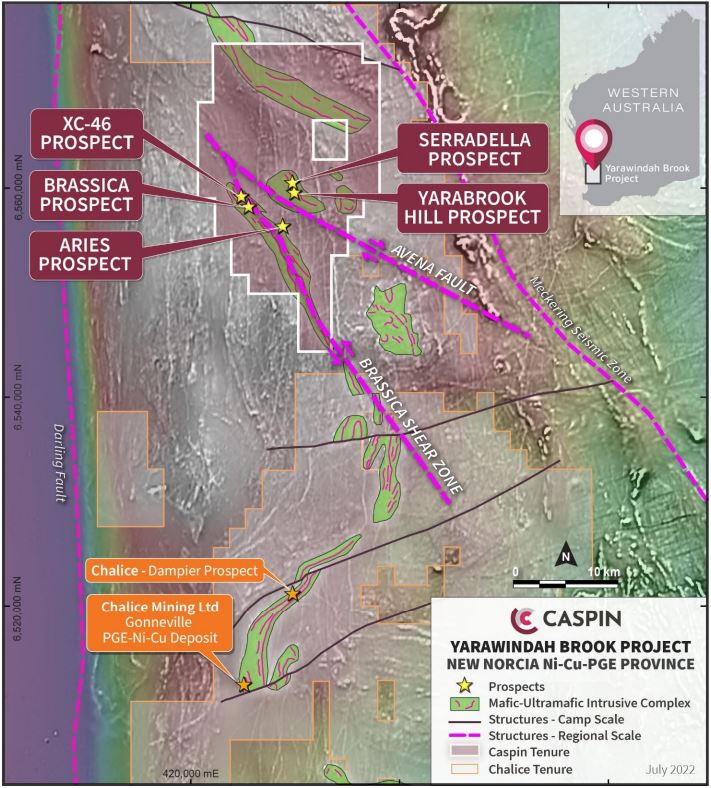
Regional structural interpretation showing the relationship between the Gonneville Intrusive Complex and Yarawindah Brook Project
CPN also unearthed visible nickel-copper sulphide mineralisation in diamond drilling at the XC-46 EM conductor, although assays are still pending in regard to grade and tenor.
The core of this conductor remains untested, with mineralisation open in all directions.
At Mt Squire, Caspin has been conducting reconnaissance aircore (AC) drilling at the Duchess copper-gold prospect and the West Musgrave magmatic nickel-copper trend.
The company has also extended a regional geochemical soil sampling program and has begun a suite of exploration programs in the region that will include 10,000 metres of drilling and 2,500 soil samples in what it considers a highly prospective, underexplored area.
Chalice Mining
Chalice Mining Ltd (ASX:CHN, OTCQB:CGMLF) is a specialist explorer and developer with a major greenfield platinum group element (PGE), nickel, copper, cobalt and gold discovery at its Julimar Project in Western Australia.
Chalice upgraded the Gonneville resource at Julimar to 350 million tonnes at 0.96 g/t 3E (platinum, palladium and gold), 0.16% nickel, 0.10% copper and 0.015% cobalt, increasing the geological confidence of the resource, as 70% (up from 45%) now sits in the indicated category.
The higher-grade sulphide component of the resource also increased, coming to 82 million tonnes at 1.7 g/t 3E, 0.21% nickel, 0.20% copper and 0.020% cobalt.
Overall, 90% of the resource above 250 metres of depth is now in the indicated category, the resource has been defined from a depth of 30 metres to 700 metres, and the mineralised system remains open down-dip, offering further potential for growth.
%20of%20Gonneville%20Indicated%20and%20Inferred%20category%20blocks.JPG)
3D view (looking northeast) of Gonneville Indicated and Inferred category blocks
CHN is now undertaking more exploration drilling, with four diamond drill rigs in operation and approvals received for over 70 drill targets at the Hartog-Dampier area.
So far, the company has received some promising visual results from disseminated sulphides 15 to 80 metres in width (averaging 1-3% sulphide) and locally abundant matrix sulphides (up to 20-30% sulphide) over a strike length of 350 metres with a dip extent of 250 metres, open in all directions.
Chalice has some $131.7 million in cash as of the end of the quarter and is well funded to complete a Gonneville scoping study for an initial mine development stage, expected to be released before the end of the calendar year.
New Century Resources
New Century Resources Ltd (ASX:NCZ) is a mining, tailings management and economic rehabilitation company. The flagship Century project in Queensland is the largest tailings remining and processing operation in Australia, being actively developed with underground and open pit operations.
The company delivered material increases to its zinc production at the Century Mine during the quarter, producing 31,699 tonnes of zinc metal, a 14% increase from the March quarter.
New Century also pursued exploration activities around the Century Mine’s open pit, targeting an increase in the mineral resource’s confidence and the eventual conversion to a mineable ore reserve.
Drilling at Watson’s Lode produced shallow zinc mineralisation up to 43.2% zinc, with additional lead and silver content. The prospect remains open along strike.
During the quarter, NCZ identified the Lilydale prospect as a target with high potential, with stratigraphy and structural setting similar to the original Century ‘Big Zinc’ ore body. Drill-testing has been scheduled for this quarter.
Poseidon Nickel
Poseidon Nickel Ltd (ASX:POS, OTC:PSDNF) is a nickel sulphide exploration and development company with three projects in the Goldfields region of Western Australia and a resource base of around 400,000 tonnes of nickel and 180,000 ounces of gold.
Over the quarter, Poseidon updated the Black Swan Underground mineral resource to 28.9 million tonnes at 0.63% nickel for 181,000 tonnes of nickel, and the Silver Swan Open Pit mineral resource to 130,000 tonnes at 9.6% nickel for 12,400 tonnes of nickel at a 4.5% cut off.
The high-grade indicated resource from both Golden Swan and Silver Swan now totals 250,000 tonnes at 7.10% nickel for 17,600 tonnes of nickel, a 75% increase in nickel metal since 2019.
On the corporate side of things, Poseidon has made solid progress on the Black Swan feasibility study, with preliminary metallurgic testing of Black Swan mineralisation demonstrating good amenability for POS’s chosen concentration methods.
The company is also in discussions with Pure Battery Technologies to provide nickel concentrate feed to Pure Battery’s proposed Kalgoorlie precursor cathode active material (pCAM) refinery.
Galena Mining
Galena Mining Ltd (ASX:G1A) is a base and precious metals explorer and developer with a 60% interest in the Abra Base Metals Mine and full ownership of the Jillawarra Project, located in the highly prospective Edmund Sedimentary Basin, in the Gascoyne Region of Western Australia.
During the June quarter, Galena brought the Abra Project to 73% completion, remaining focused on the underground access to the Abra ore body and completion of the processing plant and power station for the mine.
Galena advanced the underground development by 565 metres, reaching 1,357 metres on schedule. The mine decline now sits about 44 metres above the ore body and 193 metres below surface level.
The company also reached 79% completion for overall processing plant construction, while plant engineering and drafting work is 99% complete and site construction sits at 72% completion.
.png)
Abra processing plant construction (June 2022)
G1A has now received key overseas-supplied equipment, including the remaining mill equipment, secondary and tertiary cone crushes and LNG tanks.
Galena recently secured US$20 million in additional debt under the established Taurus Debt Facilities, with US$25 million remaining undrawn and A$48.2 million cash on hand at quarter-end, leaving the company free to focus on completing the Abra Mine’s construction.
Apollo Minerals
Apollo Minerals Ltd (ASX:AON) is exploring a large-scale, near-surface base metal project in the form of the Kroussou zinc-lead Project in Gabon, Central Africa.
Previous exploration efforts have identified 150 zinc-lead mineral occurrences over more than 80 kilometres of prospective strike length within the project area.
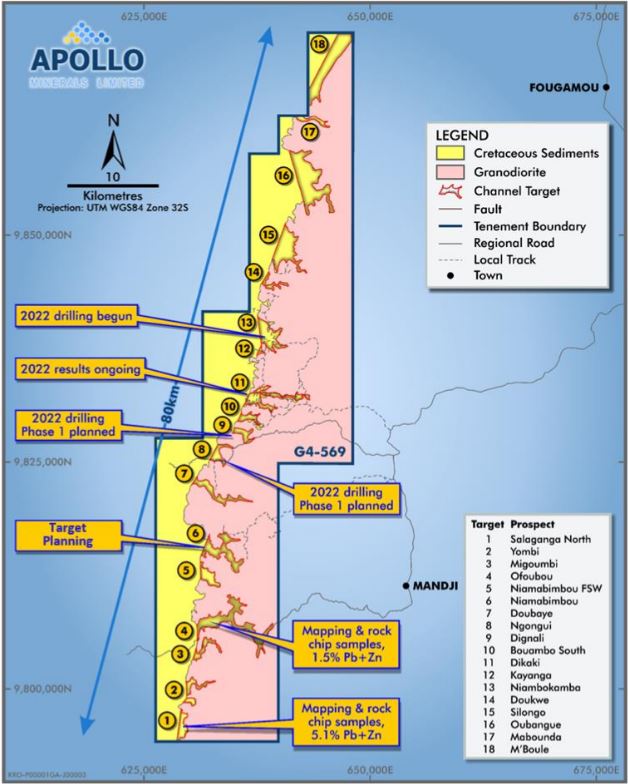
Kroussou is known to host18 prospects over more than 80 kilometres of prospective strike length.
Over the last three months, Apollo doubled the mineralised strike at the Eastern Dikaki high-grade zone to 500 metres, open along trend with thick, shallow mineralisation revealed in step-out drilling.
The company reported some particularly broad zinc and lead intercepts from this area, up to 60.2 metres at 2.4% lead and zinc from just 1.9 metres of depth with higher percentages in narrow intersections, up to 7.5% zinc and lead.
Apollo also discovered base metal sulphide mineralisation at two new prospects at Kroussou, returning rock chip grades of up to 5.1% zinc and lead, backed up with reconnaissance mapping and soil and rock chip sampling.
Across the rest of the project tenure, two diamond drill rigs are active on regional targets, with results expected presently. The company also undertook a regional airborne electromagnetic (AEM) survey over 80 kilometres of prospective strike, with results expected in this quarter.
Finally, Apollo secured 100% ownership of the Kroussou Project with the completion of its agreements with Trek Metals Ltd (ASX:TKM) and Battey Minerals Ltd.
Stelar Metals
Stelar Metals Ltd (ASX:SLB) has assembled a portfolio of copper and zinc metals exploration projects in South Australia, targeting battery metals to support the energy transition to a low-carbon future.
Stelar currently holds tenure in one of the most sought-after base metal mineral districts in South Australia, consisting of four granted tenements (1,538 square kilometres) and two tenement applications (455 square kilometres).
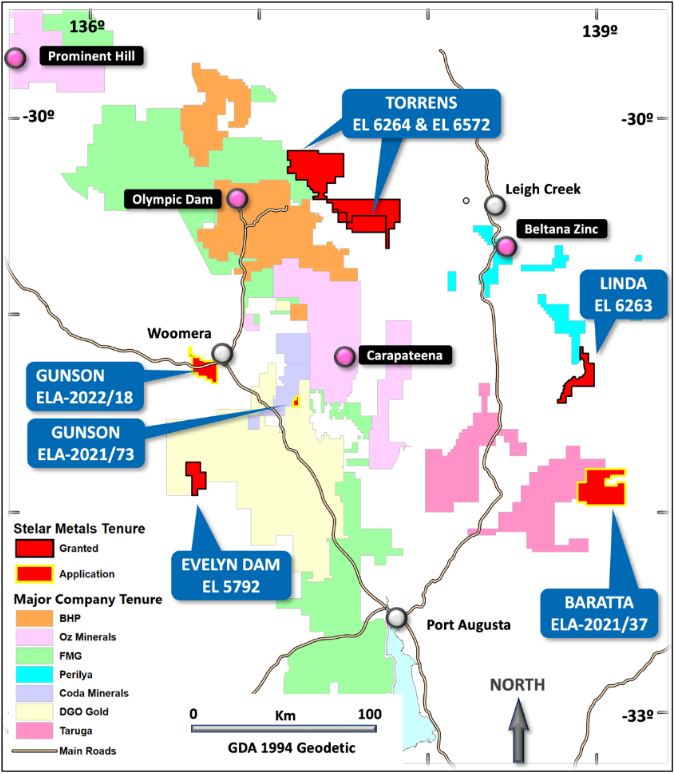
Location of Stelar Metal’s projects.
During the quarter Stelar identified high-grade zinc mineralisation at the Linda Zinc Project, confirmed with portable x-ray fluorescence (pXRF) analysis to hold 10-25% zinc mineralisation in multiple outcropping targets.
Fieldwork by CSA Global also confirmed Linda’s geological setting is highly prospective for economic deposits of carbonate-hosted zinc, prompting Stelar to resume mapping, sampling, and geochemical surveys and to acquire high-resolution orthoimagery and LiDAR to follow up these results.
On its other asset, Stelar began drilling at the Evelyn Dam iron-oxide copper-gold (IOCG) Project, targeting a large-scale IOCG geophysical anomaly.
The company will drill to 1,500 metres to test the nominal depth of the target, with first assays from the program expected late in the third quarter of this calendar year.
SLB has $5.93 million cash on hand as of the end of June and has appointed Nick Harding as joint company secretary.