
Caspin Resources Ltd (ASX:CPN) is encouraged by early signs from Duchess prospect at the Mt Squires Project in Western Australia with an outcropping gold-silver system identified in initial field sampling.
Mineralised vein systems found at surface at the prospect in the West Musgrave region have returned a rock chip result of 2.46 g/t gold and 49.7 g/t silver.
The outcropping coincides with the initial results of reconnaissance aircore drilling in which ‘bottom of hole’ results support the existence of a gold and silver anomaly with a strike of at least 500 metres.
This evidence points to a potential 2-kilometre open strike under cover to the Handpump prospect.

“Opportunity for discovery”
Caspin’s chief executive officer Greg Miles said: “This is a great example of the opportunity for discovery at Mount Squires.
"We’ve set foot on this brand-new target with almost no previous exploration and immediately picked up gold and silver bearing veins off the surface. How many places on earth can you still do that?
"And our first reconnaissance drilling program offers evidence of coherent bedrock mineralisation! We’re excited by what else we’ll find, not just at Duchess but across the project.
“I think this vindicates our belief in the Mount Squires Project and supports the company’s strategy to pursue both the Yarawindah Brook and Mount Squires projects.”
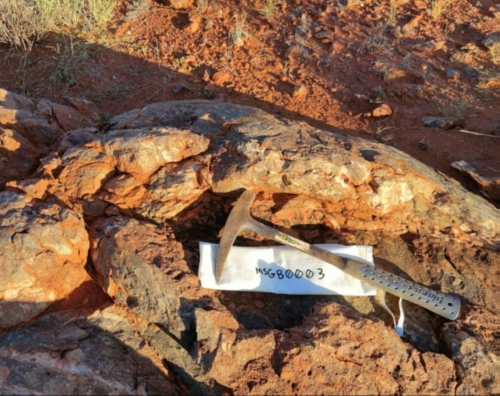
Mineralised vein outcrop at the Duchess Prospect assaying 2.46 g/t gold and 49.7 g/t silver.
Copper-molybdenum to boot
A separate, copper-molybdenum mineralisation trend has also been identified through rock chip and ‘bottom of hole’ aircore samples.
The first part of Caspin’s reconnaissance aircore program comprised 81 holes for 2,394 metres with most of the drilling on broad 400 x 200-metre centres. Field mapping and sampling was conducted alongside the drilling.
This program focused on the core molybdenum anomaly previously identified in 2021 but also extended over 7 kilometres of strike across the broader molybdenum, copper, gold and lead soil anomaly.
Drilling activities were co-funded by the State Government and DMIRS supported Exploration Incentive Scheme, Round 25, co-funded exploration drilling initiative.
Effectively open under cover
A highlight of these early results is a rock chip sample returning 2.46 g/t gold and 49.7 g/t silver from a patchy outcrop covering about 20 square metres.
Nearby aircore drill holes over two lines also returned bottom of hole results >1 g/t silver within a broader zone of coherent silver >0.5 g/t and gold >0.2 g/t mineralisation with at least 500 metres of strike.
This zone is effectively open under alluvial cover all the way to the Handpump prospect, 2 kilometres to the north which has previously returned significant gold results such as 15 metres at 2.30 g/t.
New mineralisation style
Previous drilling at Handpump demonstrated only very weak silver anomalism. Therefore, the silver mineralisation appears to be a new mineralisation style associated with the Duchess prospect.
Anomalous molybdenum rock chip values up to 60ppm have also been returned from rhyolitic outcrops and broadly correlate with the core of the molybdenum soil anomaly in the eastern margin of the Duchess prospect.
Anomalous molybdenum bottom of hole samples have also been returned from the eastern side of the prospect with a peak result of 78ppm from the last hole on the line, leaving mineralisation open to the east.
Whilst this is a very small amount of early data, considering the full drill results are still to be returned as well as another 120 rock chip samples, there is separate gold-silver and copper-molybdenum mineralisation trends emerging at the prospect.
What's next?
Drilling is scheduled to recommence at Duchess in late September to infill and extend the current drill spacing around holes that have already returned some anomalism in the major elements being targeted.
The company has also scheduled an airborne electromagnetic survey (AEM) over the Duchess prospect and the One Tree Hill trend to the east to identify potential massive nickel-copper sulphide styles of mineralisation and will complement the soil geochemistry program and reconnaissance aircore program which is yet to be completed.
A soil sampling program covering large portions of the project has been completed with 2,628 soils submitted for UltraFine analysis. Initial results are expected in September and will be used to guide upcoming drilling activities.