
Dundas Minerals Ltd (ASX:DUN) has discovered similarities between its Central and Matilda South prospects in Dundas Project, WA and the Nova-Bollinger nickel-copper-cobalt deposit following the analysis of geophysical data and models.

Background
The aim of geophysical data and models comparisons was to understand which of the survey methods and models used at Nova were most definitive in identifying the Nova and Bollinger nickel sulphide ore bodies.
Features of the most definitive survey methods were then compared to data and models from the various geophysical surveys that Dundas Minerals has completed within its tenements, with the Central and Matilda South prospects the focus.
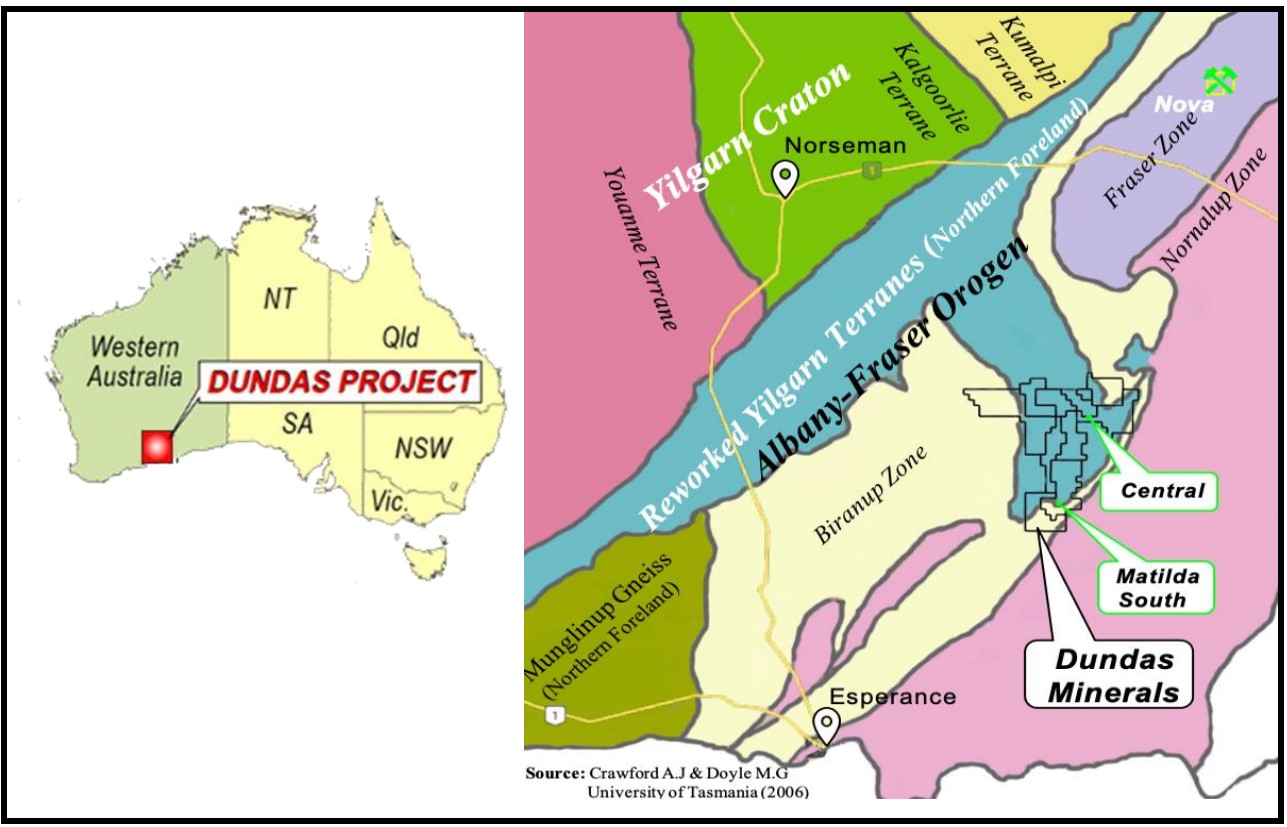
Dundas Minerals tenements (black), Central and Matilda South locations. The project area is interpreted as being in re-worked Archaean and Proterozoic (Biranup Zone) metamorphic rocks. The Nova mine is ~125km northeast of Central.
Outcomes
Ground gravity and aerial magnetic surveys
Modelling of Dundas’ gravity data indicates high density (values of 3.0 – 3.2 T/m³) mafic-ultramafic intrusions at the Central and Matilda South prospects.
These anomalies are considered to be comparable with the modelling of gravity and magnetic data covering the Nova mafic-ultramafic intrusive deposit.
From Dundas’ gravity and magnetic data, ovoid structures are observable at both Central and Matilda South.
These structures appear similar to the “eye structure” that is apparent at Nova.
Dundas’ Central and Matilda South ovoid structures are interpreted as being due to multiple mafic-ultramafic intrusions that have, on intrusion, deformed the surrounding country-rock.
SkyTEM electro-magnetic (AEM) and ground audiomagnetotellurics (AMT) surveys
At Central, late-time AEM anomalies occur along a strike length of about 10 kilometres.
This conductive trend, which may indicate the presence of massive sulphides at-depth that are associated with the interpreted mafic-ultramafic intrusions (and may host nickel mineralisation), is spatially coincident with an interpreted major fault structure that is evident from high resolution aeromagnetic images.
Modelling of the final AMT data at Central has returned low resistivity anomalism from ~60m below the surface to a depth of 600m.
The very low modelled resistivity values at Central (<1 Ohm-m) are comparable to the low resistivity values at Nova (2-12 Ohm-m) (Figure 5).><1 Ohm-m) are comparable to the low resistivity values at Nova (2-12 Ohm-m).
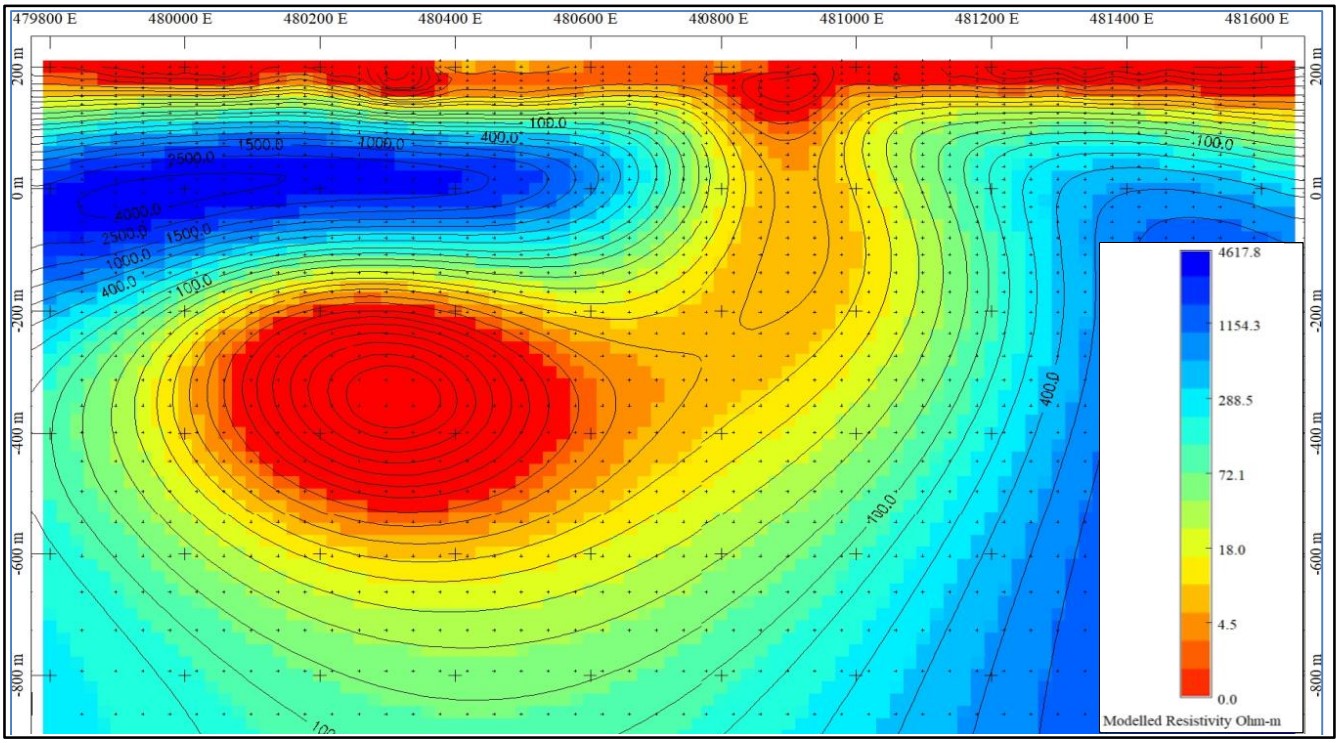
Central target – AMT Line 11000 resistivity model section (resistivity values <1 ohm-m, contoured on red colours).
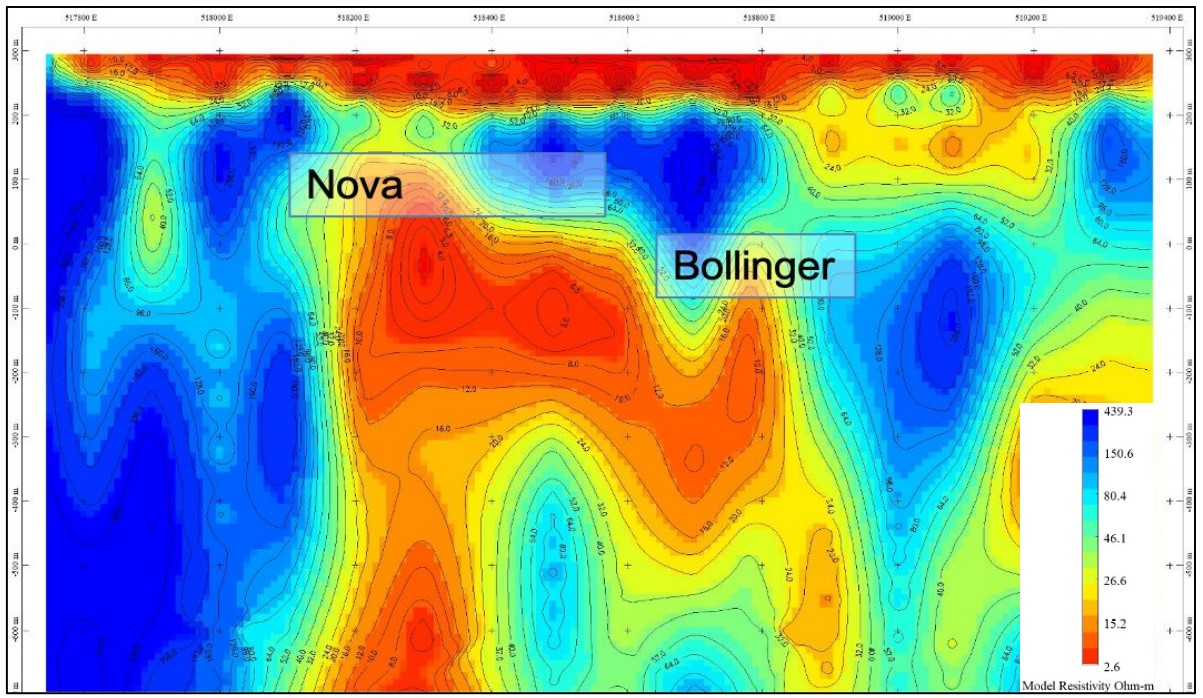
Nova-Bollinger AMT inversion model cross section. Very low resistivity values of 2-12 ohm-m (contoured on red colours) are well correlated to the location and depth extent of massive sulphide mineralisation at the deposit.