
KGL Resources Ltd (ASX:KGL) is higher on fielding further high-grade copper hits from its recently completed 23-hole drill program at Jervois Copper Project in the Northern Territory of Australia
The base metal explorer’s program set out to test four brownfields targets within and nearby Jervois’ Reward deposit — Reward Gap and East Lodes, Marshall Deeps, Reward North and Reward South.
Responding positively to the results, investors have driven share prices as much as 26.83% higher intra-day to A$0.26 while the market cap is approximately A$105.04 million.
This exploration program forms part of KGL’s mission to establish a world-class, low-cost copper mine in Australia’s north.
At present, the company is advancing project studies to land on the best development scenario. A mining management plan was approved by the NT Government in January last year.
Reward Gap and East Lodes
KGL kicked things off with four holes at the Reward Gap and East Lodes targets, designed to follow up a previous intersection which hadn’t been incorporated with the latest mineral resource model.
The explorer also set out to increase confidence in the East Lodes target, where drilling confirmed a high-grade copper intersection.
This included 11.2 metres at 1.71% copper and 20.3 g/t silver from 329.7 metres and 1.62 metres at 4.86% copper and 67.2 g/t silver from 348.15 metres.
Reward Marshall Deeps
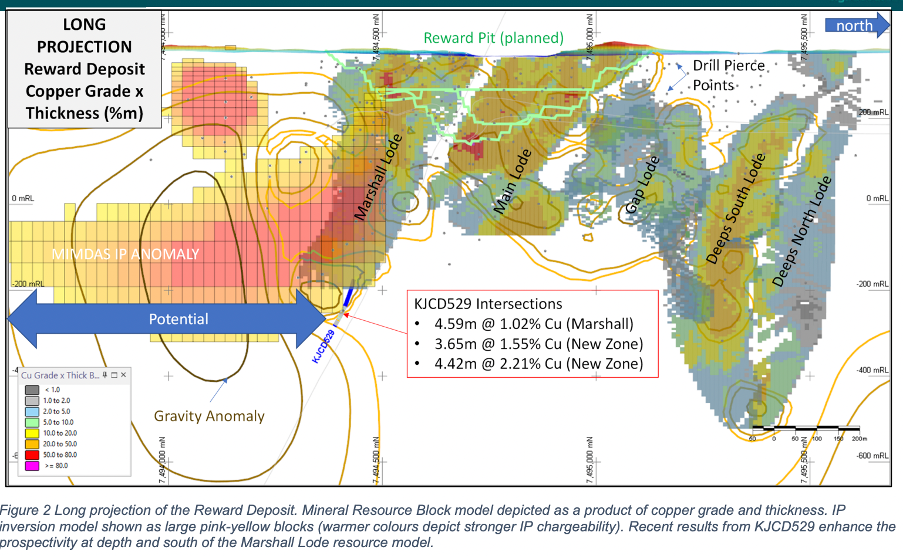
Two holes were designed to test the depth potential of the Marshall Lode at Jervois’ Reward deposit, and the deepest hole yielded the best result — a 4.59-metre intersection grading 1.02% copper, 8.8 g/t silver and 0.07 g/t gold from 704.9 metres.
What’s more, the hole continued deeper to discover two new zones of mineralisation, with better grades, to the east of Marshall, returning 3.65 metres at 1.55% copper, 17.7 g/t silver and 0.11 g/t gold from 750.5 metres and 4.42 metres at 2.21% copper, 19.9 g/t silver and 0.14 g/t gold from 763.2 metres.
Reward South
Over at Reward South (a region that includes the Reward Silver target), KGL drilled 11 holes, designed to test for extensions along strike to the south.
Two holes intersected high-grade silver, as well as lead, zinc and copper sulphides. Results include:
- 2.87 metres at 0.48% copper, 706.6 g/t silver, 0.55 g/t gold, 1.75% lead and 0.23% zinc from 180.46 metres;
- 2.48 metres at 0.61% copper, 393.6 g/t silver, 0.21 g/t gold, 6.61% lead and 1.27% zinc from 194 metres; and
- 1.59 metres at 0.05% copper, 164.5 g/t silver, 0.03 g/t gold, 4.48% lead and 6.46% zinc from 284 metres.
All things considered, KGL believes these results — coupled with the downhole electromagnetics — demonstrate the limited potential of the high-grade silver shoot.
The copper results are generally low grade and/or narrow widths, and further drilling is not currently on the cards for this region.
Reward North
KGL also drilled six holes to test extensions of the Reward deposit along strike to the north.
These targets were based on several historical copper intersections and some encouragement from the MIMDAS-induced polarisation (IP) program.
Overall, drilling confirmed the structure and orientation on the mineralisation and that the overall tenor is similar to historical drilling at reward North.
However, no additional drilling is currently proposed for this target.
What’s next?
Speaking to the findings, KGL executive chair Denis Wood said: “The potential at depth for additional mineralisation upwards of 2% copper and at minable thicknesses is clearly demonstrated by the drilling at Marshall Deeps, at the southern end of Reward.
“Hole KJCD529 will be included in the next phase of downhole electromagnetic surveys, which will help us design follow-up drilling.
“The now-completed RC drilling program at Bellbird was necessary to improve the ratio of indicated to inferred mineral resources, which is expected to result in an increase in ore reserves contained within the proposed open pit design.
“Assaying of these samples is prioritised and an updated Bellbird mineral resource and ore reserve estimates will follow.”