
Solana’s second-quarter data published by Messari underlined a gamut of challenges for the US$12.7bln blockchain, including a spate of network outages and below-par token prices, but the platform shined in other respects.
Messari warned that: “An area of concern is network reliability. As seen in 2021 and throughout Q1 and Q2, degraded network performance decreases network usage and reduces the network’s continued flow of revenue.
“If Solana were to continue to experience degraded performance that lasts for a material amount of time, a resulting drag on fundamental usage may catalyse volatility and drag on network value.
Key takeaways included:
- 70% decline in native token SOL’s market capitalisation
- 68% fall in total value locked (TVL) across decentralised finance (DeFi) protocols
- 17.6% decline in average daily transactions
- 44.4% fall in DeFi revenue
- Average annual staking yields for SOL holders fell 12.6%, though still remain relatively attractive at 4.6%
While these numbers look scary, comparative analysis shows that the blockchain acted in line with broader market trends, at least in some respects.
In the same period, TVL across all blockchains fell by an average of 67%, with DeFi revenues falling in line with this trend.
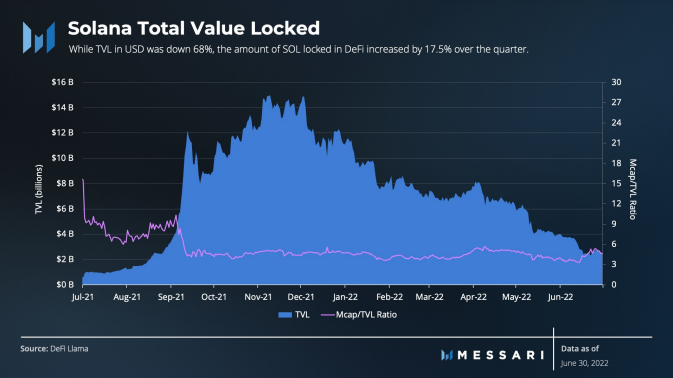
TVL has shot down this year, in line with the wider market — Source: Messari
SOL token did perform worse than its peers, with capitalisation across the cryptocurrency markets (excluding Bitcoin) falling by 56%.
Not all bad news
NFTs were a boon for the Solana blockchain this quarter: Minting rates were up nearly 50%, buoyed by the recent launches of native NFT platforms Metaplex, Serum and Magic Eden.
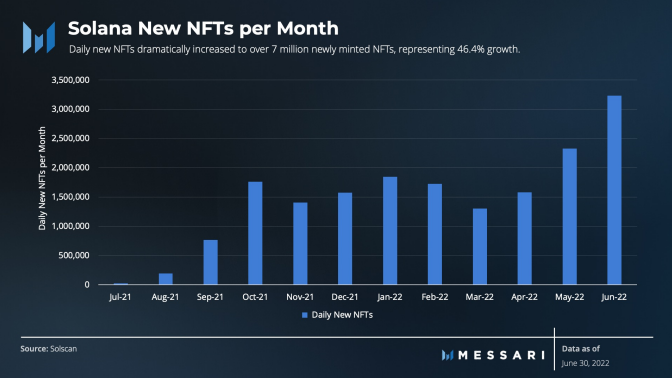
An uptick in NFT mints was partially responsible for Solana’s network issues — Source: Messari
Solana is now only second to Ethereum for secondary NFT sales.
While DeFi did see a 68% drop in TVL, Messari noted that Solana’s DeFi ecosystem is particularly diverse, with the largest protocol Marinade Finance making up only 11% of TVL.
The next four largest protocols (Solend, Serum, Raydium and Atrix) make up 36% of TVL combined.
In comparison, Binance’s largest DeFi protocol — the popular decentralised exchange (DEX) PancakeSwap — comprises nearly 50% of TVL alone.
Solana’s transaction fees were 40.6% cheaper compared to the first quarter, an expected result due to reduced network activity.
The number of active validators increased by 19.4% to 1,975, good news for both the decentralisation of the network and overall security (validators are responsible for ensuring network security, and are rewarded in SOL tokens for their efforts).
Macro pressures
Macro pressures inevitably had a knock-on effect for Solana, with the Terra Labs collapse and spate of high-profile bankruptcies across the crypto sector putting a dent in crypto’s overall public opinion
Solana has also had to grapple with a hawkish Securities Exchange Commission determined to classify SOL and similar cryptocurrencies as unregistered securities; a sentiment echoed by Bitcoin uber-maximalist Michael Saylor.
Looking forward
Despite some worrying metrics, Solana still remains among the cheapest and fastest blockchains out there.
However, in response to ongoing capacity issues, the network is poised to implement a “fee-prioritisation mechanism” which will increase network fees at times of high congestion.
To what extent that will jack up network fees is unclear, but Solana co-founder has played down the concerns.
ELI5 solana fees:
Once all the features rollout, there will be fees. Does that mean the network will be expensive? No! ????https://t.co/vWfJxYXjiK
— SMS T◎Ly, ???????? (@aeyakovenko) June 16, 2022
In the meantime, Solana stans will soon be able to visit Solana Spaces, an “embassy” for the blockchain soon to be opened to the public in New York’s Hudson Yard neighbourhood.
Visitors will be able to learn about Solana and Web3, get help setting up their own crypto wallets, and snap up some Solana-themed merchandise.