
The ASX is set to tilt down when trading begins, as the US braces for another likely rate hike when the Federal Reserve meets this week.
ASX futures were down 30 points, or 0.4%, to 6,681 very early this morning, and the local currency was down 0.2% to 69.38 US cents.
The Wall Street indices were all subdued, with the S&P 500 losing 1.2%, the Dow down 0.7% and the Nasdaq leading the charge, down 2%.
Consumer-facing businesses face a contraction in discretionary spend, with retailers Walmart (-7.7%), Target (-4%) and Amazon (-4%) now encountering signs that the economic headwinds have filtered through to the hip pocket.
IMF’s message of doom
The jitters are understandable. The International Monetary Fund today released an exceptionally gloomy global forecast, tipping that, with “the world’s three largest economies stalling”, we face the deepest recession in 50 years.
The outlook went on to itemise the concerns it has in these three juggernaut economies.
“In the United States, reduced household purchasing power and tighter monetary policy will drive growth down to 2.3% this year and 1% next year,” the IMF said on its blog.
“In China, further lockdowns, and the deepening real estate crisis pushed growth down to 3.3% this year - the slowest in more than four decades, excluding the pandemic.
“And in the euro area, growth is revised down to 2.6% this year and 1.2% in 2023, reflecting spillovers from the war in Ukraine and tighter monetary policy.”
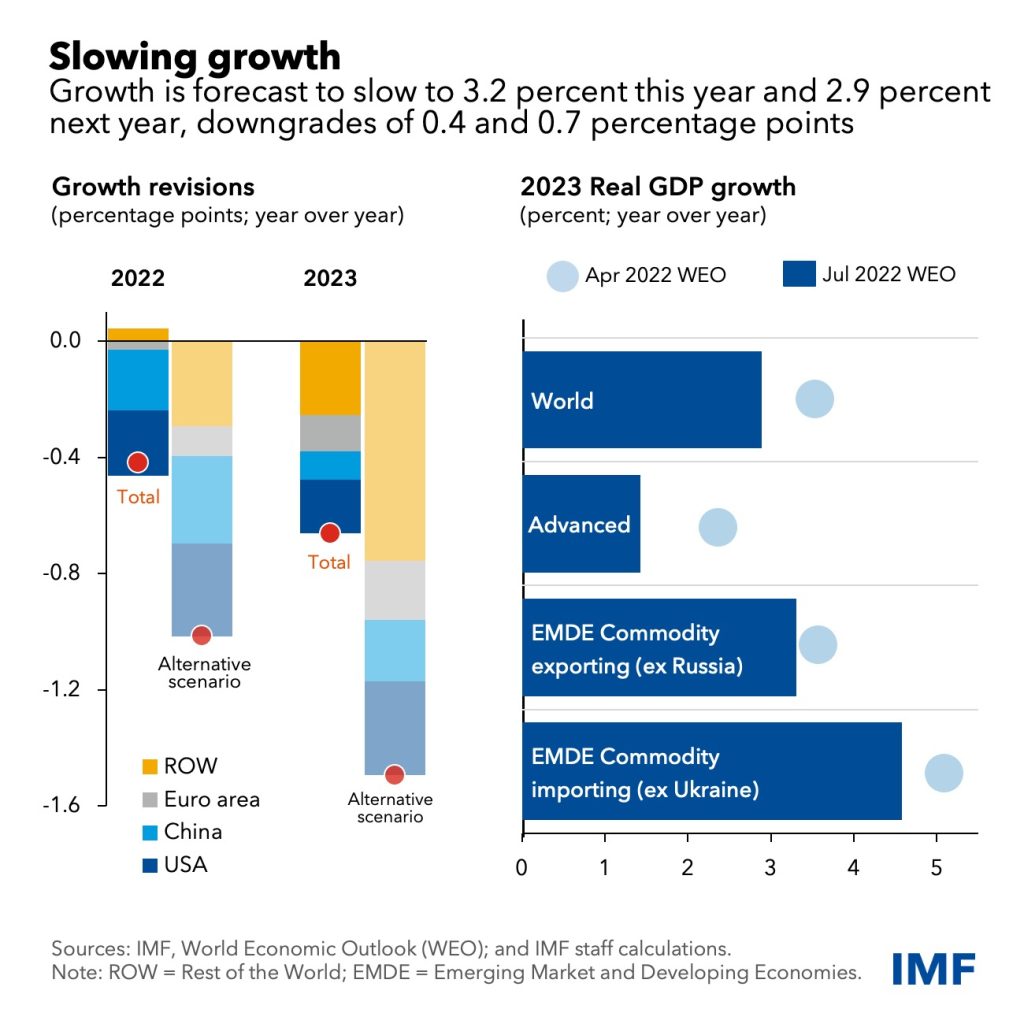
Source: IMF website
Despite slowing growth, inflation persists, particularly headline inflation on non-discretionary items like food and energy, and the IMF believes taming inflation should be the highest priority for policymakers. So, rate rises look to be part of the landscape for the foreseeable future.
“The risks to the outlook are overwhelmingly tilted to the downside,” the report said, citing war, an energy squeeze, tight labour markets, debt distress, renewed COVID-19 outbreaks and lockdowns and geopolitical fragmentation impeding global trade and cooperation in a long list of risks.
“A plausible alternative scenario in which risks materialise, inflation rises further and global growth declines to about 2.6% and 2% in 2022 and 2023, respectively, would put growth in the bottom 10% of outcomes since 1970.”
We’ve probably said it before, but hang on to your hats.
Inflation data out
The news is no better at home than in other developed economies. The markets await the June quarter consumer price index data from the Australian Bureau of Statistics, which will drop at around 11.30am today.
The data – expected to show a 6.3% jump in inflation on an annual basis – will all but lock in further tightening by the RBA. If the predictions are correct, we’re staring down the biggest jump since December 1990, when interest rates got very hairy indeed, tipping 17%.
With household debt at record highs and many newer mortgagees banking on the historically low interest rates of recent times, there could be a lot of debt distress on the horizon.