Anson Resources Ltd (ASX:ASN) has expanded its Paradox lithium asset in Utah by staking more than 500 new claims to the project’s west.
The project is now 36% larger and covers 167 square kilometres of contiguous tenure, which is highly prospective for lithium-rich brines.
Now, Anson plans to execute the western component of its expansion strategy, which involves re-entering and drilling the Mineral Canyon Fed 1-3 and Sunburst 1 wells.
Through this, the lithium explorer hopes to convert its existing inferred resources and exploration target into the higher confidence indicated and inferred resource categories respectively.
As its attention turns to the west, Anson is rounding up the eastern component of the resource expansion plan, which focused on drilling at the Cane Creek 32-1 well.
Together with its plans for the western targets, Anson hopes this activity will prime it to deliver a major resource upgrade at Paradox.
New claims bolster exploration strategy
Thanks to the 556 claims it has staked on Paradox’s western edge, Anson is one step closer to updating the resources and exploration targets at its core project.
The newly pegged claims sit west of the Sunburst and Mineral Canyon wells, which Anson plans to re-enter as part of its expansion and resource upgrade strategy.
Taking this into account, Anson has mapped an area of influence (pictured below in magenta) that could host an expanded, potential indicated resource down the line.
It’s also traced where an expanded inferred resource could lie in red.
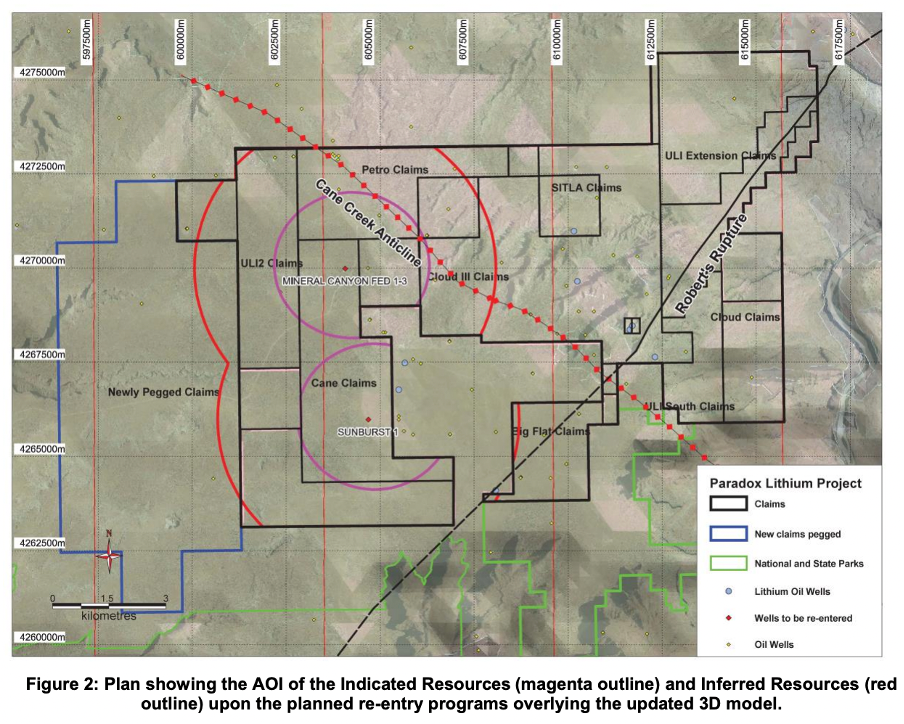
Once it completes the well re-entry and takes a closer look at the lithium-rich brines to the west, the area of interest could increase to 3 kilometres in a property known as Clastic Zone 31, as well as the Mississippian units in the upcoming resource upgrade.
Anson believes this would mark a major milestone because it means a large part of the project area could be classified as indicated resource territory.
Updated modelling
Anson recently updated its static modelling at Paradox in a bid to estimate the potentially drainable brine within the project area.
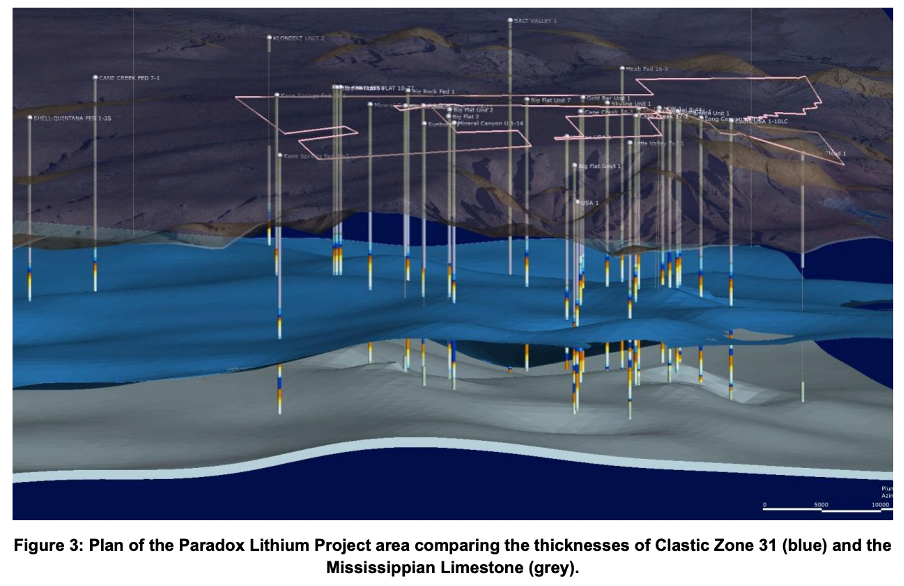
The figure below also shows drill traces of the historical wells used to calculate Paradox’s JORC resource and the exploration target.