
- FTSE 100 closes up
- Truss favourite for PM
- Retail sales slump
4.57pm: FTSE closes ahead
FTSE 100 finished Friday higher as the rally in equities remained intact.
Britain's blue-chip index finished 5.86 points higher, or 0.08%, at 7,276.37.
"Investors will be pleased to see that the rally in stocks remains intact, having lasted longer than some of the other rebounds we have seen so far this year," said Chris Beauchamp, the chief market analyst at online trading firm IG.
"But they will be wary of pushing their luck too hard into next week, given the avalanche of earnings heading their way, plus a Fed decision and the first reading on US second quarter GDP that might easily provide fresh recession worries," he added.
3.45pm: Footsie poised for higher close
London's blue-chip index looks set to end the week nearly 1.8% higher, as it closed the week making marginal gains.
The FTSE 250 looks set to end the week more than 5% higher.
3.31pm: Choppy week
Craig Erlam, a senior market analyst at OANDA, reflects on the week’s market movements.
“A choppy end to the week pretty much sums up how the rest of it has been, as investors have had to make sense of a wide range of data, earnings, rate decisions and geopolitical developments.”
“And all at a time when there is immense uncertainty around the economic outlook as a result of inflation, Covid and the war in Ukraine.”
“Most central banks have come around to the idea that aggressive tightening is the only way we're going to cut short this period of high and accelerating inflation, even if the cost of such action is a recession.”
“The majority still think a recession is avoidable but I imagine that will change over the course of the remainder of the year.”
“Lower commodity prices - most notably oil - and indications of supply chain issues improving will certainly be welcome and could be providing a sense of optimism.”
“But inflationary pressures have become more widespread so central banks will still have to tighten monetary policy much further.”
“The increasing prospect of recession probably has a role to play in yields falling; the argument being that it will weaken demand as the cost-of-living crisis bites and alleviate some of the tightness in the labour market which should in turn help lower domestic inflation.”
“But is this really going to support the stock market or are we just witnessing another bear-market rally?”
“Then there's earnings season. It's still very early days but we've seen numerous cases now of earnings surprises driven by the "it's not as bad as we feared" argument.”
“That's a relief of course, but surely not a case for a sustainable rebound. We'll soon see whether that turns out to be the case but I'm not getting carried away yet.”
2.59pm: Mixed open
Wall Street’s opening was a bit of a mixed bag, with the S&P 500 remaining relatively steady, while the Dow Jones was up 0.49% to 32,194.
The tech-laden Nasdaq, which climbed 9% over the last month, opened down, losing 0.25% to 12,028.
2.37pm: Protestors cause chaos
More holiday chaos for travellers, as protesters campaigning against high fuel prices disrupted the south-west of England.
Protesters drove in convoy slowly up and down a motorway before blockading a petrol station.
Driving at 30mph on three lanes of the M5 north and south in Somerset and the Bristol area on Friday morning, the convoy restricted tens of thousands of people headed to Devon and Cornwall to begin summer breaks.
They then blockaded a petrol station in Bridgwater, Somerset, only allowing access for emergency vehicles and essential workers.
2.14pm: Twitter falls
Twitter reported a drop in revenues, citing the global economy and uncertainty caused by Tesla boss Elon Musk trying to back out of his takeover.
The social media site sued Musk in a Delaware court to argue for him to be forced to complete a takeover he agreed.
Musk cancelled the deal over concerns about Twitter concealing the number of “bot” accounts.
Twitter says that is untrue, with some analysts believing the platform has a good chance of winning the court battle.
Twitter on Friday said revenue in the second quarter of 2022 was US$1.2bn, down 1% compared to the same period last year.
At the same time its costs rose by 31% to US$1.5bn - including US$33m in costs related to the takeover, reporting an operating loss of US$344m.
Twitter shares fell 2% in pre-market trading to US$38.70 as a result, considerably lower than the far below the $54.20 price Musk initially agreed to pay.
1.52pm: BA strike cancelled
British Airways, which is owned by International Consolidated Airlines, reached a deal with its check-in staff for a higher pay increase which will avert strike action.
Unite and the GMB both said that workers accepted a pay offer that they said represented a 13% pay increase.
More than 500 workers, who are members of Unite, voted in favour of industrial action after British Airways refused to reverse a 10% pay cut introduced during the pandemic.
With airlines and airports already struggling with delays amid staff shortages, British Airways backed down on the pay cut, which Unite said “will be paid in several stages,”
It will also reverse shift pay reductions imposed in 2020 from October 2022.
“This is a great result for our check-in members at British Airways,” said Unite general secretary Sharon Graham
“By standing together, they have forced a corporate giant like BA to do the right thing and restore levels of pay slashed in the pandemic.”
1.28pm: Oil slips
Oil prices continue to slip, leading lower for the third day, with crude oil at US$95.7 a barrel.
“Perhaps a surprising twist considering the remaining tightness in the market but also a further sign that investors are increasingly coming around to the idea of a recession in the not-too-distant future,” said Craig Erlam, senior market analyst at Oanda.
“That remains the primary downside risk for crude prices.”
“While the price drop will come as a relief to those anxiously eyeing the price at the pump every time they have to fill their cars, it doesn't offer a promising backdrop to the next OPEC+ meeting in two weeks.”
“There remains significant tightness in the market but the group is less likely to agree if the price is in the low 90s and markets are pricing in lower growth or a recession, especially if it strongly disagreed when it was $120.”
“So I guess we're heading for recession or higher prices again.”
1.03pm: US preview
US stocks were expected to open slightly lower on Friday with tech stocks coming under pressure in the wake of Snap’s disappointing results, released after trading hours yesterday, while the broader market is seen treading water following a mostly favorable earnings season so far.
Futures for the Dow Jones Industrial Average were trading flat pre-market, while those for the broader S&P 500 index were down 0.3%, and futures for the tech-laden Nasdaq-100 were down 0.5%.
“Looking at the US futures, especially the Nasdaq, tech investors are still disappointed with Snap’s results which sent the social media stock plunging yesterday, said Naeem Aslam, chief currency analyst at avatrade.com.
Snap shares slumped 25% in aftermarket trading after the social media company and parent of Snapchat reported dismal quarterly earnings figures, with losses nearly tripling to $422 million due to a challenging business environment and faltering advertising revenue.
Snap shares are likely to be punished again today, warned Aslam.
The broader market, however, is expected to fare slightly better as bargain hunters return to the market.
“This week has been mainly about US corporate earnings and their results have driven the price action. There is no doubt that we have seen a large number of companies beating Wall Street expectations and this has supported the sentiment among investors and traders,” Aslam said.
On the earnings front, the focus on Friday will be on quarterly results from American Express, Verizon and Twitter.
Investors are also looking ahead to the US Fed’s rate verdict due out on Wednesday next week. US rate-setters are fighting to rein in inflation which is currently running at a high not seen in over 40 years. Markets are largely pricing in a 75-basis point hike but there are residual expectations that the Fed may move aggressively with a 100-basis point increase.
“Today, traders are likely to maintain a somewhat cautious approach as today is the last trading day of the week and next week, we have the FOMC (Federal Open Market Committee) decision coming out,” added Aslam.
In energy markets, WTI crude oil futures were 0.5 % lower at $95.84 a barrel, while Brent crude futures were down 0.2 % at $103.63.
12.26pm: Britons concerned over disposable income
More than half of Britons worry about their disposable income as the rising cost of living crisis forces UK consumer confidence to a record low, according to new data.
Research from Deloitte.??s latest consumer tracker found confidence is at minus 19%, a record low.
Deloitte.also found that 80% of Britons who have fears over their disposable income blame this on the rising prices of necessities, such as food and energy.
62% of consumers are also spending more compared to last year.
“With inflation going up faster than average earnings, there are now more consumers feeling the cost-of-living pinch than not,” said Céline Fenech, consumer insight lead at Deloitte.
“In a sign of the times, the biggest jump in spend this quarter is on energy and housing costs, including rent and mortgages.”
“The current situation means consumers are significantly changing their spending behaviours to adapt. This might be by simply buying less, switching to cheaper brands or stores, and postponing major purchases.”
Spending on everyday items and non-essential items fell compared to the last quarter according to the research, by 2% and 5%, an indicator that consumers are drawing back on their overall spending.
12.01pm: BT merger approved
BT Group and Warner Bros Disovery Inc's joint venture (JV) has been approved by the UK’s competition watchdog, allowing the creation of a new sports channel in the UK and Ireland.
The Competition and Markets Authority had opened an investigation over the deal in early June, but decided against taking the issue further, meaning the 50:50 JV can go ahead.
According to a statement from BT, the creation of the new company can be completed in the coming weeks.
BT Sport and Eurosport UK, which is owned by Warner Bros, will be “brought together to form a sports joint venture for customers”.
11.52am: CMA blasts banks
The Competition and Markets Authority (CMA) criticised six banks for breaking rules over giving correct information to their customers.
Bank of Ireland (LSE:BKIR), Barclays, HSBC, Lloyds Banking Group, Metro Bank and NatWest all breached the rules and undertaken to make improvements, with Metro Bank forced to repay customers who were overcharged on overdrafts.
Some of the problems cited by the CMA included giving incorrect interest rates for current accounts, using accurate promotional materials online and within branches, to accurately displaying the right locations and opening times.
Adam Land, senior director at the CMA said in The Guardian, “It’s very disappointing that these six major banks have failed to uphold rules that have been in place for the last five years.”
“Customers have been let down, some of whom will receive refunds, so these high street names must get their act together. We will remain vigilant to ensure the rules are followed.”
11.14am: Truss for PM
Liz Truss is favourite ahead of Rishi Sunak to become the next Prime Minister after Conservative party member votes are counted and the results are announced on 5 September.
Sporting Index’s political spread betting experts forecast Truss to win 58% of the vote compared to Sunak’s 42%.
Truss is currently 2/5 favourite, while Sunak is 11/5.
“While Rishi Sunak has won every round of voting between Tory MPs, it’s Liz Truss that has slowly been gaining momentum throughout this leadership race,” said Neville Burdock, head of sportsbook at Sporting Index.
“With the next vote decided by the 200,000 or so Conservative party members, we predict that the Foreign Secretary will prove more popular than Sunak and stride into No.10 come September having secured 58% of the vote.”
11am: Tech revival?
Are we seeing the first signs of a tech revival?
A quick glance at the Scottish Mortgage Investment Trust, which follows a lot of tech stocks, and the tech-laden Nasdaq would suggest so.
Following a torrid start to the year which saw a mass sell-off, the Scottish Mortgage Trust is up 22% in the last month, with the Nasdaq up 9% over the same period.
Next week also promises to be a big week for tech, with updates from Apple, Amazon, Meta, Microsoft and Alphabet, Google’s parent company.
A positive set of interim results could further spark the tech revival.
10.18am: JD Sports continues to shine
JD Sports said sales remain ahead, with profit for the year expected to be in line with last year’s "record performance".
In a statement issued ahead of its AGM today, the fashion retailer said sales in the first five months of the financial year are 5% ahead of the same stage 12 months prior.
As a result, headline profit before tax and exceptional items for the year to 28 January 2023 will be in line with the financial year 2022, which was a “record performance.”
JD Sports also said it expects the current year to reflect a more normalised trading pattern, with roughly 35%-40% of total profits generated in the first half.
9.58am: Private sector activity slows
The S&P Global / CIPS Flash UK PMI said there was the weakest rise in UK private sector business activity for 17 months.
The composite output index hit 52.8, a 17-month low, while business activity also hit a 17-month low of 53.3.
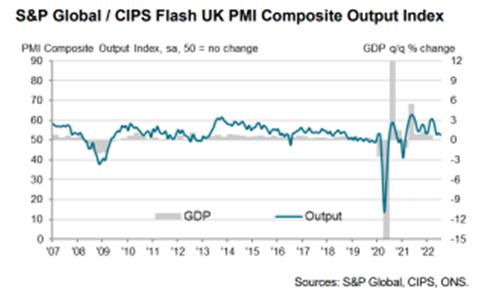
Data also outlined that UK manufacturing output fell below 50 to 49.7, a 26-month low, while UK manufacturing slipped to a 25-month low to 52.2.
While business activity increased for the 17 months running in July, the rate of expansion was at its weakest over this period, reflecting softer demand and output restraints from shortages of materials and demands.
However, input cost inflation “eased considerably” since June, and was at its lowest for 10 months, with many survey respondents noting lower commodity prices and stabilisation in fuel costs.
In terms of outlook, private sector firms remain cautious, despite an improvement from June’s 25-month low, while some service sector firms commented on a longer-term boost from a COVID-19 recovery and improving supply capacity.
Manufacturing companies, however, indicated business optimism eased to a 26-month low in July, and the gloomy economic outlook will contribute to weaker projections for output during the year.
“UK economic growth slowed to a crawl in July, registering the slowest expansion since the lockdowns of early-2021,” said Chirs Williamson, chief business economist at S&P Global Market Intelligence.
“Although not yet in decline, with pent-up demand for vehicles and consumer-oriented services such as travel and tourism helping to sustain growth in July, the PMI is now at a level consistent with just 0.2% GDP growth.”
9.22am: Retail sales slump
Retail sales slipped by 0.1% in June, with the Queen’s Platinum Jubilee unable to provide any respite for the high street.
Data from the Office of National Statistics found clothing and household goods were hit hardest, falling 4.7% and 3.7% respectively.
Jubilee celebrations did, however, lead to a spike in food sales, which climbed 3.1%, although that was the only sector to report an increase.
Silvia Rindone, retail lead at EY said “despite the long Jubilee bank holiday weekend at the start of June, today’s ONS retail sales data shows that consumers are feeling the pinch from the rising cost of living and are becoming more cautious about where and when they are spending.”
According to EY’s future consumer index, 37% of low and middle-income consumers are now only purchasing essentials, compared to 26% in February.
44% of low-income consumers are also expecting their financial situation to worsen in the next 12 months, while that figure is 15% for high-income consumers.
“A fall in consumer confidence is now having a clear impact on retailers’ bottom lines,” said Rindone.
“EY-Parthenon’s profit warning analysis, released earlier this week, shows that half of all profit warnings issued in H1 2022 came from consumer-facing sectors, compared to a third in H1 2021, with most citing rising costs as the reason for the warning.”
“The research underlines the difficulties companies face when trying to pass price increases on to consumers who are reducing their spending levels, which, in turn, is creating tensions along the supply chain and leading to high levels of unsold stock.”
8.58: Quick snapshot
FTSE 100 made marginal gains this Friday, up 5 points to 7,275. Miners led the pack, though the advances of Rio Tinto and Glencore were under 1%.
Retail sales dipped in June, albeit less than experts had expected, reflecting an economy grappling with record food and fuel prices. Clothing and household goods were hit particularly hard, according to data from the ONS.
BT and Warner Bros joint venture has been approved by the UK’s competition watchdog, allowing the creation of a new sports channel. The CMA had opened an investigation over the deal in early June but decided against taking the issue further.
JD Sports said sales remain ahead, with profit for the year expected to be in line with last year’s "record performance.” The fashion retailer said sales in the first five months of the financial year are 5% ahead of the same stage 12 months prior.
Stanley Gibbons (AIM:SGI), which owns the famous stamp emporium at The Strand, unveiled plans to delist from AIM after a turbulent two decades as a public company.
Mirriad Advertising expects to generate £2mln of revenue this year, in line with the last, as it refocuses spending away from the Chinese market. Global turnover was down 50% in the first half.
Supply@Me Capital is to raise over £300,000 through an open offer. Qualifying shareholders will be entitled to subscribe to one open offer share for every 66 held currently.
8.30am: FTSE opens higher
The FTSE 100 received a nudge from Wall Street as it opened the session modestly higher.
The index of UK blue chips added 10 points to 7,280.96, putting it on course for a solidly positive week with a gain so far of 1.7%.
Once more the miners led the pack, though the advances of Rio Tinto and Glencore were under 1%. Insurer Admiral, battered earlier this week by a profit warning, bounced 0.8% in early deals to lead the Footsie.
Poor old Haleon, the consumer health spin-out from GSK and Pfizer, was friendless as it led the losers with a 1.5% fall.
7.06 am: Modest gain predicted
FTSE 100 was forecast to open higher after another good day on Wall Street which was largely due to a revival in the share price of Tesla.
Financial spread betters had Footsie opening up around 10 points after a modest six-point gain to 7,270 on Thursday.
London’s performance underlined once again that it really does take its cue from the US rather than Europe with the ECB’s 0.5% rate rise shrugged off.
A resumption of Nord Stream 1 supplies by Russia also helped the mood, but it is tech in the US that is likely to set the tone today.
Tesla jumped almost 10% as analysts reassessed its latest results.
Heavyweights Amazon and Apple also made good gains ahead of their numbers next week, though the mood was soured a little by Snap, which plunged 25% as it missed a whole stack of estimates.
Revenues, earnings and daily active users all undershot forecasts while average revenue per user fell in its second quarter.
No guidance was forthcoming for the current three months.
"As Meta found out earlier in the year, markets will severely punish richly valued tech stocks at the first sign of trouble, and there is now some risk to the broader equity markets from the FAANGS yet to report," said Jeffery Halley at Oanda.
In the UK, consumer confidence is the focus with numbers due for that and also retail sales.
The latest consensus forecasts for retail sales are for a fall of 0.3% month-on-month in June, but this might be affected by the Jubilee weekend which gave the economy a hearty boost.
Anecdotal evidence from the chains has been mixed.
Some such as Joules, Currey's and Halfords have been suffering but Frasers was rewarded on Thursday with a 25% share price hike after profits jumped and it was upbeat about the coming twelve months.
Insurer Beazley is the largest company due to report on Friday.