
Lithium-ion battery chemistries have quickly come to dominate the electric vehicle and energy storage markets, becoming synonymous with the technology.
There is a plethora of other chemistries that are arguably cheaper, safer, and just as effective as lithium-ion, but to some extent that ship may have already sailed.
Read: Challengers emerge: alternatives to lithium-ion batteries
In this article:
- Green energy commodities here to stay
- Lithium-ion investment; a barrier to other battery chemistries
- Are VRFBs the exception to the lithium monopoly?
Green energy commodities here to stay
Even in the face of a bearish, unstable market, mineral commodities were rapidly rising across the world until very recently, especially those supporting the energy revolution.

While lithium, nickel and cobalt dominate the electric vehicle (EV) battery market, graphite, vanadium and zinc were also on the rise, supplying the structural energy grid storage market and other non-vehicle applications like anti-corrosion coatings on offshore wind turbines.
Graphite has experienced exceptional demand growth over the last few years, exhibiting year-on-year increases of 30%, which is expected to create a ‘massive’ supply shortfall by about 2030:
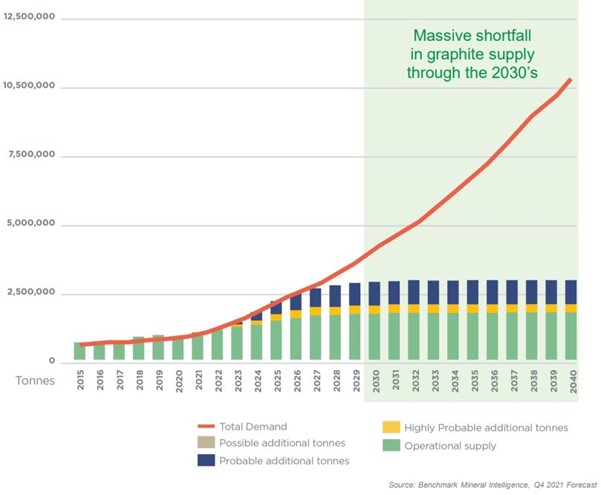
Source: Benchmark Mineral Intelligence via International Graphite
Zinc, too, has been climbing, reaching a 10-year high of US$4498.5 per tonne in April before recession fears put big dents in most commodity pricing.
The World Bank expects zinc to fall to US$2,400 per metric tonne this year, after which a slower period of growth is expected to begin.
The following graph represents the demand for zinc worldwide in 2020 and predicts increasing demand for the metal over the next 10 years. Represented with forecast figures for 2025 and 2030, by renewable energy type:
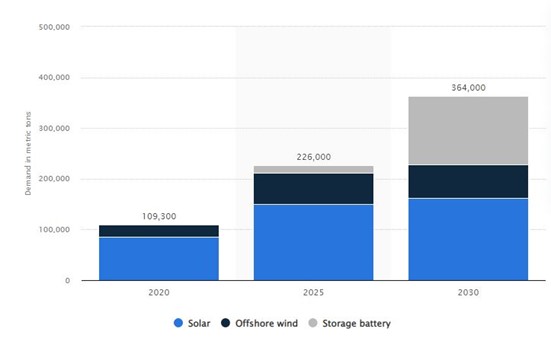
Source: Statista
Similarly, Argus Media predicts demand in the global vanadium redox flow battery (VRFB) sector could rise to at least 9,100 tonnes of vanadium pentoxide (V²O⁵) in 2022 from 3,640 tonnes last year, a 150% increase.
Argus is not alone, with commodity researcher Roskill forecasting a 20.7% average uptick in vanadium used in batteries per year from 2020 to 2029.
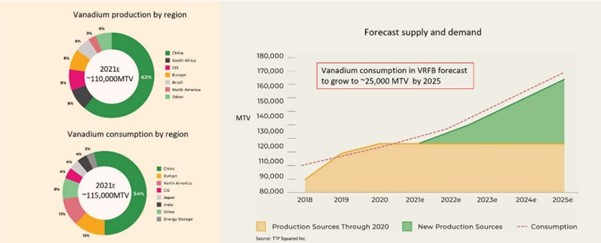
Source: TIP Squared Inc via Australian Vanadium
These spikes in demand are driven by several factors, but the main catalyst is certainly the oncoming energy revolution and the ongoing decarbonisation of the world economy.
There are signs the sharp lift in prices is reaching its zenith; copper, nickel, aluminium, zinc, cobalt and lithium are all down for the month of July, although none have fallen below their prices this time last year.
This may be a symptom of a bearish market, or simply a correction to an overzealous market hike, but either way the demand for battery commodities is here to stay.
Lithium-ion investment; a barrier to other battery chemistries
Europe has quickly become the fastest growing region for new EV lithium-ion-based gigafactories outside of China.
Benchmark Mineral Intelligence’s Lithium-ion Battery Gigafactory Assessment puts Europe’s planned annual capacity at 789.2 gigawatt-hours (GWh) in 2030, a six-fold increase from its 2018 numbers.
That’s enough capacity to create 15 million electric vehicles per year.
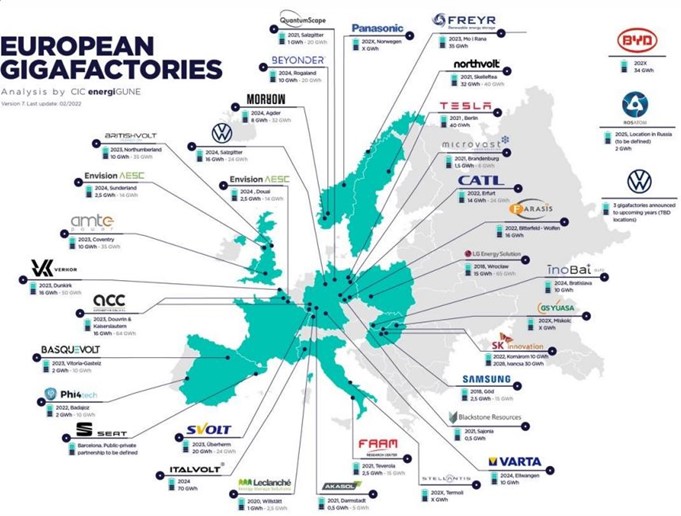
Source: CIC energiGUNE
These gigafactories are designed to manufacture lithium-ion chemistry batteries and represent billions of dollars in private and public investment.
“I do think there's a space in the battery storage industry for probably most technologies,” Altamin managing director Geraint Harris said when asked about alternatives to lithium-ion batteries.
Altamin Ltd (ASX:AZI) is an emerging European metal producer, focused on servicing the next generation of base and battery metal production in the heart of the European Union.
“But most of the factories being built now, certainly across Europe, are tooling up for the battery chemistries of today,” Harris explained.
“It's not that easy when you want to switch technologies, and their paybacks are about 10 years.”
Phil Hearse, founder and executive chair of International Graphite Ltd (ASX:IG6) – a company in the midst of developing a fully-integrated graphite battery product stream on Australian shores – agrees.
“Graphite is not a replacement for lithium, or cobalt or nickel,” Hearse emphasised.
“Solid state carbon (of which graphite is a crystalline form) batteries essentially replace liquid electrolyte with solid material, like a polymer, and have the potential benefit of being lighter than the traditional lithium-ion batteries.
“They're certainly not a replacement in the near future. What confirms that is the massive investments going into gigafactories, particularly in Europe.
“Those investments will take quite a time to recover their capital, and therefore, you must be on the right technology to be making those investments.”
In other words, even if some alternative battery chemistries are arguably superior in performance, the sheer weight of capital already invested in lithium-ion gives it strong momentum in the industry for the next 10 years at least.
Who’s to say what the next big breakthrough will be.
Are VRFBs the exception to the lithium monopoly?
While lithium-ion batteries are the chemistry of choice for electric vehicles, vanadium redox flow batteries or VRFBs are quickly becoming a front-runner for grid stabilisation and structural applications, already installed in dozens of test facilities in several countries.
They offer a particularly attractive storage option compared to lithium-ion in that they are very low maintenance once established and very long lived, expected to last more than 20 years with no degradation over time.
Overall VRFBs boast:
- long battery lives of up to double lithium-ion’s expected longevity;
- low cost and impact from a single, cheap, reusable mineral;
- a high level of modularity that allows for uncomplicated capacity expansions; and
- little to no safety or environmental risks.
Their drawbacks include a large battery footprint and a low kilogram-to-watthour energy density, neither of which are deal breakers outside of the electric vehicle industries.
While lithium-ion technology has reached mega-watt-sized applications, Australian Vanadium Ltd (ASX:AVL) managing director Vincent Algar believes VRFBs are the superior choice in terms of structural grid batteries.
“Where the lithium-ion battery is really good is in that immediate store and recover type of scenario, but it's been pushed into the larger end of the market as a station,” Algar said.
“But it's not the ideal source, at a very large scale it's got safety issues, it's still got degradation and therefore capital issues. In very hot places they need to be cooled, so efficiency drops as well.”
These kinds of environmental factors are particularly relevant given how much of Australia’s mining occurs in hot, arid regions of the country. The kind of environments VRFBs excel in.
“That's one of our big selling points; that if a mine site wants to get to net zero, they can put solar in, they can put wind in, they can put lithium batteries in,” Algar explained.
“But if they want to get to net zero, there's only one way to do that, and that's with the vanadium redox flow battery.”
Australian Vanadium’s subsidiary VSUN has already installed a VRFB at Water Corporation’s innovation hub in Shenton Park, Western Australia, at its Water, Research and Innovation Precinct.
Similar batteries are being tested and installed at sites across Australia, from nickel mines to private properties and research facilities.
The conversation about which batteries should power our grids is particularly relevant these days, given the Australian Energy Regulator is suing the Hornsdale Power Reserve, owner of the Tesla battery array in South Australia, for failing to provide power as promised during a major coal plant failure in 2019.
"It is vital that generators do what they say they can do if we're going to keep the lights on through the market's transition to variable renewable generation," Australian Energy Regulator chairwoman Clare Savage said.
In other words, the quality of the energy storage options we choose now will inform the security of our power supply for years to come.