
Resource Mining Corporation Ltd (ASX:RMI) has intersected a lateritic nickel profile in maiden drilling at its Kabulwanyele Nickel Project in Tanzania.
Nineteen holes totaling 700 metres were drilled in the 1,000-metre reverse circulation (RC) program, with RC chip results returning intercepts of ferruginous layers, saprolite (highly weathered rocks), saprolitic rocks (moderately weathered rocks) and fresh rock.
The thickness of the ferruginous layer combined with saprolite/saprolitic rock layers ranges between 5 to 50 metres, with most of the holes ending in fresh rock.
Samples collected from the drilling program have been dispatched to Nesch Mintek Mwanza for preparation to be shipped to the ALS Chemex South Africa for analysis.
Assays upcoming
Assay results are expected in the next two months.
“We are very pleased to have completed the drill program testing the Kabulwanyele mineralisation," Resource Mining Corporation chairman Asimwe Kabunga said.
"Our Tanzanian in-country team completed the program on time and on budget.
"We look forward to releasing the assay results as soon as they become available."
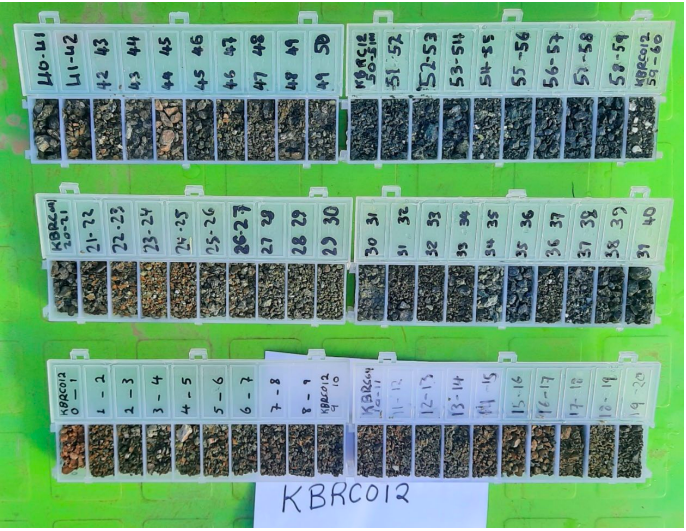
RC chips.
Future program
A gravity survey program will commence in the next two weeks to determine the size and characteristics of the mafic-ulframafic inlier that has been weathered to form the identified nickel laterite anomalies.
The gravity survey has the potential to define further targets associated with primary magmatic sulphide mineralisation, and these can be followed up by a ground electromagnetic (EM) survey to help identify any conducting sulphide layers that may exist at depth.
Any combination of targets identified by the gravity and EM surveys will be drill-tested using deeper diamond drilling.
Exploration at Kabulwanyele to date confirms the potential for lateritic nickel zones as well as an underlying nickel-enriched source within the mafic-ultramafic inlier.
In 2021, the company conducted a sampling program that included a collection of 254 soil samples and 19 rock chip samples from all tenements at the project. The program returned highly encouraging nickel and cobalt results and delineated a nickel-cobalt anomaly with a strike length of 2 kilometres, which is broadly coincident with a historically mapped nickel laterite.
All samples collected returned grades equal to, or exceeding, 500 parts per million (ppm) nickel and 200 ppm cobalt, with grades of up to 1.27% nickel tested in a rock sample, and up to 0.85% nickel in soils.