
Corazon Mining Ltd (ASX:CZN) has used innovative geochemical studies undertaken by the University of Tasmania to identify a new target area for a potential porphyry copper deposit at the Mt Gilmore Project in northern New South Wales.
The new target area with a signature similar to known large porphyry deposits has been generated from initial results of a mineral chemistry vectoring study.
Based on the positive results generated by the university Corazon plans to undertake a new phase of targeted fieldwork at the Mt Gilmore Project.
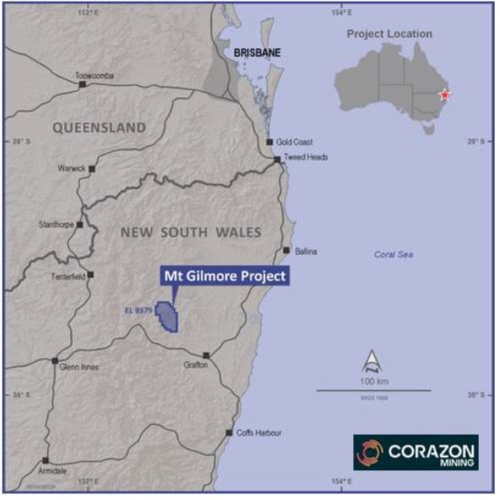
Mt Gilmore Project location.
Why the studies?
The Mt Gilmore Project is within the New England Orogen of northeastern NSW.
Geochemical and geophysical surveys completed by the company have indicated the potential for concealed intrusion-related or porphyry copper-gold hydrothermal systems.
However, identifying precise drill targets has been difficult due to the size of the geochemical anomalies (ie main target area of ~8 x 2 kilometres), poor surface exposure and lack of historical drilling.
There has been significant research undertaken in recent years devoted to mineral chemistry studies to assist in the exploration for blind mineral deposits.
Work by the Centre for Ore Deposit and Earth Sciences (CODES) at the University of Tasmania has included porphyry vectoring and fertility tools (PVFTs), which use the chemical compositions of hydrothermal minerals to predict the likely direction and distance to mineralised centres and the potential metal endowment of a mineral district.
Positive early results
Studies completed by CODES on Mt Gilmore rock and drill core samples have delivered positive early results, which Corazon believes support the project’s prospectivity and strong porphyry copper potential.
This work shows that the Mt Gilmore copper-gold-cobalt trend has a complex hydrothermal history and geochemical characteristics particular to known large porphyry copper deposits.
Corazon said the results were extremely encouraging and that additional mineral studies and geophysics would assist the definition of targets expected to be easily testable with drilling.
It is believed that with additional Mineral Chemistry Vectoring Studies from rock samples located more broadly throughout the project, the heat source causing the porphyry copper deposit(s) geochemical signature, may be defined.
What comes next?
The company plans to begin its next phase of exploration at Mt Gilmore next month.
This will include surface rock-chip sampling for detailed Mineral Chemistry Vectoring Studies and geophysical surveys (possibly gravity and IP), initially targeting the Gordonbrook Hill prospect.
This low-impact exploration is expected to be completed over the next three to four months, subject to availability of geophysical contractors.