
BMEX Gold Inc (TSX-V:BMEX) has revealed the final interpretation of a ground Fixed Loop Transient Electro Magnetic (EM) survey performed over its Dunlop Bay property in the prolific Abitibi region of Québec.
The Vancouver-based mining exploration company explained that the survey hoped to define drilling targets in the vicinity of the Dunlop Bay Ouest showing, which is also known as the Ghislau showing. Three conductivity anomalies - ANO1, ANO2 and ANO3 - were identified, forming an east-north-east trending conductive corridor, said the company.
In a statement, BMEX Gold president Robert Pryde said: "The results from the FL-TDEM survey are very encouraging as they suggest the continuity of the known Dunlop Bay Ouest showing westward. Amongst the three anomalies, ANO1 and ANO2 are strong from early to late time channels and have modelled plates with high conductance which might reflect the presence of massive sulphide bodies.”
READ: BMEX Gold discovers Luxor gold zone at King Tut and announces its 2022 exploration program
He added: “ANO1 was never tested by drilling. I am pleased to announce that this zone will be further investigated during our field program starting in the next few weeks. In addition to these areas, our previous data compilation and analysis of historical work has identified several high-grade gold targets as well as gold rich massive sulphide targets on the Dunlop property."
BMEX has engaged Laurentia Exploration to complete a field program at the Dunlop Bay property. The company said the program will start in July with the following goals:
- Find the continuity of existing mineralization;
- Enhance the understanding of the various structural and geological controls over the known occurrences; and
- Discover new showings as recent data compilation work has defined several structural trends related to the known Dunlop Bay showing, that need to be confirmed on the field.
The company noted the field program will focus on confirming, locating and understanding the systems in order to generate drill targets that will be tested by a 3,000-meter program scheduled for fall 2022.
In addition, data compilation has also identified high grade surface gold mineralization including the Bella where historical grab samples returned up to 273.71 grams per ton (g/t) gold (Au) and Omela veins where historical grab samples returned up to 14.48 g/t Au). Minimal historical work has been completed on these targets and they have not been drilled, the company said.
In addition, the Mont Laurier Est showing extension on BMEX ground will also be investigated during the field work season, the company said. Indeed, a recent re-interpretation of historical prospection maps and recent detailed imagery has revealed that copper-gold-silver rich massive sulphides can be found in this area.
Finally, systematic outcrop description and mineralization sampling will be undertaken on the rest of the property, and especially around the Baie Dunlop showing to confirm the above-mentioned structural model.
BMEX’s Dunlop Bay project consists of 76 mineral claims that cover 4,226 hectares.
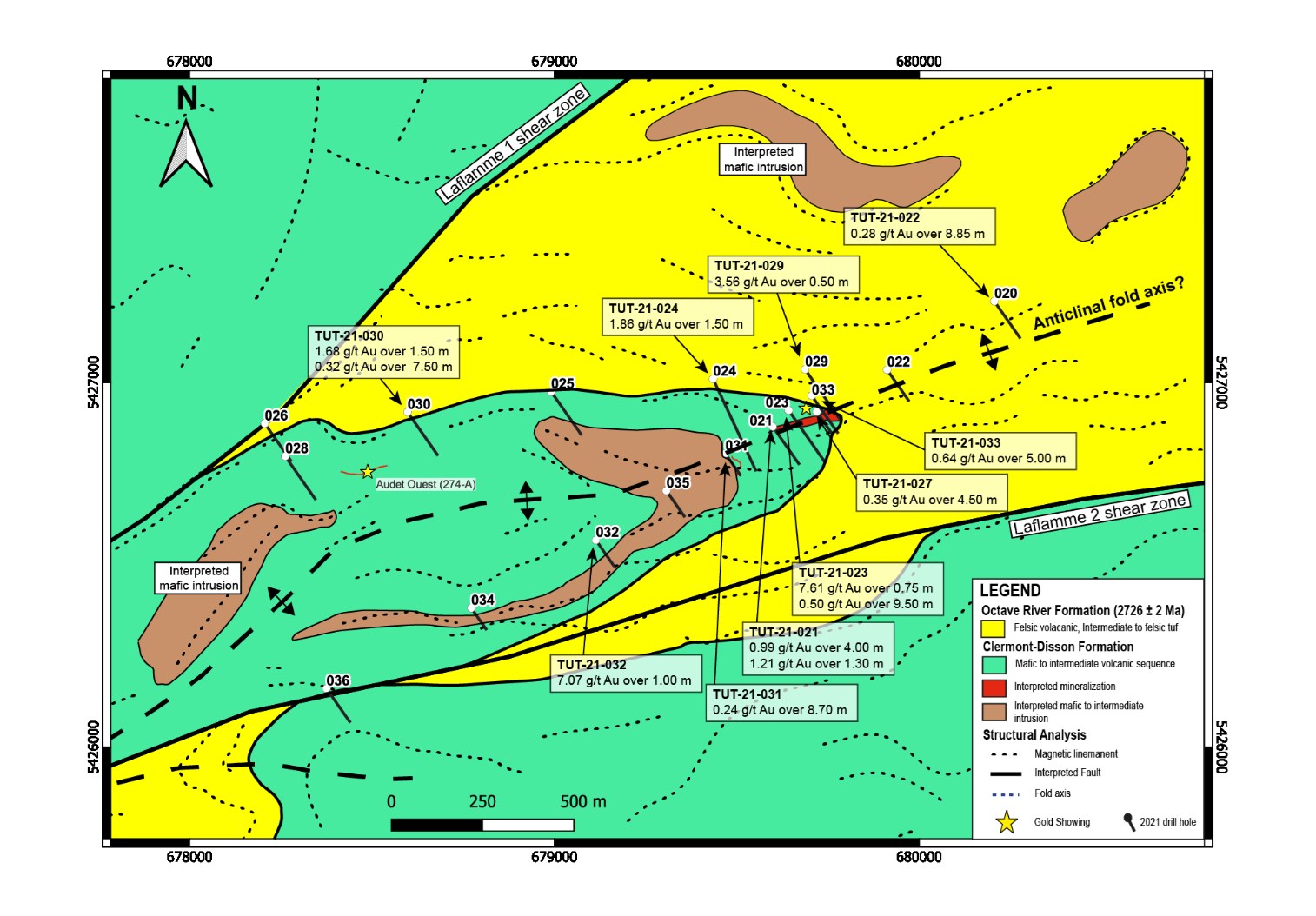
Meanwhile, BMEX’s King Tut project also received an adjusted geological and structural interpretation, based on its late 2021 drilling campaign. A major fold hinge seems to control the location of the heart of Tut gold system; this hinge has not been drilled to the west of the known showing, said the company.
Other potential fold axis' were also interpreted on King Tut, said BMEX, while noting that confirming these structural theories will require follow up field work to begin later this summer.
Contact the author Uttara Choudhury at uttara@proactiveinvestors.com
Follow her on Twitter: @UttaraProactive