
Strickland Metals Ltd (ASX:STK) is trading higher after delivering encouraging drilling results from Millrose Gold Project on the northeast flank of the Yandal Belt in Western Australia.
The drilling at the 100%-owned project has returned broad high-grade oxide gold results and a number of new high-grade zones.
Assays from 22 reverse circulation (RC) and 13 diamond drill holes produced strong results including:
- 5 metres at 11.5 g/t gold from 68 metres and 65 metres at 4.4 g/t from 95 metres including 3 metres at 20.2 g/t and 3 metres at 33.5 g/t;
- 10 metres at 13 g/t from 66 metres;
- 4 metres at 9.8 g/t from 8 metres; and
- 7 metres at 2.4 g/t from 68 metres
Three new zones of high-grade mineralisation were also uncovered in the initial RC and diamond drilling targeting fresh rock intersections along strike from the existing Millrose resource. These require further drilling to delineate the size and scale of the higher-grade units.
Highlights from the initial drilling include:
- Millrose Central – 25 metres at 1.0 g/t gold from 61 metres and 46 metres at 1.0 g/t from 104 metres;
- Millrose North – 8 metres at 4.0 g/t from 104 metres; and
- Millrose South – 21 metres at 1.0 g/t from 86 metres.
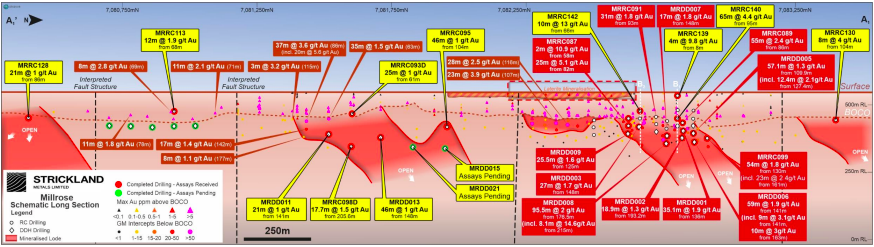
Long section of the Millrose gold project, highlighting the +20 gram x metre (GM), (red) north plunging higher grade lodes.
“Large potential scale”
“We’re extremely pleased to provide further excellent results from our flagship Millrose gold project,” said CEO Andrew Bray.
“The oxide results continue to surprise to the upside both in terms of width and grade, while also contributing to a strong economic case around the development of Millrose.
"RC hole MRRC140 (65 metres at 4.4 g/t gold from 95 metres) was drilled directly up dip from the previously reported MRDD008 (95 metres at 2.0 g/t gold from 176.5 metres, including 8 metres at 14.6 g/t gold from 215 metres), which extended mineralisation beneath the current mineral resource.
“Wide spaced (120 metres) diamond and RC drilling has also delineated three new high-grade zones of mineralisation along strike.
"The Millrose Central zone appears to be about 350 metres in strike with the contact zone extending to roughly 30 metres true width.
"Drill rigs will return in due course with a view to locating higher grade lodes and subsequently completing a mineral resource drill out.
“Equally exciting is that mineralisation is just beginning to open up in the north, with drilling intersecting the start of another potential dilation zone (MRRC130: 8 metres at 4.0 g/t gold from 104 metres).
"Gold mineralisation is also open to the south, with the southernmost hole (drilled to date), returning 21 metres at 1.0 g/t gold from 86 metres (MRRC128).
“These sets of results demonstrate the large potential scale of the Millrose system, particularly in light of the fact we have only drilled approximately one-quarter of the mineralised shear structure to date.
"The drill rigs will continue systematically testing the shear structure to the north and south to fully delineate the size and scale of the Millrose gold system, before returning to undertake closer spaced infill drilling.”
New zones identified
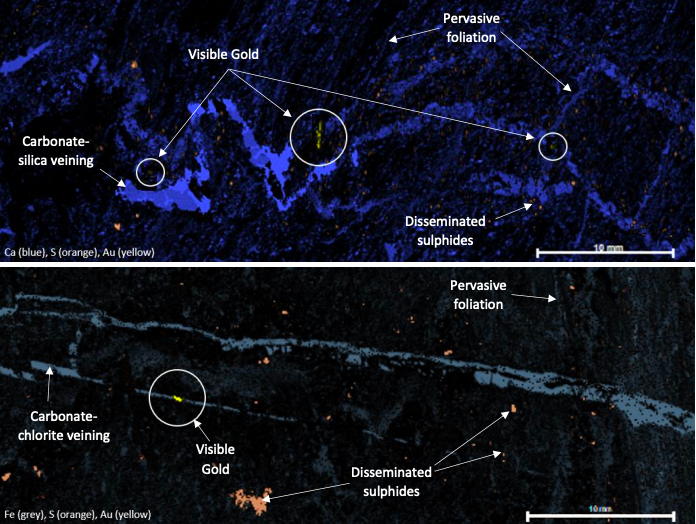
Micro-XRF elemental imagery showing free gold.
Two sets of shear structures are understood to control the mineralisation at Millrose.
To understand the main controls on gold mineralisation, Strickland undertook micro-XRF scanning of core samples across Millrose to map the relationship between gold, alteration, structure and geochemistry.
This technique scanned a 4 by 2 centimetres wide piece of core to map the various elements present. Several samples from diamond holes in Millrose North and several samples from Millrose Central were analysed as part of this process.
Preliminary results show that gold is present in multiple styles, spanning both shear structures.
Investors have welcomed the results, sending shares as much as 14.82% higher this morning to $0.062.