
Great Boulder Resources Ltd (ASX:GBR) has further confirmed the golden potential of Mulga Bill within the Side Well Gold Project in Western Australia with the latest diamond drill assays returning up to 5.9 metres at 39.37 g/t gold from 84.3 metres including 3.6 metres at 63.79 g/t from 85.4 metres.
This result from hole 22MBDD005, described by GBR as “sensational”, verifies the down dip continuity of the original Mulga Bill discovery hole that returned 3 metres at 34.54 g/t from 32 metres.
The company has received assays from the final diamond holes drilled in April 2022 at Mulga Bill with another strong result being 1-metre at 12.25 g/t from 224 metres.
GBR shares are 15.07% higher in early trading at $0.084.
Aircore also delivers
Aircore drilling at Side Well is also returning positive results that support the definition of targets for follow-up reverse circulation (RC) drilling.
Best results are 3 metres at 4.32 g/t gold from 47 metres at Mulga Bill and 1-metre at 8.51 g/t from 60 metres at Loaded Dog.
“Sensational result”
Great Boulder’s managing director Andrew Paterson said about the diamond drill assays: “This sensational result is in a shallower part of Mulga Bill, on the same section as our first high-grade intersection early last year.
“The intersection is within the upper part of the weathering profile below the base of gold depletion, so there is likely to be a component of supergene enrichment in the gold grade.
"The significance of this result is that it supports our geological interpretation in that area, which has changed significantly since the first holes were drilled.
"It is also significant that the hole intersected a thicker zone of very high-grade mineralisation compared to the narrower intersections reported in earlier diamond holes.”
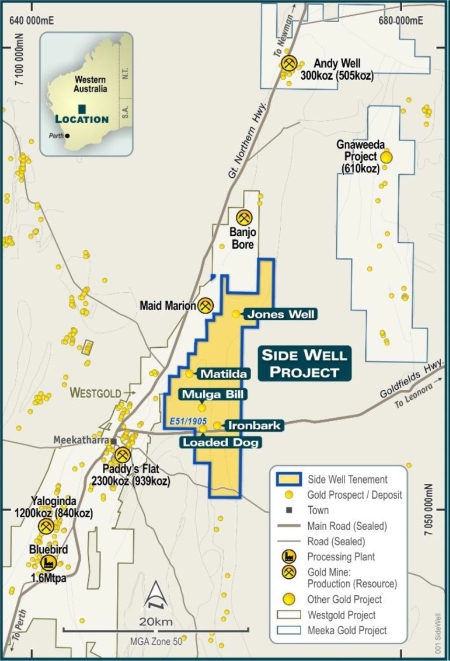
The Side Well Gold Project is near Meekatharra in Western Australia.
Loaded Dog returns
Another result of note from the aircore drilling at Mulga Bill is 2 metres at 1.07 g/t gold from 93 metres while Loaded Dog also returned:
- 3 metres at 1.82 g/t from 45 metres;
- 4 metres at 1.63 g/t from 76 metres; and
- 4 metres at 1.16 g/t from 72 metres.
Aircore results to date provide further encouragement within gaps in previous drill coverage along the 6-kilometre-long Mulga Bill footprint while the Loaded Dog results add definition.
The 4 metres at 1.63 g/t result demonstrates potential for additional mineralisation further west, as it comes from the westernmost hole on that line.
The company is awaiting results from another 21 aircore holes and these are expected in the coming weeks.
RC drilling continues
RC drilling is making good progress at the southern end of the Mulga Bill corridor and at the nearby Ironbark prospect, with initial assays expected in August.
“RC drilling has been progressing well since the end of June, with holes completed at the southern end of the Mulga Bill trend as well as at Ironbark,” Paterson said.
"We are now drilling continuously rather than on a campaign basis, which means we expect a steady flow of results throughout the rest of the year and into 2023.”
Meanwhile, at the Whiteheads Gold Project, assay results from the 95-hole aircore program completed in June 2022 remain outstanding.
Collaborative research
With reference to GBR's collaborative research project with the CSIRO, Australia’s national science agency, Dr Walid Salama, a senior research scientist at CSIRO Australian Resources Research Centre in Perth, has used a TESCAN TIMA scan on a sample of quartz vein showing visible gold from diamond hole 22MBDD002 to produce a map of mineral species within the sample.
A sub-section of the scan displays a number of sulphide minerals attached to a grain of gold. There are five different bismuth minerals in the sample around the gold, three of which contain copper.
This observation provides a clear explanation for the geochemical correlation between gold, bismuth and copper at Mulga Bill.