
City strategists and analysts are predicting more uncertainty and volatility in coming months, as Prime Minister Boris Johnson promoted loyal cabinet members into key posts after the resignations of Chancellor Rishi Sunak and several other ministers and key aides continued into today.
"The resignations of Sajid Javid and Rishi Sunak likely mark the beginning of the end for PM Boris Johnson. The questions now are when, who and what might it mean for policy," wrote Benjamin Nabarro, a senior strategist at Citi, this morning.
Given the ongoing unrest, the question is how long new chancellor Nadhim Zahawi and co can enjoy their new office, said Rabobank’s head of macro strategy, Elwin de Groot.
"It could mean that the government will come up with popular measures, such as another tax cut, in an effort to regain the confidence of voters and party members," de Groot said.
Express: BORIS FIGHTS ON! DECLARING...I’M NOW FREE TO CUT TAXES #TomorrowsPapersToday pic.twitter.com/FV27cDpYM8
— George Mann ????⚒️???? (@sgfmann) July 5, 2022
This echoes reports from Westminster that suggested the departure of Sunak removed the main obstacle for Johnson to push through such policies, with a 10 Downing Street aide telling Politico that Zahawi would emphasize “not just balancing the books but growing them — we’re looking ahead to a more dynamic plan for growth from the Treasury or driven by the Treasury across all economic departments.”
The pound slumped to a two-year low against the dollar yesterday, hit by both the continuing strength of the greenback, the fallout from the cabinet resignations and the Bank of England’s latest financial stability report, which warned that the economic outlook for the UK and globally has deteriorated.
Sterling has "even underperformed the euro" over the past three months, SaxoBank sales trader Mike Owens noted, with the region coping with its own problems thrown up by the Ukraine war, energy price crisis and a predicted recession.
Although Johnson said today that he will "hang on in there", the odds on his departure have continued to shorten, with senior Tories and political commentators agreeing that his position looks increasingly tenuous.
His time as Prime Minister is not expected to extend beyond the parliamentary summer recess, according to Sporting Index head of trading Neville Burdock.
"We predict he has only two months left in No.10 and won’t be in position when parliament returns after the summer recess on September 4," said Burdock.
Currency analyst Marshall Gittler at BDSwiss said he was "not sure whether [Johnson leaving] is good or bad for GBP.
"In my view his departure would be long-term beneficial for GBP, but in the short term the uncertainty might hurt the currency," said Gittler.
"In particular, could the Bank of England hike rates aggressively while the political world is in flux?
“If the cabinet continues as is then Britain will probably move away from Sunak’s relatively tight fiscal policy toward an easier policy, but it’s not possible to price that into the pound given a) the political uncertainty and b) the pound’s sensitivity to overall risk sentiment.”
Rabobank's De Groot said the movement in the pound "suggests that the British economy might be better off with a new prime minister".
But while Johnson seems unlikely to resign, "the wider parliamentary party seemingly has few reasons to hold off," said Citi's Nabarro.
He believes the party's 1922 Committee will be "more likely than not" to push ahead with a second confidence vote this month, with a Conservative election contest "likely to follow" in July and August.
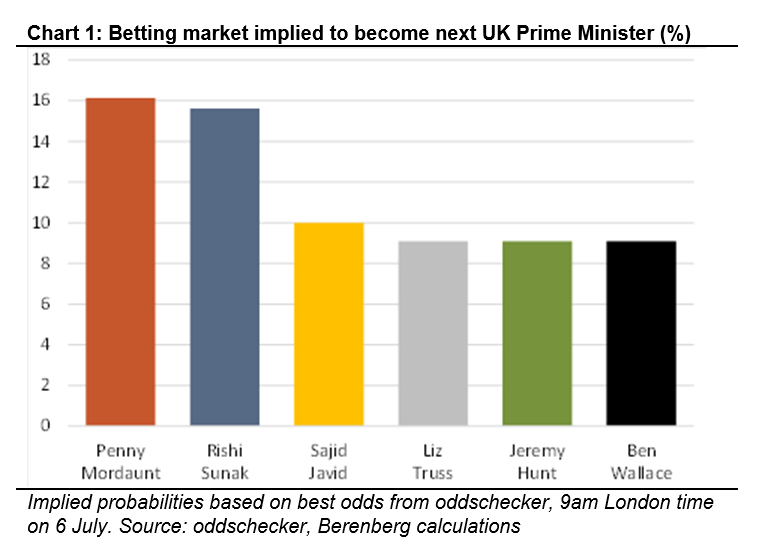
"We expect any subsequent leadership contest to pit the more statist group of Brexiteers (led by Patel, Mordant) against the libertarians (led by Javid, Sunak). On balance, we think the latter are more likely to win out," Nabarro said.
"More fundamentally, the UK remains an economy beset by challenges, but absent a clear strategy. With the Conservative Party divided, we don't expect a leadership contest to deliver a clear path forward."
The next few months in UK politics are difficult to call, said Berenberg senior economist Kallum Pickering.
"If the fight to oust Johnson turns even messier, and it is followed by a noisy leadership contest, increased near-term uncertainty may add further downward pressure to UK risk markets and sterling.
"Furthermore, a Conservative leadership election followed by a snap election during the new leader’s honeymoon phase is not unthinkable – especially if the polls move in their favour.
"While the questions about whether Johnson will finally be out, who may succeed him, and even which party may be running the country next year adds to near-term uncertainty, the UK is set to benefit if Johnson were to be replaced by a more diligent and serious individual."
He added: "Relative to, say, a potential Biden versus Trump presidential election in the US in 2024, the next UK general election and the outlook for economic policy seem positively boring. After some six years of Brexit and Boris, that’s not a bad thing."
For investors, Myron Jobson, senior personal finance analyst at Interactive Investor, said “diversification is the name of the game when it comes to investments – and even more so in a time of geopolitical tensions and rising inflation.
"Think global, think well diversified investment funds and investment trusts as a starting point. These help to spread investment risk across sectors, markets and countries."
He said UK investors have turned away from 'personalities' for the last few months in favour of passive investments and ‘steady as she goes’ capital preservation strategies, according to its most bought investments data.