
- FTSE 100 closes 82 points higher
- US stocks weak ahead of Fed meeting minutes
- Sterling steady although UK prime minster's position looks untenable
4.50pm: Bouncebackability
The FTSE 100 index closed higher on Wednesday, recouping a chunk of the previous session’s drop helped by a fall in the value of sterling, although the UK currency steadied in spite of the uncertainty over the future of UK prime minister Boris Johnson following further junior Cabinet resignations after two big guns quit on Tuesday.
UK blue-chips also ended off their highs as Wall Street stocks made cautious early progress ahead of the release of minutes later today from last month’s Federal Reserve policy meeting.
London's blue-chip index closed 82.30 points, or 1.2% higher at 7,107.77, below the session peak of 7,198.72 but well above the opening low of 7,025.35.
But in New York, around London’s close, the Dow Jones Industrial Average was down 105 points, or 0.3% to 30,862, while the broader S&P 500 index lost 0.4% and the tech-laden Nasdaq Composite shed 0.5%.
Chris Beauchamp, chief market analyst at online trading platform IG commented: “While stocks have avoided sustained falls after Tuesday’s shaky session, the mood remains febrile. The drop in the euro and weakness in yields shows that investors remain very nervous about the economic prospects of the global economy, and the opportunistic bargain hunting in stocks may not have much staying power.”
Beauchamp added: “The British prime minister might be heading rapidly towards his resignation, despite his protestations to the contrary, but the pound seems relatively steady. Losses have been pared back, and while the currency has dropped sharply this looks more like a function of dollar strength, given the similar weakness for the euro against the greenback.
“Boris’ apparently-imminent defenestration might not have much impact, since it is unlikely to provoke a general election. Even if it did, without Jeremy Corbyn to scare investors, markets seem much more sanguine about a change of government than was the case in 2019.”
3.55pm: Scottish Mortgage leads Footsie higher
The prospect of Boris Johnson facing another confidence vote after a day of resignations and recriminations does not seem to be upsetting the equity market unduly.
Recovering from Tuesday's recession blues, the FTSE 100 is heading into the close in positive mood, up 110.98 points or 1.58% at 7136.45.
The pound is a different story however.
The political uncertainty combined with the strength of the dollar has pushed sterling 0.4934% lower to US$1.1889.
Earlier it fell to US$1.877, new low since the early days of the pandemic.
But against the euro it is up 0.294% to €1.1682.
Back with equities, and tech investor Scottish Mortgage Investment Trust PLC (LSE:SMT) is benefiting from the positive mood on the US Nasdaq market, up 6.91%.
Abrdn PLC (LSE:ABDN) has added 5.74% after it unveiled a £300mln share buyback, starting today.
But with worries about recession never far away, the oil price is on the slide again.
Brent crude is down 2.73% to US$99.96 a barrel while West Texas Intermediate is off 3.47% at US$96.05.
So Shell PLC (LSE:SHEL, NYSE:SHEL) is off 0.77% and BP PLC (LSE:BP.) is odwn 0.46%.
3.12pm: US service sector beats forecast
The US service sector has seen growth slip in June, but not by as much as expected.
The USM non-manufacturing PMI came in at 55.3 last month, down from 55.9 but better than the forecast fall to 54.3.
US ISM Non-Mfg PMI Jun: 55.3 (est 54.3; prev 55.9)
- Biz. Activity: 56.1 (est 54.0; prev 54.5)
- Employment: 47.4 (prev 50.2)
- New Orders: 55.6 (prev 57.6)
- Prices Paid: 80.1 (prev 82.1)
— LiveSquawk (@LiveSquawk) July 6, 2022
Following the update the Dow Jones Industrial Average is up 0.25%, the S&P 500 is 0.12% better and the Nasdaq composite has added 0.21%.
3.06pm: Sunak favourite to replace Johnson, says William Hill
It's all over bar the shouting for Boris Johnson, to judge by bookies William Hill.
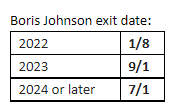
The prime minister leaving this year is just 1/8, with punters turning their attention to who will replace him.
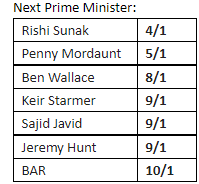
Rishi Sunak's resignation as chancellor on Tuesday has seen him take pole position for the job (although curiously his fellow departee Sajid Javid does not seem as popular.)
William Hill said Penny Mordaunt had headed the market at 6/1 for the last few months, with Sunak back at 9/1.
But now Sunak's odds have nosedived to just 3/1.
Mordaunt is the 4/1 second favourite, while Ben Wallace, Defence Secretary, has been punted into 13/2 from 9/1.
William Hill spokesperson, Tony Kenny, said: “The door to No 10 is creaking open and that’s seen a big shake-up in the next leader betting, with Rishi Sunak the best backed to take over since resigning from his role as Chancellor.
“Sunak is now a 3/1-clear favourite having been as big as 9/1 earlier in the week, while Ben Wallace has also been well-backed in the last few hours.”
2.45pm: Wall Street awaits Fed minutes
US stocks have opened flat as investors held off from making any major moves ahead of the minutes from the Fed’s latest rate-setting meeting being released this afternoon.
At the open, the Dow Jones Industrial Average, the S&P 500 and the Nasdaq Composite were steady at 30,977 points, 3,833 points, and 11,328 points respectively.
Analysts at ING predicted that the Fed minutes would sound hawkish and were set to increasingly fall on deaf investor ears.
“If [Fed chair] Powell’s recent remarks are anything to go by, the tone of the FOMC minutes will cause cognitive dissonance, with markets now openly questioning how far and how long the Fed can tighten policy before having to reverse course,” the analysts wrote in a report.
Back with the excitement in the UK, and the FTSE 100 is holding on to most of its gains, up 117.05 or 1.67% at 7142.52.
2.25pm: Pound continues to slide against the dollar
The turmoil in the UK government, with several MPs in Parliament calling for Boris Johnson to quit and former health secretary Sajid David saying the problem starts at the top, the pound remains under pressure.
As Johnson faces the prospect of another no confidence vote if he does not quit, sterling is down 0.329% against the dollar at US$1.1909 having earlier fallen as low as US$1.1883.
This is the lowest level since 19 March 2020 - the beginning of the pandemic.
Sky's Ed Conway has tweeted a good graphic showing the pound versus dollar over the years.
It's not a pretty sight at the moment:
Since the pound is once again close to a record low against other currencies around the world, perhaps it’s time for a bit of historical perspective.
With that in mind, here’s an annotated history of the pound sterling since the 1960s pic.twitter.com/TyojvD9wQG
— Ed Conway (@EdConwaySky) July 6, 2022
But he believes the current weakness is as much due to the strong dollar as the political chaos over here:
NEW: pound drops beneath $1.19 vs US dollar for the first time since March 2020.
BUT before anyone tries to attribute this to ongoing UK political chaos, this latest fall looks more like a story of dollar strength than sterling weakness.
Still: we’re heading for v v low levels… pic.twitter.com/uqUb03PzkT
— Ed Conway (@EdConwaySky) July 6, 2022
Given sterling is up 0.349% against the euro at €1.1688 at the moment, he has a point.
12.58pm: Trainline leads FTSE 250 risers
The mid-cap index is also moving higher, although at a slightly more relaxed pace than the FTSE 100.
While the blue chip index is up 111,71 points or 1.59% to 7137.18, the more domestically focused FTSE 250 is 1.34% higher at 18,560.74.
Leading the way is Trainline PLC (LSE:TRN), up 21.6% after the rail ticket provider hiked its full-year sales and earnings expectations.
Also moving ahead was discoverIE Group PLC (LSE:DSCV) as the electronics group paid £5mln for circuit board specialist CDT.
11.55am: Wall Street set for downbeat start
US stocks are expected to open lower ahead of the release later of the Federal Open Market Committee minutes from its previous rate-setting meeting.
The Federal Reserve's thoughts about the economy and the path for interest rates will be closely scrutinized as markets brace for the prospect of recession.
Futures for the Dow Jones Industrial Average were trading 0.2% lower pre-market, while those for the broader S&P 500 index were down 0.2% and futures for the tech-laden Nasdaq-100 were off 0.3%.
On the data front, the Fed policy meeting minutes will be the key driver for markets.
While some investors are holding out hope that the second half of the year may prove a little better for equity markets, recession fears have even hit oil prices amid fears that demand for oil will drop off as growth falters. In the meantime, growth fears are helping lift the US dollar.
Elsewhere, officials in Shanghai are mass testing for coronavirus (COVID-19) again following a surge in cases in the past two days, signaling that economic activity in China may slow down again, said Ipek Ozkardeskaya, senior analyst at Swissquote Bank.
Back in the UK the FTSE 100 remains upbeat, climbing 116.49 points or 1.66% to 7141.96.
Meanwhile new UK chancellor Nadhim Zahawi seems to have been talking up the prospects of tax cuts, according to the Time political editor:
Nadhim Zahawi's broadcast round this am is being billed by some in Whitehall as the most expensive in history - if it comes to pass
He strongly hinted that corporation tax rise from 19% to 25% will be reversed - £16bn per year
He also leaned into income tax cut - £5bn a year
— Steven Swinford (@Steven_Swinford) July 6, 2022
Nadhim Zahawi also pledged to honour his commitment to 5.1% pay rise for teachers
If that was repeated across the public sector we'd be talking in the region £12-£15bn
Worth remembering that spending review only factored in pay rises of 3% across the board
— Steven Swinford (@Steven_Swinford) July 6, 2022
10.52am: Pound dips again against the dollar despite rate rise talk
Bank of England bods have been out and about today and hinting at further UK rate rises.
The Bank's chief economist Huw Pill said in a speech at a Global Banking and Finance conference in London: "An immediate issue for monetary policy makers is whether the pace of policy tightening now needs to change.
"In May, inflation reached 9.1%.The [Monetary Policy Committee] forecasts a further rise to around 11% later in the year, once rises in international commodity prices stemming from Russia’s invasion of Ukraine pass through to UK utility and food prices...
"We recognise the hardship associated with elevated inflation rates. For those who spend a higher proportion of their income on energy and food – unfortunately, a group particularly numerous among the less well off – recent price rises have imposed a significant squeeze on their real incomes. These are difficult times for many people...
"It is essential we bring inflation back down to target, so as to reduce the uncertainties facing households and allow firms to plan for the future."
But he added later: "As the patterns of individual votes on Bank Rate in recent months reveals, unanimity [on the MPC] about the short-term interest rate outlook no longer exists."
Ealier deputy governor Sir Jon Cunliffe told the Today the Bank would act "forcefully" to make sure high inflation did not become the new normal.
He said: "People can have confidence that we will act to make sure that that doesn't happen."
The comments have done little for the pound, which has dipped again against the dollar and is down 0.028% to US$1.1945.
Susannah Streeter, senior investment and markets analyst at Hargreaves Lansdown, said ‘’Turmoil in Westminster is adding another layer to the uncertainty hanging over the prospects for the UK economy amid a darkening global outlook. The pound has plummeted to levels not seen since March 2020 in the early days of the pandemic.
"However, the flight to the dollar accounts for much of the slide in sterling we’ve seen over the last 24 hours as investors take fright about the worries about recessions hitting.
"Boris Johnson’s position has appeared precarious for months, so the ministerial desertions haven’t moved the dial that much. Immediately after news of the resignations came through, the pound rose ever so slightly against the dollar. This was a subtle reaction but it indicates that a government without Boris Johnson at the helm is not being factored in as a big detriment to the UK economy."
Meanwhile the FTSE 100 remains in positive territory, albeit off its best levels.
It is up 108.39 points or 1.54% at 7133.86, having earlier climbed as high as 7198.
9.59am: Housebuilding activity falls for first time in two years
UK construction firms saw a slowdown in activity in June to the weakest growth for nine months.
And worries about the near-term economic outlook led to a sharp decline in business expectations for the year ahead, according to the latest S&P Global/CIPS report.
The construction purchasing managers' index came in a 52.6 in June, down from 56.4 the previous month.
While that still signals growth, it was the slowest rate of expansiion since September 2021.
Civil engineering was the most resilient sub-sector in June while house building was the weakest-performing area of construction activity for the fourth month running. Moreover, the latest index reading of 49.3 signalled an overall downturn in residential work for the first time since May 2020.
Latest #PMI data pointed to a slowdown in UK construction activity with the #PMI at 52.6 (May: 56.4), it's lowest since September 2021. Housing activity fell for the first time in over 2 years. Read more: https://t.co/HOKem9CWYG pic.twitter.com/JBpmuACv9d
— S&P Global PMI™ (@SPGlobalPMI) July 6, 2022
Tim Moore, economics director at S&P Global said: "The gloomy UK business outlook and worsening consumer demand due to the cost of living crisis combined to put the brakes on construction growth in June. Commercial construction saw a considerable loss of momentum as clients exercised greater caution on new spending, while long-term infrastructure projects ensured a relatively resilient trend for civil engineering activity...
"Construction companies appear braced for a difficult second half of the year as new order growth and business activity expectations fell again in June, reflecting inflation concerns, higher interest rates and less favourable domestic economic conditions. Measured overall, the degree of optimism across the construction sector is now the lowest seen since July 2020."
Meanwhile in the eurozone, construction activity continued to fall in June, with the PMI down from 49.2 in May to 47.0, its lowest since February 2021.
There were contractions in housing, commercial and civil engineering work.
Further risk of #eurozone recession as #construction output and orders fall at increased rates in June #PMI #EUR #ECB.
Full release at https://t.co/Gvdn8uaXYe pic.twitter.com/rF7tzseEEg
— Chris Williamson (@WilliamsonChris) July 6, 2022

9.35am: No clear path forward - Citi
A Tory leadership contest is likely but is unlikely to deliver a clear path out of the current economic mess.
Benjamin Nabarro, a senior strategist at Citi, wrote this morning: "The resignations of Sajid Javid and Rishi Sunak likely mark the beginning of the end for
PM Boris Johnson.
"The questions now are when, who and what might it mean for policy?
"While Johnson seems unlikely to resign, the wider parliamentary party seemingly has few reasons to hold off. We think it more likely than not the 1922 Committee executive push ahead with a second confidence vote next week. A Conservative election contest is likely to follow through July and August.
"We expect any subsequent leadership contest to pit the more statist group of Brexiteers (led by Patel, Mordant) against the libertarians (led by Javid, Sunak). On balance, we think the latter are more likely to win out.
"More fundamentally, the UK remains an economy beset by challenges, but absent a clear strategy. With the Conservative Party divided, we don't expect a leadership contest to deliver a clear path forward."
Meanwhile Andrew Sentance, senior adviser at Cambridge Econometrics, is not impress with what he has heard of the new Cabinet's plans:
According to media reports this morning, the new UK plan to deal with the “cost of living crisis” will be to boost public spending & cut taxes. Last time this was tried in the mid-70s, inflation rose even higher - to record levels. Expect the same if this policy is pursued again.
— Andrew Sentance (@asentance) July 6, 2022
9.08am: Oil price recovers
A slump in the price of oil was one reason for the big fall in the Footsie yesterday, packed as it is with commodity companies.
But with news that Oslo has stepped in to halt a strike by Norwegian oil and gas workers, crude is heading higher again.
Brent is up 2.63% at US$105.47 a barrel while West Texas Intermediate - which fell below US$100 on Tuesday - is up 2.07% at US$101.46.
This is helping support the market, with the FTSE 100 up 142.41 points or 2.03% at 7167.88.
The latest figures from the continent have also proved a bright spot.
Neil Wilson at Markets.com said: "Positive German factory order numbers helped sentiment but the mood is febrile and recession fears are not less today than they were yesterday."
8.25am: Abrdn leads the way
The risers in the leading index are across the board, as investors dive in after Tuesday's falls.
Abrdn PLC (LSE:ABDN) is top of the pile, up 7.25% after it unveiled a £300mln share buyback programme, with the first phase of £150mln starting today.
Also higher are JD Sports Fashion PLC (LSE:JD.), up 3.8% and Ocado Group PLC (LSE:OCDO), 3.58% higher.
Tech investor Scottish Mortgage Investment Trust PLC (LSE:SMT) has added 3.11% after the revival on the US Nasdaq market.
And the FTSE 100 continues to climb, up 152.53 points or 2.17% at 7178.
Richard Hunter, head of markets at interactive investor, said: "The UK’s premier index staged a rebound in early exchanges, with gains broadly based and with the more beaten down stocks enjoying some relief.
"This comes after a punishing session yesterday which wiped almost 3% from the index as energy stocks felt the full force of the selling pressure. This was enough to add to the damage which has been done over recent weeks, and the FTSE100 is now down by 3.5% in the year to date, despite the early bounce today...
"The imminent reporting season on both sides of the pond now takes on additional significance as investors attempt to gauge not only the current performance of corporates on the ground, but also outlook and guidance comments from companies given the murky waters of growth and economic prospects.”
8.14am: Markets shake off recession blues - for the moment
Leading shares are heading higher in early trading despite the UK government seemingly on a knife edge.
After falling nearly 3% on Tuesday, the FTSE 100 is up 101.56 points or 1.45% at 7127.03.
Sentiment has been helped by a revival on Wall Street after global markets had a major case of the recession blues earller.
But the markets are nothing if not volatile at the moment.
Naeem Aslam, chief market analyst at Avatrade, said: "The mood among investors and traders remains pessimistic as the threat of an economic downturn lingers. Yesterday, we saw an interesting price action for the US stock markets as the stock indices plunged at the beginning of the session but then towards the market close, we saw an enormous recovery.
"Today’s price action is going to focus on two things: firstly, the political crisis in the UK, which began yesterday with the resignation of [some] of Johnson’s top team members.
"Secondly, traders will be looking at the [Federal Reserve] minutes, which will be released later today. The expectations are that the Fed will confirm their hawkish stance, and this means more interest rate hikes and the attitude of whatever it takes to bring inflation lower as Jerome Powell said previously that the biggest risk for the US is failing to restore price stability."
The pound slumped to a two year low against the dollar yesterday. It was hit by both the continuing strength of the greenback - thanks to the Fed's hawkish rate policy - and the fallout from the UK cabinet resignations.
But it has edged up 0.07% to US$1.1957 this morning although it is down 0.05% against the euro at €1.1642.
Elsewhere online electrical retailer AO World PLC (LSE:AO.) has recovered some of its recent falls, up 9.57% to 51.5p after it said it planned to raise around £40mln at 43p a share, including a retail offer, to boost its balance sheet.
The firm's shares have been under pressure on cash concerns, with one third party credit insurer saying it had rebased its cover.
7.18am: Footsie tipped to rise despite UK political turmoil
FTSE 100’s rollercoaster week is set to continue with financial spread bet firms predicting a rise of around 50 points at the start.
All eyes today will be on the latest developments at Number 10 where PM Boris Johnson had to find a new Chancellor and Health Secretary quickly after both Rishi Sunak and Sajid Javid resigned last night.
According to the reports yesterday it was differences over the economy that caused Sunak to step down, with suggestions that Johnson’s plans to tax less and spend the country’s way out of its current problems will be easier to implement without the Chancellor advising the opposite.
New chancellor Nadhim Zahawi said this morning his aims were fiscal control, tax cuts and getting inflation down.
In last night's emergency reshuffle Steve Barclay was appointed healh secretary to replace Javid.
Elsewhere, it was a case of more recession worries, though after a major wobble at the start in the US the S& P and Nasdaq finished higher.
Jeffery Halley at Oanda noted: “In the US, equity markets opened much lower, but US bond yields outdid them, slumping on recession nerves overnight and sending the US 10-year down to 2.805%, leaving the 2-year 10-year yield curve teetering on inversion.
“The still-richly-valued growth stocks of the Nasdaq are the most interest-rate sensitive on US markets, and small moves in the risk-free discount rate have outsized price impacts in these environments.”
Asian markets were heading lower towards the close.
In the UK so far, white-collar recruiter Robert Walters announced a record quarter to June with net fee income up by 26% at £112mln with half-year fees also a new high.
All its four regions saw good growth with the UK the laggard, though it still posted a 13% rise to £20.4mln.
Europe was up 35%, Asia 22% but America and the Middle East did best with a gain of 56% albeit from a smaller base than the other three arms.
Profits for the year will be slightly more than previously expected due to the strong first half, the company added.