
Valor Resources Ltd (ASX:VAL) has completed an extensive data review on the Surprise Creek Project northwest of the Athabasca Basin in Canada, which returned high-grade uranium drill results of 2.1 metres at 4.37%.
A significant number of very prospective targets were also uncovered, which will be followed up with reconnaissance fieldwork in the coming weeks to validate and improve geological understanding of the exploration model.
Other significant historical drilling results at Surprise Creek Fault target include 1.5 metres at 0.1% U3O8, 0.43 metres at 0.49% and 0.15 metres at 0.83%.
The Surprise Creek Fault target comprises a uranium geochemical anomaly of more than 25 ppm uranium in soils over 500 metres in strike length and including rock chips of up to 6.37% U3O8, associated with a north-northwest striking fault system. The soil geochemical anomaly was partially drill tested and remains open in several directions.

“Great potential”
“The historical data review has highlighted some exciting uranium and copper targets with the high-grade uranium drill results of 2.1 metres at 4.37% U3O8 at Surprise Creek Fault being most noteworthy,” said Valor executive chairman George Bauk.
“The historical results and lack of modern exploration for over 20 years suggests there is great potential in this area.
“Based on the historical data review, the company increased its land position at the project to the southwest by pegging a further 11 square kilometres. Given the copper mineralisation trend at the southwest part of the property, we thought it was only logical to peg the open ground.
“We are continuing to work through the historical exploration data from our eight projects in the Athabasca Basin and will release further results of these reviews in the coming months.
"The exploration team will commence on-ground work at the Cluff Lake and Surprise Creek projects in July and results of the recently completed airborne gravity surveys at the Cluff Lake, Hook Lake and Hidden Bay projects will be finalised during the current quarter,” he added.
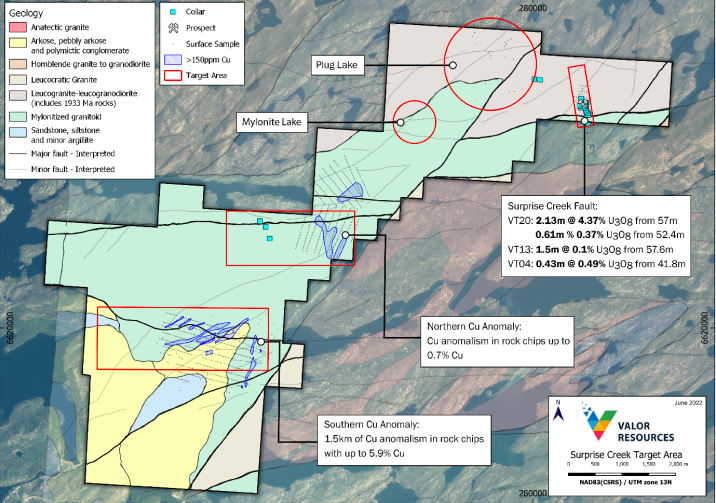
Surprise Creek Project - target areas.
Historical targets
Data from the 1950s through to the late 1970s were used in the review as little uranium or copper exploration has been carried out in the area since then.
All diamond drill holes have been reported and surface samples reported have been filtered based on soil samples of more than 2 ppm uranium, rock chip/boulder and unknown sample types of more than 5 ppm uranium.
The company plans to carry out on-ground work to verify some aspects of the historical sampling before advancing targets to the next stage.
History lessons
The most significant exploration at the Surprise Creek Fault target was conducted by Van-Tor Resources, whic completed 27 diamond holes in 1968 to test an area of uranium mineralisation at surface.
Drilling by Van-Tor Resources returned several significant intercepts including:
- 2.1 metres at 4.37% U3O8 from 57 metres including 0.9 metres at 7.5% and 0.61 metres at 0.37% from 52.4 metres;
- 1.5 metres at 0.1% from 57.6 metres;
- 0.15 metres at 0.1% from 4.8 metres;
- 0.43 metres at 0.49% from 41.7 metres; and
- 0.15 metres at 0.83% from 29.6 metres
Lake targets
Plug Lake target contains multiple occurrences of basement-hosted uranium mineralisation hosted within W-NW striking veins or structures. Mineralisation is known to be spatially associated with amphibolite lenses. Rock grab samples of up to 5,004ppm uranium have been reported from this area.
The Mylonite Lake target consists of an occurrence of basement-hosted uranium mineralisation within a structurally complex zone interpreted from geophysics and aerial photography. The interpreted intersection of E and NE-striking faults in the area is a structural setting that is considered favourable for hosting uranium mineralisation
Copper targets
Widespread geochemical soil and rock chip sampling programs conducted in the 1970s in the west and southwest of the project area uncovered consistent and significant copper mineralisation in two different areas.
The southern copper anomaly is the most significant with rock chips up to 5.9% copper and soil samples assaying up to 3,300 ppm copper. The +150 ppm copper anomaly in the south can be traced over 1.5 kilometres and remains open beyond the survey boundaries.
The northern copper anomaly contains rock chips up to 0.7% copper and soil samples up to 340 ppm copper. Follow-up drilling was recommended but never completed.
The Surprise Creek Project is in the Archean Zemlak Domain within the Rae Province, northwest of the Athabasca Basin, and directly abuts the Beaverlodge Domain, which hosts many of the district’s uranium deposits.