
- FTSE 100 closes down over 200 points
- US stocks plunge on return after Independence Day
- Banks fall on call for higher reserves
4.50pm: State of decline
The FTSE 100 index closed sharply lower on Tuesday as Wall Street returned from the US Independence Day break in dismal fashion amid ongoing global recession worries ahead of US non-farm payrolls data due on Friday.
The UK blue-chip index closed down 207.18 points, or 2.9% at 7,025.47, just above the session low of 7,016.78 and well below the opening peak of 7,260.30.
In New York, around London’s close, the Dow Jones Industrial Average had dropped 576 points, or 1.9% to 30,520, while the broader S&P 500 index shed 1.7% and the tech-laden Nasdaq Composite lost 0.6%.
Chris Beauchamp, chief market analyst at online trading platform IG commented: “Once again, the return of US traders from their holiday has dealt the death blow to hopes of a European market rally that lasts longer than about 24 hours. This recurrence of selling has put indices across the board into the red, as growth and inflation fears return right on cue. Normally July provides some welcome relief to markets after a choppy June, but so far the instinct to sell any bounce, no matter how small, remains all-encompassing.”
He added: “The FTSE 100 looked like the most solid performer coming in to today’s session, but small gains for some names have been outdone by the huge declines in commodities. As supply concerns give way to seemingly-inescapable recession worries, oil and mining stocks have gone deep into the red, a situation that has been replicated on Wall Street too.”
3.45pm: Footsie heading for biggest daily fall for nearly three weeks
Leading shares remain sharply lower on growing fears of recession.
The FTSE 100 is down 175.92 points or 2.43% at 7056.73, albeit just off its low of the day of 7042.
This would be the biggest one-day percentage fall since June 16, 2022.
Mining shares are proving a particular drag on concerns that a slowdown will hit demand for commodities.
For the same reason oil is on the slide, with Brent crude down 5.21% to US$107.59 and West Texas Intermediate 4.31% lower at US$102.76.
(Don't hold your breath waiting for that to be reflected in pump prices, however).
So Glencore PLC (LSE:GLEN) is down 8.05%, Antofagasta PLC (LSE:ANTO) has fallen 7.27% and Anglo American PLC (LSE:AAL) is off 7.03%.
Among the oil companies, Shell PLC (LSE:SHEL, NYSE:SHEL) has slid 6.67% and BP PLC (LSE:BP.) has dropped 6.13%.
Also heading lower on fears a downturn will hit its aeroengine business is Rolls-Royce Holdings PLC (LSE:RR.), 7.67% lower.
3.10pm: US factor orders rise
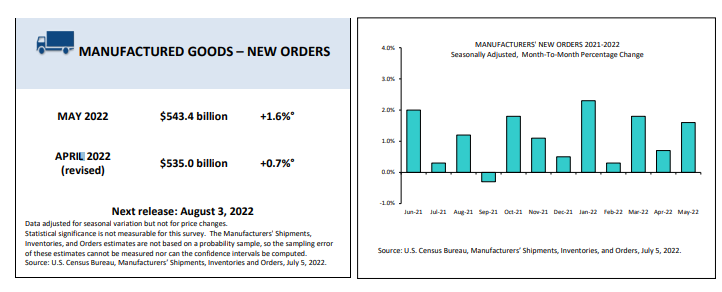
US factory orders have come in much stronger than expected, which of course will only add to the idea that the Federal Reserve could perhaps hike rates by more than is currently expected.
They rose by 1.6% in May, up from 0.7% the previous month and better than the expected fall to 0.5%.
Durable Goods Orders (M/M) May F: 0.8% (est 0.7%; prev 0.7%)
- Durables Ex-Transp: 0.7% (est 0.7%; prev 0.7%)
- Cap Goods Orders Nondef Ex-Air: 0.6% (est 0.5%; prev 0.5%)
- Cap Goods Ship Nondef Ex-Air: 0.8% (prev 0.8%)
— LiveSquawk (@LiveSquawk) July 5, 2022
2.52pm: Wall Street hit by slowdown concerns
US stocks have opened lower as clear signs the US economy is losing momentum amid high inflation and tightening monetary policy weighed on the minds of investors.
Just after the open, the Dow Jones Industrial Average had shed 503 points at 30,595 points.
The S&P 500 had dipped 65 points at 3,761 points and the Nasdaq Composite was down 201 points at 10,927 points.
This comes as strategists at Morgan Stanley (NYSE:MS) (Morgan Stanley (NYSE:MS)) said the slowdown in US growth was worse than expected amid the Ukraine war and China’s covid-zero policy.
Strategists led by Michael Wilson wrote in a note that, if equity markets failed to rally further, the S&P 500 could sink to 3,000 points, about 22% below its latest close.
All this has down nothing for the FTSE 100, of course, which has hit its low for the day, down 174.71 points or 2.42% to 7057.94.
2.24pm: Footsie slump accelerates
The rout is continuing as leading shares fall further, with investors worries about the prospect of recession as central banks raise rates to try and head off surging inflation.
A jump in the price of natural gas as Norwegian oil workers go on strike is not helping matters.
Nor are downbeat comments from the Bank of England, even as it says banks appear resilient amid the downturn.
The FTSE 100 is now down 153 points or 2.12% at 7079.65, nearly at the day's low.
Susannah Streeter, senior investment and markets analyst at Hargreaves Lansdown, said: "There are still clear and present dangers on the horizon. Emerging markets are highly sensitive to surges in commodity prices, fresh COVID-19 waves are a continued risk and China’s fragile property market is still seen as a potential threat to stability. Although the Bank believes that right now the UK financial system will be able to keep calm, carry on and cope with the ongoing turbulence, another bolt from the blue still risks shattering confidence and resilience.
"The volatility in financial markets is expected to continue and if central banks raise key interest rates faster than factored in, there could be fresh dramatic falls. There is enough liquidity for now to grease the wheels of the system, with trading not seizing up, but another sharp deterioration in asset prices could put pressure on vulnerabilities in the market-based financial system. What the bank wants to avoid is another dash for cash which swept through the financial markets at the onset of the pandemic. This saw investors selling their most liquid assets, so even those judged as safer like bonds were driven down dramatically leading central banks to step in with mass purchases.
"The Bank of England is uneasy at the expectation that the buck will always stop at Threadneedle Street and that as an institution it will always be able to step in and try and save the day."
Miners remain among the major fallers on recession fears.
Anglo American PLC (LSE:AAL) is down 6.34%, Glencore PLC (LSE:GLEN) has lost 5.69% and Antofagasta PLC (LSE:ANTO) has fallen 5.56%.
But Rolls-Royce Holdings PLC (LSE:RR.) is the biggest loser, down 7.52% on concerns a slowdown will hit its aeroengine business hard.
Entain PLC (LSE:ENT) is off 6.23% ahead of the gaming group's latest update this week and awaiting the UK Gambling Act review
12.40pm: Barclays leads banking shares lower
Banking shares are lower despite the Bank of England saying UK lenders appear resilient amid the worries about the UK economy.
The Bank's financial policy committee said the sector had considerable capacity to support lending to households and businesses.
"Major UK banks' capital and liquidity positions remain strong, and profitability has strengthened in aggregate," the Bank said.
But it did say they would need to set aside more cash to absorb any shocks in the financial markets from next year.
So it has raised the so called counter cyclical capital buffer that banks much hold from 1% to 2% from next July. This means the banks would have to hold an extra £11bn of capital.
In the market Barclays PLC (LSE:BARC) is down 2.21%, NatWest Group PLC (LSE:NWG) is 1.53% lower, HSBC Holdings PLC (LSE:HSBA) has fallen 1.33% and Lloyds Banking Group PLC (LSE:LLOY) has lost 0.55%.
Overall the FTSE 100 is down 70.96 points or 0.98% at 7161.69.
11.50am: Wall Street set for downbeat start
US stocks are expected to open lower as trading starts in earnest after the Independence Day holiday with expectations that the US will soon start rolling back tariffs on imports from China bringing only some short-lived cheer to the market.
Prevailing concerns about the rising trajectory for inflation and interest rates are proving hard to displace, however, and stock futures were back under pressure before long.
Futures for the Dow Jones Industrial Average were trading 0.4% lower pre-market, while those for the broader S&P 500 index were down 0.4% and futures for the tech-laden Nasdaq-100 were off 0.5%.
Naeem Aslan, chief market analyst at Avatrade said: “Higher inflation has created a significant threat to the US economy, and there are higher chances of the US economy falling into a recession. Investors believe that if President Biden rolls back some of the Trump administration tariffs on China, it will positively impact inflation, meaning we could see inflation numbers falling but not significantly."
Some investors are holding out hope that the second half of the year may prove a little better for equity markets. The first half of the year was particularly rough for stocks, with the S&P 500 index recording its worst performance since 1970. But any move to adjust tariffs on Chinese imports is only likely to ease inflation slightly and broader price pressures look like they are here to stay.
There are also key data coming out this week that will help decide market direction.
“Two important economic events are taking place this week, and traders are highly likely to focus on them. First, we will get the Fed Minutes which will give us more clarity about the Fed’s think behind their current hawkish monetary policy,” said Aslam.
“Secondly, and more importantly, the US non-farm payroll data will be coming out on Friday. Remember, the Fed pays close attention to the US job market, and any significant weakness in the US job market could easily force the Fed’s hand to change the direction of its monetary policy,” he added.
In energy markets, WTI crude oil futures were up 0.3% at $108.71 a barrel while Brent crude futures were 0.7 % higher at $112.35.
Back with the UK market, the FTSE 100 is off its worst levels but is still down 65.21 points or 0.9% at 7167.44.
11.25am: Euro hits lowest since 2002 against the dollar
The euro is trading at 20 year lows against a resurgent dollar, after a slowdown in the region's growth.
The S&P Global composite purchasing managers' index - which includes manufacturing and services - fell to 52 for the eurozone in June, down from 54.8 in the previous month.
The service sector PMI dropped from 56.1 in May to 53.
S&P said: "Stalling demand conditions and weaker activity growth were reflected in a further dampening in business confidence amongst eurozone firms. The level of sentiment was the weakest since October 2020 and subdued in the context of historical data
"On the price front, cost burdens surged further, albeit with the rate of inflation retreating further from March's peak. Consequently, charges levied rose at a slightly reduced pace, but one that was nonetheless marked."
Against the dollar the euro fell 1.4% to US$1.0284 before recovering some ground to US$1.0298.
The pound is up 0.6146% against the euro to €1.1681 but down 0.69% against the dollar to US$1.2029.
10.50am: Global economy has worsened and is putting pressure on finances, says Bank of England
It's not what you might exactly call a surprise, but global economic conditions have worsened and are putting increased pressure on household and business finances, according to the Bank of England.
In its latest Financial Stability Report it said: "The economic outlook for the UK and globally has deteriorated materially," adding that inflationary pressures have risen sharply following Russia's invasion of Ukraine.
It said: "Prices of essential goods such as food and energy have risen sharply in the UK and globally, and the outlook for growth has worsened."
(Most people would have noticed that themselves, perhaps).
It said higher prices, weaker growth and tigher financing conditions would make it harder for households and businesses to repay or refinance debt.
So they will become more stretched and vulnerable to further shocks.
Risks include not only the continuing fallout of the war in Ukraine, but also COVID-19 disruption in China and the continuing concerns about its property market.
As for the stock market, the Bank predicts equity and commodity markets are likely to remain volatile.
As if on cue, the FTSE 100 is currently down 91.93 points or 1.27% at 7140.72, not far off its low for the day so far.
10.12am: Gas prices jump as new strikes set to hit supply
Natural gas prices have hit a four month high, adding to inflationary concerns, as Norweigian oil workers go on strike.
Susannah Streeter, senior investment and markets analyst atHargreaves Lansdown, said: ‘’Scorching inflation has provoked a summer of strikes across Europe and now Norwegian oil workers have joined in, and their action is set to exacerbate the pain of rising prices.
"The action by offshore workers on rigs is leading to even tighter supply in the already squeezed energy market. The strikes have hit Equinor’s operations on the Norwegian continental shelf and three fields have been closed. If, as planned, the action escalates by Saturday almost a quarter of Norway’s gas output could be shut down, as well as 14% of its oil production.
"With the screws turning tighter on supplies, natural gas prices in Europe have jumped to the highest level in four months. TTF Futures [in the Netherlands] climbed again to €165, a price last seen in early March soon after the Russian invasion of Ukraine. The reduced flows will be a setback to ambitions by the European Union to ensure nations fill gas storage capacity to a minimum of 80% by the start of November.
"It comes at a highly fragile time geopolitically, given that the EU is facing the threat that Russia will turn off the taps abruptly, potential plunging vital industries into crisis. Germany, so heavily reliant on has imports, is now drafting legislation to enable the government to buy stakes in struggling energy companies that are buckling under the strain of higher wholesale costs."

9.44am: Service sector expands in June but input prices continue to rise
The UK service sector has performed better than expected in June.
The S&P Global services purchasing managers' index came in at 54.3, better than the 53.4 expected which would have represented a flat result compared to May.
The composite PMI - combining services and manufacturing - rose to 53.7 from the previous 53.1.
But new order growth slowed, suggesting uncertainty ahead, and the month also saw the second fastest rise in input prices since the survey began 26 years ago.
Some 37% of service sector firms said they raised prices in June as a result with further increases expected later this year.
Tim Moore, economics director at S&P Global, said: "The service sector remained in expansion mode during June, but persistently high inflation has started to dent discretionary spending and negatively influenced demand projections across the board.
"New order growth was the weakest since the national lockdown in early 2021, with survey respondents reporting business and consumer hesitancy in response to the uncertain economic outlook."
The news has done little for the FTSE 100, which is now down 73.15 points or 1.01% at 7159.5 on renewed fears of out-of-control inflation.
9.08am: Semiconductor shortage continues to stifle new car market - SMMT
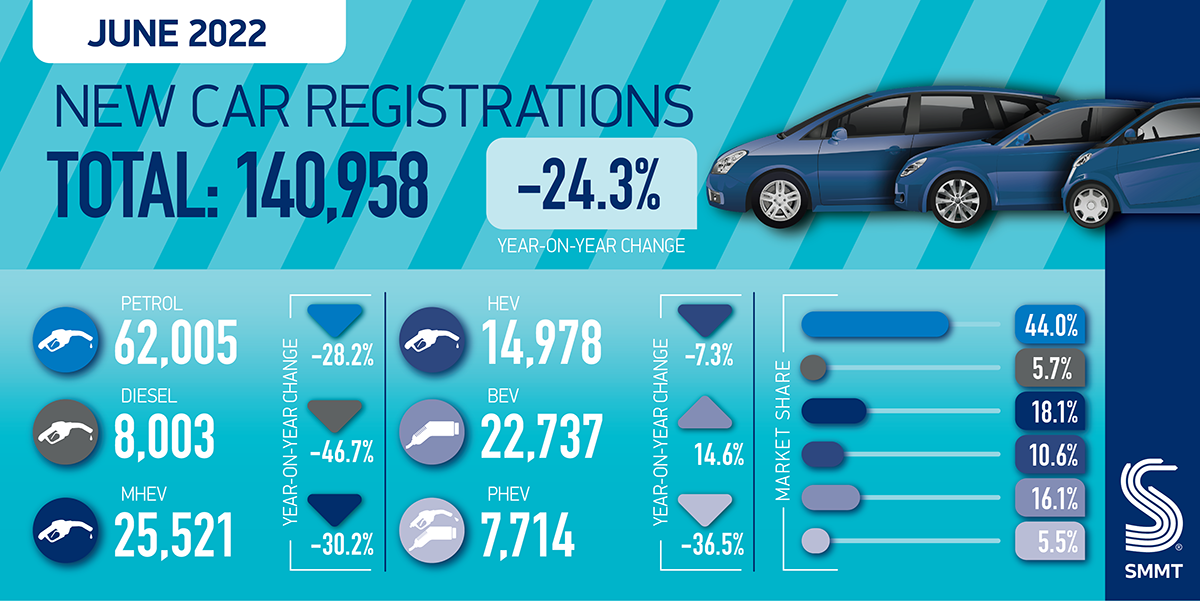
The UK car industry has suffered its worst June for sales for 26 years, according to the latest figures.
Registrations of new cars fell by 24.3% last month compared with a year ago, to 140.958 vehicles, reported the Society of Motor Manufacturers and Traders (SMMT)
This is the weakest performance for the month since 1996, as the cost of living crisis adds to the continuing supply shortage.
Battery electric vehicles continued their growth streak, however, with a 14.6% increase in volume in June, as market share continued to grow, reaching 16.1%, up from 10.7% a year before.
For the year so far, the SMMT said global vehicle production has struggled to keep up with demand, exacerbated by pandemic restrictions in China.
New car registrations for first six month of the year have fallen by 11.9% to 802,079 units – the weakest first half year performance since 1992, bar COVID-19-hit 2020.
Mike Hawes, SMMT chief executive, said: "The semiconductor shortage is stifling the new car market even more than last year’s lockdown. Electric vehicle demand continues to be the one bright spot, as more electric cars than ever take to the road, but while this growth is welcome it is not yet enough to offset weak overall volumes, which has huge implications for fleet renewal and our ability to meet overall carbon reduction targets.
"With motorists facing rising fuel costs, however, the switch to an electric car makes ever more sense and the industry is working hard to improve supply and prioritise deliveries of these new technologies given the savings they can afford drivers."
8.49am: Leading shares do a U-turn
Well that didn't last long.
The FTSE 100 is now in the red, down 27.32 points or 0.38% at 7205.33.
Retailers continue to provide some support, with Ocado Group PLC (LSE:OCDO) up 3.14% and J Sainsbury PLC (LSE:SBRY) 2.16% better after its update.
But miners are among the main fallers, perhaps on concerns that a better than expected services report could mean less stimulus to the economy from the country's authorities.
Antofagasta PLC (LSE:ANTO) has fallen 1.81%, Anglo American PLC (LSE:AAL) is down 1.43% and Glencore PLC (LSE:GLEN) is off 1.27%.
The biggest decline has come from Standard Chartered PLC (LSE:STAN), off 2.05%.
8.15am: FTSE up just a point
Leading shares are virtually flat in early trading.
The FTSE 100 is up just 1.01 points at 7233.66 as investors await the latest economic data including UK service sector figures and US factory orders.
There are also hopes that President Biden could be preparing to roll back some of the tariffs imposed on China during the Trump era, in an attempt to ease pricing pressures in the economy.
Jim Reid at Deutsche Bank said: "This has apparently been a divisive issue inside the administration, since although their removal could help ease inflation, it would also give up leverage in obtaining concessions from China, so there’s geopolitical as well as economic factors at play here."
J Sainsbury PLC (LSE:SBRY) has added 2.4% despite reporting a 4% fall in like for like sales in the last 16 weeks and saying it would invest £500mln to help keep prices low.
It said pressure on households would only intensify during the rest of this year.
Richard Hunter, head of markets at interactive investor, said: "Although the company is maintaining guidance for full-year underlying pre-tax profit to come in between £630mln and £690mln, this would represent a decline from the previous year’s number of £730mln, underlining the pressure on sales despite the group’s other strategic measures.
"Despite something of a relief bounce in opening exchanges, the share price has reflected the company’s current travails, having dropped by 23% over the last year, as compared to a marginal gain of 1% for the wider FTSE 100. Competition in the sector remains intense, ranging from a resurgent Tesco to the price discounters Aldi and Lidl."
Elsewhere the Royal Bank of Australia raised interest rates by an expected 50 basis points to 1.35% as - in common with other central banks - it tries to tame surging inflation.
"Inflation is forecast to peak later this year and then decline back towards the 2–3 per cent range next year," Bank governor Philip Lowe said.
"Today's increase in interest rates is a further step in the withdrawal of the extraordinary monetary support that was put in place to help insure the Australian economy against the worst possible effects of the pandemic."
6.50am: Footsie set to edge higher
The FTSE 100 is seen slightly higher ahead of Tuesday’s open after some star-spangled respite.
CFD firm IG Markets has the London benchmark up around 16 points, making the price 7,256 to 7,259 with just over an hour to go until the start of trading.
With no US pricing to distract due to Independence Day it has been a calm and steady overnight in equity markets.
“A US holiday overnight meant a 12-hour break from the noise. (New Yorkers don’t do 8-hour days, lunch is for wimps) What is clear is that the strategy of watching the rooster fight from the sidelines instead of getting involved remains the sensible one,” said Jeffrey Halley, analyst at OANDA.
Asian trading was meanwhile mixed.
Japan’s Nikkei moved 268 points or 1.02% higher to trade at 26,420 whilst Hong Kong’s Hang Seng edged up only 0.1% to 21,852, and the Shanghai Composite dropped 0.69% to be priced at around 3,380.
Around the markets
The pound: US$1.2116, up 0.136%
Gold: US$1,811 per ounce, up 0.08%
Silver: US$20.13 per ounce, up 0.68%
Brent crude: US$113 per barrel, up 1.6%
WTI crude: US$110 per barrel, up 1.9%
Bitcoin: US$20,305, up 6.15%
Ethereum: US$1,156, up 9.66%