
- FTSE 100 closes down 1.96%
- UK economy grows by just 0.8%
- Bunzl bucks downward trend
4.50pm: FTSE closes firmly lower
FTSE 100 closed the last day of June out firmly lower, shedding around 143 points, or 1.96%, at 7,169.
"Stock markets have fallen heavily in June so it seems only fitting that they're ending the month with big losses as reality continues to bite," said Craig Erlam, market analyst at forex firm OANDA.
"There's no getting away from recession chat and while the heads of the Fed, ECB and BoE didn't exactly fuel that during their panel discussion on Wednesday, they didn't do anything to dispel it either.
"They all know that there's a strong likelihood of recession this year or next and investors are increasingly accepting that fate as well," he added.
3.40pm: Global markets suffer a grim first six months
Leading shares remain resolutely in the red as we head into the close, as recession fears dominate sentiment.
The FTSE 100 has fallen 186.12 points or 2.55% to 7126.2, with the falls accelerating after an opening fall on Wall Street.
Craig Erlam at Oanda said: "Stock markets have fallen heavily in June so it seems only fitting that they're ending the month with big losses as reality continues to bite.
"There's no getting away from recession chat and while the heads of the Fed, ECB and BoE didn't exactly fuel that during their panel discussion on Wednesday, they didn't do anything to dispel it either. They all know that there's a strong likelihood of recession this year or next and investors are increasingly accepting that fate as well."
At the end of the first half of the year, the FTSE 100 is down just over 5%.
Global stock markets as measured by the MSCI All Country World Index have fared even worse, down 20% so far this year. This marks the worst performance in the opening six months since the index was founded in 1990.
There were a broad range of losers in the UK blue chip index.
B&M European Value Retail SA (LSE:BME) is the biggest faller, down 6.06% as its shares went ex-dividend.
British Airways owner International Consolidated Airlines Group SA (LSE:IAG) is down 5.96% amid the continuing chaos at UK airports.
Ocado Group PLC (LSE:OCDO) has lost 5.92% despite extending its partnership with French retailer Groupe Casino, while technology investor Scottish Mortgage Investment Trust PLC (LSE:SMT) has fallen 5.2% in the wake of Nasdaq weakness.
Virtually the only riser at the moment is Bunzl PLC (LSE:BNZL), up 1.09% as it raised its guidance.
3.22pm: OPEC+ sticks to the plan
Despite pressure to pump more crude to help bring petrol prices down, the OPEC+ group of oil producers has stuck to its production targets after its latest meeting.
Craig Erlam at Oanda said: "As expected, OPEC+ stuck to its planned 648,000 barrel increase in August and refrained from any decision beyond then which could add an element of uncertainty to future targets, particularly given recent reports that even Saudi Arabia and UAE are running near capacity.
"The global economic uncertainty doesn't make planning ahead any easier, either. The prospect of a recession has created more two-way price action in recent weeks, preventing any unsustainable surges in the price of crude as China reopened and the OPEC+ deficit increased."
After the news, Brent crude is down 1.2% at US$114.86 while West Texas Intermediate is down 1.98% at US$107.61.
3.06pm: Bunzl leads the Footsie risers
With the FTSE 100 under the cosh it would be a surprise if there were many risers.
And indeed there are not.
Bunzl PLC (LSE:BNZL) is leading the way in a very small field, up 0.67% after the specialist distribution group raised its guidance.
Then comes BAE Systems PLC (LSE:BA.), up 0.22%, and Croda International PLC (LSE:CRDA), edging up 0.09%, and, er, that's it.
2.44pm: Wall Street drops sharply after US data
US stocks plunged at the open as rising recession fears continued to crush sentiment.
Just after the open, the Dow Jones Industrial Average had shed 462 points at 30,568 points.
The S&P 500 had dropped 51 points at 3,768 points and the Nasdaq Composite had shed 165 points at 11,013 points.
The falls came after headline inflation in the US as measured by the Personal Consumption Expenditures (PCE) Price Index remained unchanged in May at 6.3%.
The Fed’s preferred gauge of inflation – the Core PCE Price Index - decreased slightly to 4.7% in the 12 months ending in May compared to 4.9% for the 12 months ending in April, in line with market expectations.
The data is a renewed indication that price pressures are beginning to ease after core inflation reached a 40-year-high of 5.2% for the 12 months ending in March.
However, the data also showed that purchases of goods and services decreased 0.4% in May, after a 0.3% gain in April as rising prices put pressure on consumers’ wallets.
Back in the UK, the falls in the US have pushed leading shares even deeper into negative territory.
The FTSE 100 is now down 188.16 points or 2.57% at 7124.16.
This means at the halfway point of the year, the index is now down 5% in 2022.
2.31pm: Bitcoin under pressure
Bitcoin has fallen below US$20,000 as the cryptocurrency gets caught up in the general gloom about the outlook.
It is currently at 19,185.9, and Marcus Sotiriou, analyst at digital asset broker GlobalBlock, said: "Bitcoin fell further this morning to $19,000, as it trades below the 200-weekly SMA [simple moving average].
"So far, Bitcoin has not retested this level as resistance, but if it does and rejects back down, this would be a very bearish signal. This is because it would be the first time that this level has been broken on a long-time frame and could suggest an extended bear market is on the horizon."
While it was still above US$20,000, Craig Erlam at Oanda had said: "It's getting very nervy in the crypto space and another significant break below here could bring fresh anxiety and more pain. It's still hard to create much of a bullish case for bitcoin beyond its admirable resilience but how long can that sustain it? The broader environment in financial markets certainly isn't helping."
1.44pm: Mixed picture from US inflation and jobs numbers
A key US inflation number has shown signs of improvement.
The personal consumption expenditures index came in flat at 6.3% year on year in May, while the core figure fell from 4.9% to 4.7%.
Month on month the figure rose by 0.6%.
The PCE index is one the US Federal Reserve keeps a close eye on, but such a slight dip is unlikely to tip the balance one way or the other as far as interest rate rises go.
Personal spending dropped month on month by 0.2%, compared to expectations of a rise of 0.4%.
Inflation Report: PCE eased to a 6.3 Y/Y & the policy sensitive core PCE eases to a 4.7% pace Y/Y from 4.9% previously. Inflation remains elevated & demands further policy action but did improve in May. Divergence btw PCE & CPI well underway.
— Joseph Brusuelas (@joebrusuelas) June 30, 2022
Meanwhile the weekly jobless claims came in at 231,000, higher than expected.
The previous week's figure of 229,000 was revised up to 233,000. Analysts had been expecting another 229,000 this week.
A lot of data. Jobs and spending numbers are not good. Flat YoY PCE is good but MoM still went up. Core PCE went down which is a good sign. Mixed news. Follow the levels. pic.twitter.com/1wYnfQk7xc
— Ryan Rozbiani (@RyanRozbiani) June 30, 2022
Naeem Aslam, chief market analyst at Avatrade, said: "The US data has brought mixed news for the markets as we do see some improvement in some of the data, but overall, the data is still saggy
"As for the price action, we do see more bids coming today on the back of this number as the data has worked in favor of lawmakers, but the drop in personal spending will keep traders on edge. We are likely to see traders booking their profits a lot more quicker."
12.33pm: Businesses call for government support amid "perfect storm"
Businesses are calling on the UK government for urgent help as they face a perfect storm of rising costs, supply chain issues and problems in recruiting staff.
At the British Chambers of Commerce annual meeting, director general Shevaun Haviland said: "Businesses are facing unprecedented challenges, exacerbated by the conflict in Europe, which follows a once in a lifetime pandemic that literally brought life as we know it to a halt...
"Increasing cost of raw materials over last summer, supply chain and shipping issues, problems in recruiting people, and by this March spiralling energy prices.
"It really is the perfect storm of increasing costs, firmly putting the brakes on recovery."
She said its latest quarterly economic survey, due next week, painted a bleak picture. It would show less than half of firms surveyed - only 43% - were expecting to increase profitability in the next 12 months.
Just clarified this with BCC. They see flat q2 flat q3 contraction q4 - so no technical recession.
— Simon Jack (@BBCSimonJack) June 30, 2022
She said: " Ahead of the spring statement we urged the government to temporarily reverse their commitment to raise National Insurance Contributions and to support businesses with energy costs.
"However, the Spring Statement was a missed opportunity. We saw some support for business, but the lack of a clear strategic direction meant it did not give clarity or confidence.
"This has to change as we are on limited time. The government has until the autumn budget to reset, rethink and get their house in order.
"First they need to put in place support for businesses now to weather this storm
"And, secondly they need to work in partnership with us, to develop a long-term, economic strategy for growth."
11.50am: Wall Street set for downbeat start
US stocks were expected to open lower on Thursday with the twin concerns of runaway inflation and faltering growth once again dominating sentiment.
Futures for the Dow Jones Industrial Average were trading 0.9% lower pre-market, while those for the broader S&P 500 index were down 1.1% and futures for the tech-laden Nasdaq shed 1.4%.
“Jerome Powell, Christine Lagarde and Andrew Bailey blamed pandemic and the war for sending inflation off the chart at a European Central Bank event yesterday. We blame them for having called inflation transitory and having been left behind the curve for too long,” said Ipek Ozkardeskaya, senior analyst at Swissquote Bank, referring to the head of the US Federal Reserve, the European Central Bank and the Bank of England respectively.
Price pressures across the globe have been building steadily and the central banks’ attempts to rein in inflation appear to have had little success so far, with key indicators of inflation continuing to rise while economic growth falters, creating a worst-of-both-worlds situation.
In closely watched remarks on Wednesday, the Federal Reserve chairman said he was concerned about the chances of failing to fight inflation and conceded that there is a possibility of interest rates rising too high which may, in turn, tip the economy into recession.
More signs of this could come with the US personal consumption expenditures index due later, along with the latest weekly jobless claims.
“Happily for the Federal Reserve, investors don’t care much about the PCE index, even though the latter is what the Fed is watching to determine whether inflation is in line with its policy,” noted Ozkardeskaya.
“The PCE index was at 6.3% last month, much lower than the CPI index as the PCE gives a lower weight to gasoline and rents, which sent CPI inflation skyrocketing. Therefore, even if the Fed could bring the PCE down to 2%, it won’t solve the problem of high energy, high rents,” she added.
Still, given that stock prices are already on a downtrend, a rise in yet another gauge of inflation might yet spark more selling.
Back in the UK, the FTSE 100 is showing no signs of recovery - quite the reverse - and is now down 144.23 points or 1.97% at 7168.09.
10.50am: Aston Martin leads mid-cap fallers
The FTSE 100 remains close to the day's low, down 1.86% at 7176.40.
The more domestically focused FTSE 250 is faring even worse, down 2.18% at 18,623.86.
Aston Martin Lagonda Global Holdings PLC (LSE:AML) is the biggest faller in the mid-cap index, down 10.45% following a report in Autocar that the luxury car group is looking to raise funds to strengthen its financial position ahead of planned investment.
A raft of companies have seen their shares quoted ex-dividend, including Bank of Georgia Group PLC (LSE:BGEO) which has dropped 7.41%.
9.47am: UK car production rises for first time in 11 months
Some positive UK economic news, provided you like cars.
UK car production rose 13.3% in May, the first growth after 10 consecutive months of decline, according to the Society of Motor Manufacturers and Traders.
Battery electric car production more than doubled, increasing by 108.3%, with 4,525 built.
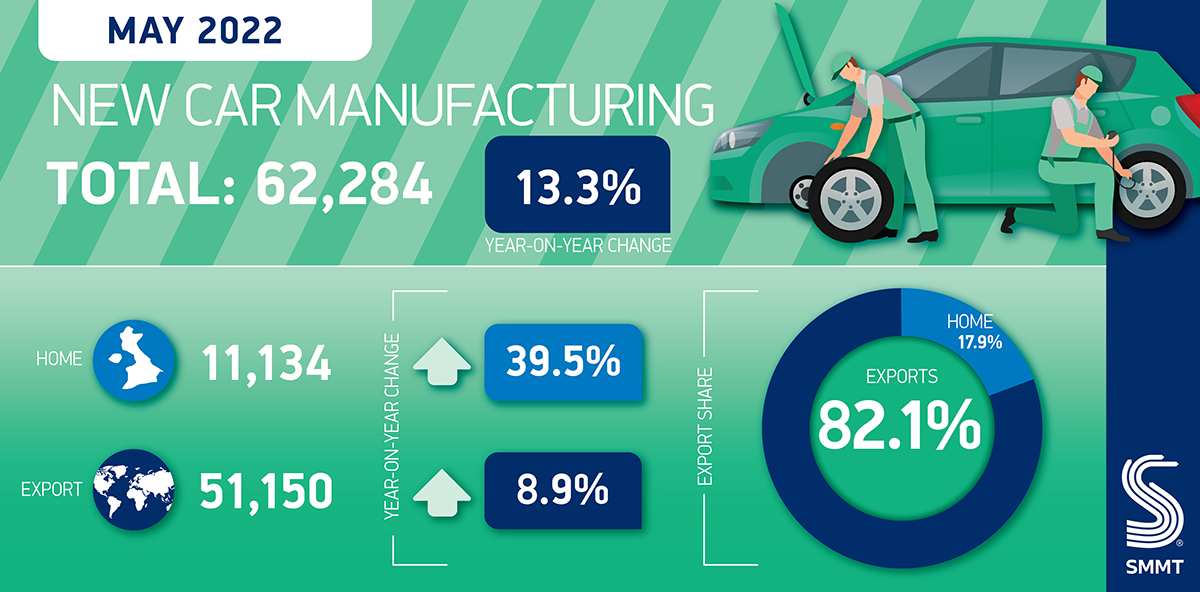
But the SMMT added: "This rise, which comes despite the closure of a major car plant last year, along with key model changeover at another, must, however, be viewed in context against May 2021, which was still suffering significantly from pandemic related headwinds
" Indeed, output remains 46.3% below the pre-pandemic month in 2019, with ongoing supply chain issues, increasing economic uncertainty, rising business costs and disruption caused by the war in Ukraine."
And the sector is calling for urgent government help to mitigate £90mln uplift in its energy costs and protect UK automotive’s competitiveness.
Mike Hawes, SMMT chief executive, said: "May’s return to growth for UK car output is hugely welcome after 10 months of decline, indicating the sector’s fundamental resilience.
"Any recovery, however, will be gradual as supply chain deliveries remain erratic, business costs volatile and geopolitical instability still very real. With the industry racing to decarbonise, we need to safeguard manufacturing competitiveness, drive investment and develop the skill base. Government and industry have a role to play in this transformation and collaboration will be essential if the UK is to remain at the forefront of automotive innovation."
9.05am: Persimmon and Barratt slide
Housebuildesr are among the leading fallers after the Nationwide reported a slowing of the UK housing market.
Persimmon PLC (LSE:PSN) is down 4.28% while Barratt Developments PLC (LSE:BDEV) has lost 3.74%.
Susannah Streeter, senior investment and markets analyst at Hargreaves Lansdown, said: "There are tentative signs that already homebuyers are baulking at the red hot housing market, with house price rises easing off slightly.
"But worries about rates rising, and the potential of being locked out of cheaper deals going forward, still seems to be fuelling this race to move for now. Investors though are nervous about the prospects for a potential dip in prices next year, which could affect demand for new homes. House builders Persimmon and Barratt Developments fell by around 4% in early trade, while Bellway slipped 3%, adding to steep declines since the start of the year.’’
Andrew Montlake, managing director of mortgage broker Coreco, also expects growth to continue slowing: “We're almost certainly past the peak of the property market, with the rate of price growth now slowly nudging down.
"The age of ultra-cheap money is over and that, coupled with the unprecedented cost of living crisis and rising rates, is starting to feed through into house price growth. Increased borrowing costs and the immense pressure on household finances will almost certainly start to temper demand in the months ahead, which will see the rate of price growth slow further during the second half ot the year. The one constant in these times of flux, of course, is the lack of supply and homes being built. The abject lack of good quality, affordable housing will support prices even as we go through an unprecedented cost of living crisis."
Among the other fallers on the leading index are a couple of companies going ex-dividend.
B&M European Value Retail SA (LSE:BME) is down 5.1% while Burberry Group PLC (LSE:BRBY) is off 3.89%.
Overall the FTSE 100 is only heading one way, now down 130.07 points or 1.78% at 7182.25.
8.30am: No positivity as Footsie flops
Leading shares have opened sharply lower as a poor trading half year comes to an end, with investors concerned about a global slowdown or even recession as central banks raise interest rates to try and tame surging inflation.
Russia's war on Ukraine shows no sign of ending, adding to the anxiety, while the lingering effects of COVID-19 remain.
The FTSE 100 is down 121.15 points or 1.66% at 7191.17, in the wake of fairly hawkish comments from central bankers on Wednesday at the ECB forum in Portugal.
Richard Hunter, head of markets at interactive investor, said: "The absence of any immediate positive catalysts, combined with the circumspect outlook comments from the central banks, pulled the rug from the FTSE100... in opening exchanges.
"The losses were broad-based, with particular weakness feeding through to the retailers and the miners, while the housebuilders also came under further pressure given the challenges facing the UK economy.
"The slump leaves the index down by 2.5% in the year to date, almost doubling the loss from the previous session and showing yet again how precarious the current backdrop is proving to be.”
7.48am: UK GDP grows by 0.8% while house prices up 10.7%
A slowdown in the UK economy in the first quarter has been confirmed today, with the final estimates in line with the intial reading.
On a quarterly basis UK GDP grew by an unrevised 0.8% in the first three months of the year, according to the Office for National Statistics, down from 1.3% in the fourth quarter.
On an annualised basis, the economy grew at 8.7% in the first quarter, up from 6.6% in the final three months of 2021.
ONS Director of Economic Statistics Darren Morgan said: "Our latest estimate for economic growth in the first quarter is unrevised as a whole, showing the UK economy continued to recover from the pandemic."
But real household disposable incomes fell by 0.2%, a bigger drop than previously estimated.
Meanwhile there are signs of a modest slowdown in the UK housing market, according to the latest figures from Nationwide, although the rise is still in double digit figures.
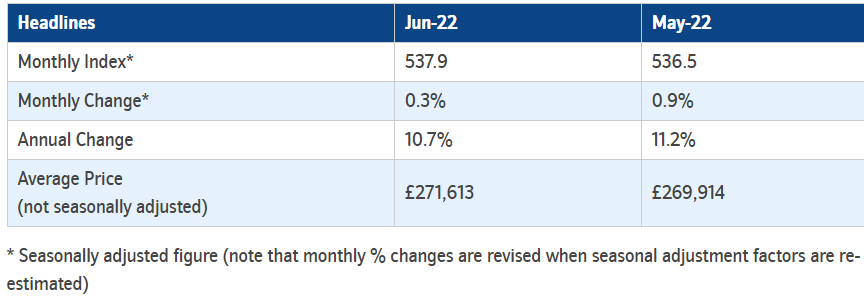
Annual house price growth was 10.7% in June, down from 11.2% in May.
Prices rose by 0.3% month-on-month, after taking account of seasonal effects, the 11th consecutive monthly increase.
The price of a typical UK home climbed to a new record high of £271,613, with average prices increasing by over £26,000 in the past year
Robert Gardner, Nationwide's chief economist, said: “There are tentative signs of a slowdown, with the number of mortgages approved for house purchases falling back towards pre-pandemic levels in April and surveyors reporting some softening in new buyer enquiries. Nevertheless, the housing market has retained a surprising amount of momentum given the mounting pressure on household budgets from high inflation, which has already driven consumer confidence to a record low.
“Part of the resilience is likely to reflect the current strength of the labour market, where the number of job vacancies has exceeded the number of unemployed people in recent months. Furthermore, the unemployment rate remains close to 50-year lows. At the same time, the stock of homes on the market has remained low, which has helped to keep upward pressure on house prices.
“The market is expected to slow further as pressure on household finances intensifies in the coming quarters, with inflation expected to reach double digits towards the end of the year. Moreover, the Bank of England is widely expected to raise interest rates further, which will also exert a cooling impact on the market if this feeds through to mortgage rates."
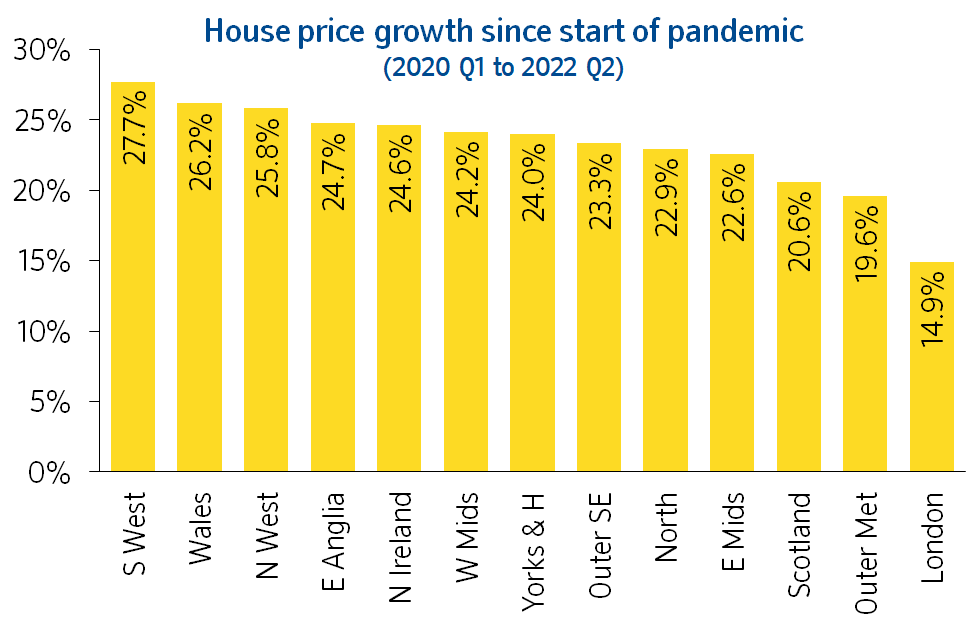
Regionally, the South West overtook Wales as the strongest performing area in the second quarter while London was the weakest performer.
Since the pandemic began, the same pattern holds, with the South West the best performer and London taking the wooden spoon.
6.50am: Footsie set to fall again
FTSE 100 was tipped for another hefty dip at the open with the UK economy set to be the main discussion point.
Estimates from financial spread bet firms had Footsie down by more than 50 points at the start of trading following mixed performances in the US and Asia overnight.
A final read on the UK’s first quarter is due today with the consensus that this will confirm a sharp slowdown in economic activity.
Economists expect the final number to be growth of around 0.8%, down from 1.3% in the previous quarter.
Nationwide’s housing index should also indicate whether rising interest rates and recent mortgage hikes are starting to have an impact on the housing market.
Bunzl and Hunting are the picks of the companies releasing updates today (read more).
Abroad, China’s economy has started to improve again as Covid restrictions are eased.
Its service sector grew by the fastest in 13 months with the official number in June rising to 54.7 from 48.2. Higher than 50 points to expansion.
Manufacturing in China also recovered to 50.2 from 49.6 a month earlier, again showing a return to overall growth.
Jeffery Halley, a senior analyst at Oanda, described it as "a handsome reopening bounce".
US markets had a sluggish day and remain on course for one of their worst halves in decades.
"The market’s struggling to find direction," was a common refrain with nerves about the upcoming results reason and whether forecasts are too optimistic adding to the jitters.
Unless there is a dramatic change in sentiment today, the S&P 500 is on course for its biggest first-half percentage drop since 1970.
Nasdaq, meanwhile, is facing its worst-ever first-half performance, while Dow Jones is looking at the biggest January-June fall since the financial crisis of 2008-9.
6.50am: Early Markets - Asia / Australia
Asian shares were lower on Thursday as Australia’s S&P/ASX200 finished the financial year down 10.2% and the day down 1.97%.
Investment banking firm Jarden noted that more than A$500 billion of fixed-rate loans will expire at the end of 2023, triggering a +40% increase in borrowing costs as those loans catch up with the Reserve Bank of Australia’s interest rate settings.
Japan's Nikkei 225 and South Korea’s Kospi were both trading about 1.5% lower on Thursday.
The Shanghai Composite in China was an exception, gaining 1.49%, while Hong Kong’s Hang Seng index slipped 0.34%.