
Provaris Energy Ltd (ASX:PV1) has lodged a Referral submission with the Northern Territory Environment Protection Authority (EPA) for the proposed 2.8 GW green hydrogen production and export project on the Tiwi Islands.
The Referral has been prepared to inform the NT EPA of the proposal by Provaris to develop green hydrogen production and export facilities on Melville Island, within the Tiwi Islands.
Hydrogen will be produced by electrolysis of purified sea water powered by solar energy, with annual production expected to reach 100,000 tonnes of hydrogen.
“A key milestone”
Provaris’ managing director and CEO Martin Carolan said: “The Referral submission for the Tiwi H2 Project is a key milestone for Provaris, as the company continues to demonstrate the benefits of compressed hydrogen as an export carrier to alternatives that require mega-scale and capital and energy-intensive processes for conversion to transport and reconversion back to hydrogen.
"Tiwi H2 offers the NT and Australia a first-mover advantage for the export of green hydrogen into Asia.”

Martin Carolan.
First stage of assessment process
Referral submission is the first stage of the NT EPA assessment process, with a decision on assessment level expected in October 2022.
Provaris is committed to making the future of green hydrogen accessible through the simplicity and efficiency of compressed hydrogen, and the Tiwi H2 Project has the potential to be Australia’s first export project of gaseous green hydrogen.
Being primarily on existing plantation land and within Port Melville, the Tiwi H2 Project aims to minimise environmental impacts compared to the selection of a greenfield site, development time and costs, as well as provide proximity and access to the future demand markets in the Asia-Pacific region.
“Safe, sustainable” supply chain
Executive director and chief development officer Garry Triglavcanin said: “The Referral has been developed to demonstrate the Tiwi H2 Project will develop a safe, sustainable and efficient supply chain for exporting green hydrogen in a way that minimises environmental and social impacts.
"Provaris is committed to working closely with the Tiwi Island stakeholders to develop a project that delivers benefits to the local community during all project phases.”
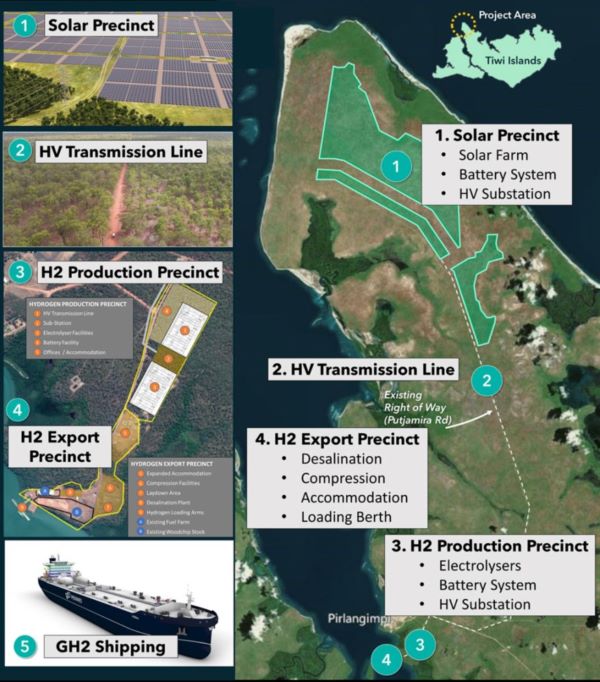
Map of Tiwi H2 Project proposal footprint and site layout.
H2 Project components
The Tiwi H2 Project consists of:
- Solar Precinct (2,640 hectares) on the northern tip of Melville Island about 12 kilometres north of the nearest town, Pirlangimpi, and 22 kilometres north of Port Melville. The Solar Precinct is comprised of three portions of Tiwi Plantations Corporation (TPC) plantation to be cleared.
- Transmission Line Corridor (150 hectares) for a high voltage 275 kV dual circuit 30-kilometre transmission line that will carry the power generated at the Solar Precinct to the H2 Production Precinct.
- H2 Production Precinct (40 hectares) on remnant bushland immediately north of Port Melville and about 1.3 kilometres southeast of Pirlangimpi. Within this precinct, seawater extracted from Apsley Strait will be purified and then converted by electrolysis into hydrogen.
- H2 Export Precinct (32 hectares) within Port Melville’s development boundary, where the hydrogen will be compressed and loaded onto Provaris’ proprietary compressed hydrogen ships (H2Neo) by loading facilities at the port.
The hydrogen will be exported to markets in the Asia-Pacific region.
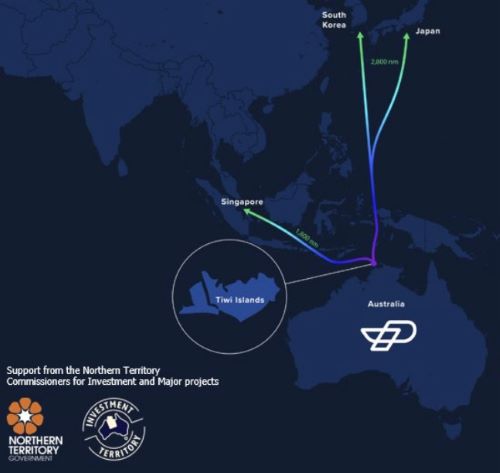
Proximity of the Tiwi H2 Project to key Asian hydrogen markets.
Port Melville is on the Apsley Strait, which runs north-south between the Melville and Bathurst islands. The community of Pirlangimpi (Garden Point) is about 1.5 kilometres north of Port Melville and 130 kilometres north of Darwin.
The Tiwi H2 Project is a key part of Provaris’ overall objective to develop a safe, sustainable and efficient supply chain for exporting green hydrogen.
In-principle support
This project has the in-principle support of key stakeholders to continue to progress the development of the required environmental and engineering assessments – including the Tiwi Land Council, the Munupi Clan, NT Port and Marine Pty Ltd and the Northern Territory Government.
Provaris acknowledges that: “Twenty years ago, Tiwi leaders decided that they would use up to 10% of their land to create an economy, with real jobs for their children and grandchildren… Tiwi leaders determined to establish a number of commercial businesses and enterprises in order to create jobs and income for their people.” (TPC 2022)
The company is steadfast on ensuring that the Tiwi H2 Project helps meet this vision, creating jobs and income for the Tiwi people.
The Referral submission was prepared with the support of Darwin-based consultants EcOz Environmental Consultants, along with the inclusion of technical and engineering studies across the solar site (CE Partners), transmission line, desalination, electrolysis and compression.
Next steps
With the Referral submission lodged on June 30, 2022, and subject to the NT EPA accepting the Referral, the Referral and supporting information will be made available for public comment.
After considering the Referral and comments, it is expected in early October 2022 that the NT EPA will decide on the level of environmental impact assessment is required.
Construction of the Tiwi H2 Project will likely be undertaken in stages, so that hydrogen production and export volumes can increase over time in line with customer demand, benefit from ongoing capital cost reductions across the supply chain, as well as maintain an acceptable level of construction workforce in relation to the local communities.
Provaris will continue to develop and progress the detailed engineering design of the Tiwi H2 Project throughout 2022 and 2023, in line with the permissions and approvals of the Munupi Traditional Landowners.
Project schedule
This work will run in parallel to Provaris’ ship engineering and class approval program to be completed in mid-2023.
The target project schedule is summarised:
- Development/detailed engineering: 2022 and 2023.
- Financial close/commence construction: early 2024.
- Initial construction phase: 2024-2026.
- Commencement of hydrogen export: early 2027.
- Project life: 30+ years.