
- FTSE 100 closes 65 points firmer
- Commodity stocks provide main support
- But US stocks retreat after weak confidence data
4.50pm: Footsie manages fresh gains
The FTSE 100 index closed higher on Tuesday supported by advances from heavyweight commodity issues even as Wall Street fell back following early gains after weak US consumer confidence data.
The UK blue-chip index ended 65.09 points, or 0.9% higher at 7,323.41, below the session peak of 7,362.37 but well above the session low of 7,258.32.
However, in New York around London’s close, the Dow Jones Industrial Average was 168 points, or 0.5% lower at 30,269, while the broader S&P 500 index lost 1.0% and the tech-laden Nasdaq Composite shed 1.7%.
Fawad Razaqzada, market analyst with City Index and FOREX.com noted: "Earlier today, there was a bit of optimism in the air with European equity markets rising noticeably. Investors were showing resilience in the face of rising interest rates, inflation, and recession risks. Granted, some indices and individual names were bouncing back from severely oversold levels, which should have been expected.
"But as I have been consistently warning, let’s not underestimate the big macro risks facing investors. It is far too early to be optimistic that this latest recovery will hold. In fact, the markets were starting to break lower after the early advance in the US session was rejected at the time of writing. The renewed weakness was triggered fresh data showing plunging consumer confidence."
He added: "Last week we saw the University of Michigan’s consumer sentiment survey crash to record lows. Thus, the bar was set very low ahead of today’s publication of The Conference Board’s (CB) barometer. Even so, the CB’s consumer confidence index tumbled more than expected. The headline figure fell to 98.7 from a downwardly revised 103.2 and well below expectations of around 100.0. the slump in confidence was driven by a plunge in 'expectations' sub-index as the present-situation sub-index fell only marginally.
"Business confidence was not great either, judging by the latest read on the Richmond Fed manufacturing index. It fell to -19 compared to -5 previously to reach its lowers level since May 2022 – the height of the pandemic. New orders plunged big time, while expectations for conditions in the future worsening sharply."
The analyst concluded: "Against this backdrop, it is difficult to justifying buying stocks on the hope that the Fed will ignore inflation and start cutting back interest rates from as early as next year. I am therefore of the view that the markets will remain in the 'sell-the-rallies' rather than 'buy-the-dip' mode."
4.05pm: Pound mixed as Sturgeon lays out proposal for new independence referendum
Sterling is has fallen back against the dollar as the prospect of a new vote for independence in Scotland comes closer.
First minister Nicola Sturgeon has published a new bill on a referendum and has called on prime minister Boris Johnson not to block the move.
Scotland's First Minister Nicola Sturgeon says the Independence Referendum Bill will propose a vote on Scottish independence to take place on 19 October 2023
For more on this and other news visit https://t.co/NEDMP2uP6W
— Sky News Breaking (@SkyNewsBreak) June 28, 2022
The pound is down 0.4484% against the dollar at US$1.2212 but has edged up 0.785% against the euro to €1.1602 as earlier talk of a 50 point basis interest rate rise from the European Central Bank faded following comments from president Christine Lagarde in Portugal.
In a report last year on a possible referendum, Capital Economics said: "The interactions between Brexit, the deterioration in Scotland’s fiscal situation and the continued lack of an easy option for the currency have made the economics of Scottish independence even more challenging than at the time of the first referendum in 2014.
"This doesn’t mean an independent Scotland couldn’t be an economic success. But it would require Scotland to put in place credible plans to cut the budget deficit. The resulting fiscal squeeze would restrain economic growth and mean that in its first 5-10 years, an independent Scotland is more likely to fall further behind the rest of the UK than catch it up."
On the reaction to a vote for independence, it said: "The experience after the UK voted to leave the EU is a useful precedent, although the moves would surely be on a smaller scale if Scotland voted to leave the UK.
"After Brexit, the pound fell by 15% and stayed weak until the UK-EU negotiations concluded nearly five years later....It may be reasonable to expect the initial moves to be a third or half as big if Scotland voted for independence. For example, the pound may weaken by 5-7%"
3.52pm: Footsie off its peak but remains well in the green
Leading shares remain in positive territory heading into the close, albeit slightly down on the day's peak.
The FTSE 100 is up 82.51 points or 1.14% at 7340.83, having earlier hit 7362, helped by a rising oil price and news that China was relaxing quarantine requirements on incoming vistors.
Despite mixed signals from the government on defence spending, companies likely to benefit are in the ascendency.
Rolls-Royce Holdings PLC (LSE:RR.) has risen 7.33% and BAE Systems PLC (LSE:BA.) is 3.16% better, while in the mid-cap index Babcock International PLC (LSE:BAB) has climbed 8.23%.
The increase in crude - Brent is off its best but still up 0.79% at US$116 a barrel - has lifted Shell PLC (LSE:SHEL, NYSE:SHEL) by 3.76%.
Meanwhile the Chinese news has led to gains in mining shares, with Glencore PLC (LSE:GLEN) up 3.25%.
But the water sector has sprung a leak after a downbeat note on the sector from JP Morgan.
Severn Trent PLC (LSE:SVT) has slid 4.96% while United Utilities Group PLC (LSE:UU.) is off 1.5%.
In the FTSE 250 Pennon Group PLC (LSE:PNN, OTC:PEGRY) is down 6.36% after water regulator Ofwat included its South West Water business in an investigation into how water and wastewater companies manager their wastewater treatment works.
3.09pm: US consumers less confident
US consumer confidence has fallen by more than expected in June amid rising inflation and to its lowest level for 17 months.
The Conference Board Consumer Confidence Index fell to 98.7 from 103.2 in May, itself revised down from 106.4.
Analysts had forecast a decline to 100.
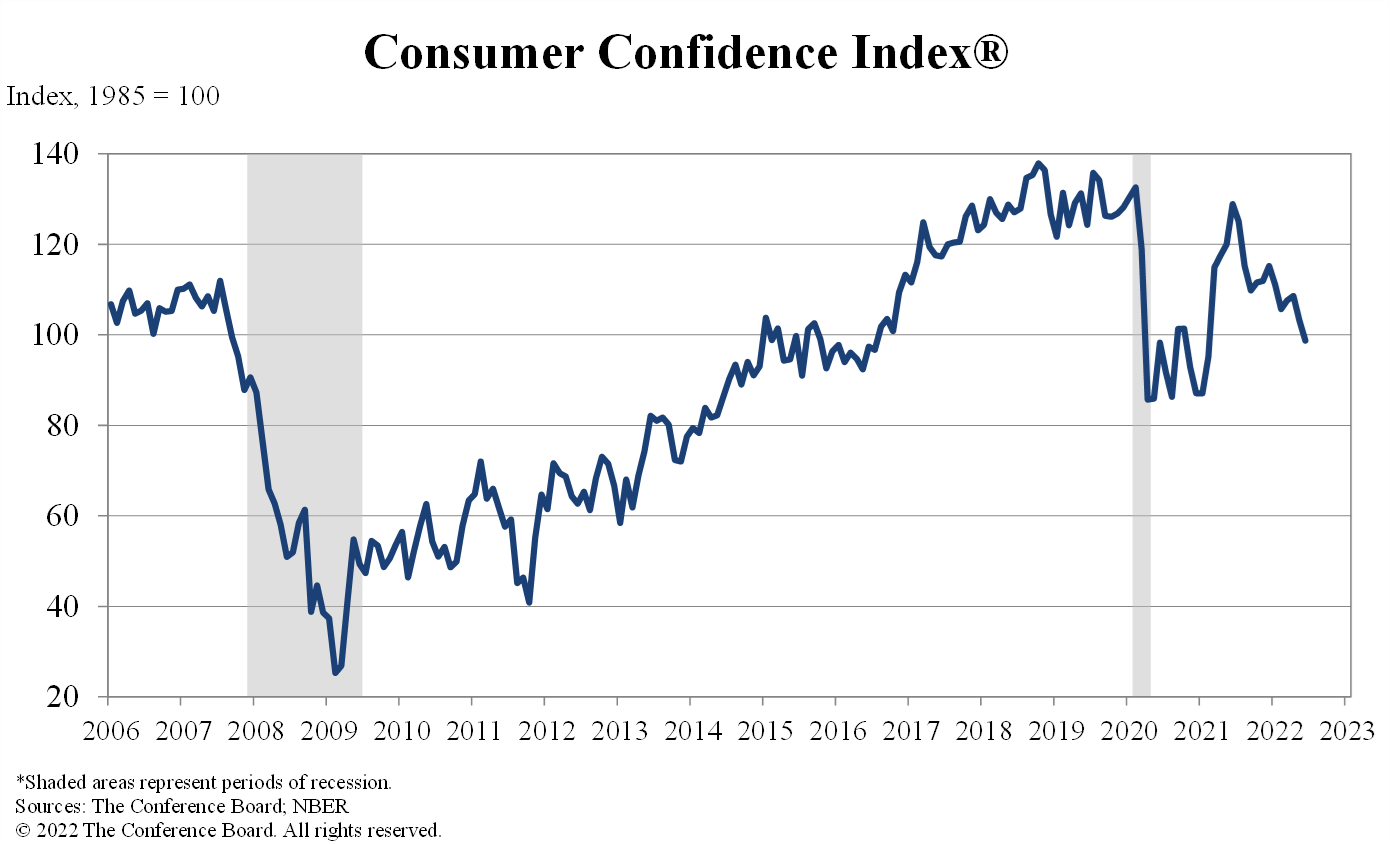
The Present Situation Index—based on consumers’ assessment of current business and labor market conditions— dipped to 147.1 from 147.4 last month.
The Expectations Index—based on consumers’ short-term outlook for income, business, and labor market conditions—decreased sharply to 66.4 from 73.7 and is at its lowest level since March 2013.
“Consumer confidence fell for a second consecutive month in June,” said Lynn Franco, senior director of economic indicators at the board. “While the Present Situation Index was relatively unchanged, the Expectations Index continued its recent downward trajectory—falling to its lowest point in nearly a decade.
"Consumers’ grimmer outlook was driven by increasing concerns about inflation, in particular rising gas and food prices. Expectations have now fallen well below a reading of 80, suggesting weaker growth in the second half of 2022 as well as growing risk of recession by yearend.”
“Purchasing intentions for cars, homes, and major appliances held relatively steady—but intentions have cooled since the start of the year and this trend is likely to continue as the Fed aggressively raises interest rates to tame inflation. Meanwhile, vacation plans softened further as rising prices took their toll. Looking ahead over the next six months, consumer spending and economic growth are likely to continue facing strong headwinds from further inflation and rate hikes.”
US CB Consumer Confidence Jun: 98.7 (est 100.0; prev R 103.2)
- Present Situation: 147.1 (prev R 147.4)
- Expectations: 66.4 (prev R 73.7)
— LiveSquawk (@LiveSquawk) June 28, 2022
2.48pm: Wall Street on the rise
US stocks have opened higher as the news China had halved its required quarantine time for travellers buoyed investor confidence.
Just after the open, the Dow Jones Industrial Average had gained 198 points at 31,636 points.
The S&P 500 had added 21 points at 3,921 points and the Nasdaq Composite had added 39 points at 11,564 points.
Meanwhile, new data showed US house price growth decelerated in April for the first time since November 2021.
According to the S&P CoreLogic Case-Shiller index, house prices climbed 20.4% in April, compared to 20.6% in March – an indication that rising mortgage rates may be beginning to have an impact on house prices.
Back in the UK, the FTSE 100 remains close to its peak, up 93.38 points or 1.29% at 7351.7.
2.23pm: Boots fails to step out with new suitors
A £5bn sale of high street chemist Boots has been abandoned after failing to receive adequate offers, its US owners have announced.
Walgreens Boots Alliance said: "Since launching the process, the global financial markets have suffered unexpected and dramatic change.
"As a result of market instability severely impacting financing availability, no third party has been able to make an offer that adequately reflects the high potential value of Boots and No7 Beauty Company.
"Consequently, WBA has decided that it is in the best interests of shareholders to keep focusing on the further growth and profitability of the two businesses."
Walgreen shares are down 2.58% in premarket trading.
Neil Saunders, managing director of GlobalData Retail, said this was not necessarily good news for Boots.
1. Might have been easier to sell if Walgreens had invested rather than bringing Boots down to their own rather poor level of retailing
2. No new owners not necessarily good for Boots as Walgreens will likely have it treading water until they can complete a sale https://t.co/ZyxwaGuwM2
— Neil Saunders (@NeilRetail) June 28, 2022
1.02pm: FTSE 250 underperforms
The more domestically focused FTSE 250 is also in positive territory but it is underperforming the blue chip index.
The mid-cap is up 0.33% at 19,383.12, with Babcock International PLC (LSE:BAB) 9.1% better on hopes of increased defence spending.
But in common with its peers, water company Pennon Group PLC (LSE:PNN, OTC:PEGRY) is down 5.51% after a negative note on the sector from JP Morgan.
Pennon has also been undermined by water regulator Ofwat including South West Water in its investigation into how water and wastewater companies manager their wastewater treatment works.
Meanwhile the FTSE 100 is up 94.75 points or 1.31% at 7353.07.
11.59am: Wall Street set for recovery
US stocks are expected to open higher, recovering after a late fall back on Monday to resume a recent rally as investors assessed news that China is loosening its coronavirus (COVID-19) travel restrictions and looked ahead to fresh US economic data.
Futures for the Dow Jones Industrial Average were trading 0.5% higher pre-market, while those for the broader S&P 500 index and the tech-laden Nasdaq-100 were also both up 0.5%.
News that China’s National Health Commission has said it would loosen its strict quarantine requirements for international travelers helped lift the mood on Tuesday. Travel firm stocks rose pre-market boosted by the China move.
Energy companies were also positive features as oil prices rose, with Brent crude adding 1.3% to $112.44 a barrel.
Weakening economic data have recently provided investors with some hope that the Federal Reserve might become less hawkish as it tries to tackle sky-high inflation but the overall mood remains fragile.
Richard Hunter, head of Markets at interactive investor, said: “Markets in the US drifted lower after a recent run of gains, opening up the debate as to whether the spike was something of a relief rally, rather than a conviction rally. Investor confidence takes time to build but is easily shattered and as such volatility is never far away. Even so, the losses were shallow in the absence of any strong catalysts, with volumes light, suggesting that there could be an element of calm before the next set of challenges arrive."
He added: "The main test over the following weeks is likely to come in the form of the second quarter and half-year reporting season, where the current state of the economy on the ground will become apparent. At this early stage, pre-announced company data is suggesting that almost twice as many corporates are likely to show weaker rather than stronger numbers. This would represent an improvement from the first quarter of this year, but a decline from the same period a year ago.
"In the meantime, losses were capped by some economic data for durable goods in the US which showed a strong increase in May, implying a continuation of business spending. This in turn could vindicate the Federal Reserve’s insistence that the economy remains robust enough to withstand the current round of rate rises, although of course such data cannot be taken in isolation. Further releases today on consumer confidence and house prices will add further colour to the state of the nation.
"The main indices therefore remain entrenched in negative territory for the year, with the Dow Jones having lost 13.5%, the S&P500 18% and the tech-heavy Nasdaq continuing to bear the brunt of a higher interest rate environment, losing 26% so far in 2022."
Back in the UK, the leading index is managing to sustain its positive mood.
The FTSE 100 is up 94.28 points or 1.3% at 7352.6, heading for its best level for nearly three weeks
11.17am: ECB "will go as far as necessary" to deal with inflation - Lagarde
Inflation in the euro area is undesirably high and it is projected to stay that way for some time to come, European Central Bank president Christine Lagarde has told a meeting of central bankers in Portugal.
She said the situation was a great challenge for the bank's monetary policy, and would lead to the first rise in rates in 11 years in July.
It plans a 25 basis point rise at next month's meeting with a possible larger increase in September.
She blamed the current problems on "an extraordinary series of external shocks" with global supply chain disruptions combining with increased demand, and all exacerbated of course by the war in Ukraine.
"We will go as far as necessary to ensure that inflation stabilises at our 2% target over the medium term," she added. "As Victor Hugo is said to have remarked, perseverance is the 'secret of all triumphs'."
The euro area is facing a complex mix of shocks which are reducing growth and pushing up inflation, says President Christine @Lagarde at the #ECBForum on Central Banking.
It is imperative for policymakers, within their mandates, to address the risks to the outlook
1/2
— European Central Bank (@ecb) June 28, 2022
The ECB has faced another issue recently with the gap between borrowing costs in Italy and Germany widening, and has announced a new policy tool to try and ease this pressure.
She said: "The new instrument will have to be effective, while being proportionate and containing sufficient safeguards to preserve the impetus of Member States towards a sound fiscal policy."
10.37am: Crude climbs further
Oil continues to rise ahead of confirmation that the G7 plans a cap on Russian oil prices.
With supply disruptions and doubts over whether OPEC can increase production to any great degree even if it wants to, Brent crude has climbed 1.52% to US$116.84 a barrel.
West Texas Intermediate, the US benchmark, is up 1.33% at US$111.03.
Neil Wilson, chief market analyst at Markets.com, said: "OPEC convenes this week and is expected to leave production for July and August as agreed at the June meeting, but there could be a discussion on September increases. Meanwhile, supply disruptions continue in Ecuador and Libya."

9.40am: Defence firms in demand
Leading shares continue to hold on to much of their gains.
The FTSE 100 is currently up 69.37 points or 0.96% at 7327.69.
As well as commodity companies, defence firms are also gaining ground.
Susannah Streeter, senior investment and markets analyst at Hargreaves Lansdown, said: "As warnings come thick and fast from military chiefs about the threat to peace in Europe, the expectation is that spending on defence will take a much larger slice of government budgets going forward.
"With commitments to rapidly increase the number of troops on alert, military hardware requirements will be higher and that’s helping lift the share price of defence contractors."
So Rolls-Royce Holdings PLC (LSE:RR.) has risen 5.82% and BAE Systems PLC (LSE:BA.) is 1.55% better.
9.08am: Severn Trent hit by downgrade
Amid the buoyancy there are some shares missing out.
Severn Trent PLC (LSE:SVT) has sprung a leak, down 4.28% to 2731p as analysts at JP Morgan cut their recommendation from neutral to underweight, with a 2700p price target.
Peer United Utilities Group PLC (LSE:UU.) has slipped 1.84%.
Also lower is JD Sports Fashion PLC (LSE:JD.), down 1.39% after a downbeat outlook statement from Nike.
Overall though the FTSE 100 is still well in the green, up 78.11 points or 1.08% at 7336.43.
8.15am: Commodity companies help push Footsie higher
Leading shares are off to a bright start as investors shrug off worries about stagflation as well as shuffling their portfolios for the half-year end.
The FTSE 100 has added a better than expected 83.2 points or 1.15% to 7342.45, helped by a strong performance from the oil companies as crude continues to climb.
BP PLC (LSE:BP.) is 2.67% better while Shell PLC (LSE:SHEL, NYSE:SHEL) has climbed 2.57%
Richard Hunter, head of markets at interactive investor, said: "The slight rebound in the oil price and some further pressure on sterling gave the FTSE100 a ... head start in early exchanges, leaving the UK’s premier index down by just 0.8% in the year to date. The average dividend yield currently runs at a generous 3.9%, which is sufficient to leave the index relatively flat on a total return basis, underpinned by a raft of defensive stocks which have a particular attraction in the current environment."
Mining shares are also doing well on hopes of a recovery in commodity-hungry China, which has just unveiled plans to ease quarantine restrictions on overseas arrivals.
Glencore PLC (LSE:GLEN) is up 3.78%, Rio Tinto PLC (LSE:RIO) has risen 3.64% and Anglo American PLC (LSE:AAL) has added 3.21%.
The European Central Bank will be in focus again this morning, as investors look for more clues on the bank's proposed anti-fragmentation tool when president Christine Lagarde speaks at the Sintra forum in Portugal.
Eyes will also be on the conclusion of the G7 meeting in Germany - including any confirmation of a cap on Russian oil prices - while the latest US consumer confidence figures are due later.
6.50am: Flat start expected for markets but oil firms to benefit from crude rise
The FTSE 100 is set for a flat start on Tuesday, with economic concerns dragging but oil companies expected to pull the index higher after jawboning at the G7 revealed little prospect for crude prices to come down soon.
London’s gauge of blue-chip shares was predicted to dip 0.8 points on the IG spread-betting platform, after adding almost 50 at the start of the week to take it to 7,258.32.
Wall Street had an off day overnight, with all main indices finishing in the red, led by a 0.7% fall for the Nasdaq, 0.3% decline for the S&P 500 and 0.2% drop for the Dow Jones.
Equities could still bounce, though, says market analyst Jeffrey Halley at Oanda.
“Markets are in a schizophrenic frame of mind day-to-day, but underlyingly, are still desperately keen to buy this medium-term dip,” he said.
“Additionally, it is the month and quarter-end this week, and that will prompt no small amount of portfolio rebalancing by institutional investors globally.
“We should expect the back-and-forth chop-fest to continue this week in the equity space, and possibly, the currency space.”
London’s oil heavyweights will be boosted as crude prices were the big mover overnight, with a barrel of Brent up 1.2% to US$116.5, from US$110 at the end of last week.
Oil was helped by a Reuters story, says Halley, where France’s president Emmanuel Macron was overheard telling US president Joe Biden at the G7 meeting, that a call to the UAE had informed him that both they and Saudi Arabia were maxed out on production capacity.
Given that the two gulf states had been thought of as the only two countries in OPEC cabal with spare capacity to boost global deliveries and so could reduce prices, “that is probably the last thing the world needs to hear right now,” said Halley, adding that the pain doesn’t stop there for energy markets.
Along with reduced Russian gas flows to Europe, Libya also announced it may declare a force majeure on over half of its daily production shortly and Ecuador said over the weekend that it may cease production entirely due to domestic cost-of-living protests.
6.50am: Early Markets - Asia / Australia
Asia Pacific shares were mixed on Tuesday with light trading volumes favouring the notion of an exhausted market.
DBS Group Research strategists said in a note that “Investors remained wary of bear market rallies and could not shake off lingering U.S. recession worries.”
Japan’s Nikkei added 0.48% to trade at 26,998 whilst Hong Kong’s Hang Seng was more volatile, losing 0.52% to 22,110.
China’s Shanghai Composite was on the front foot, albeit by only 0.20% and South Korea’s Kospi gained 0.31%.
Australia’s S&P/ASX200 advanced 0.60% even as UBS warned that investors should brace for a 20% fall in Australian corporate profits over the next six months.