
Artrya Ltd (ASX:AYA) CEO John Barrington and his team are harnessing exponential growth in technological capability to address the largest cause of death in the world – coronary artery disease – with an AI-powered rapid diagnostic tool.
The medtech boss has encountered his fair share of life-changing solutions in his time, with a background in surf-lifesaving and a strong presence in the arts, including as chair of the John Curtin Gallery, past chair of the Perth International Arts Festival, member of the Creative Economy Taskforce and deputy chair of the National Portrait Gallery.
He draws a direct line from his ongoing interest in the arts to his current interest in the technology sector: “Creativity and human innovation are linked – they’re products of the human mind.
“That creative process of conceiving of the idea, extrapolating, testing and refining – whether it be a novel or a poem or a new technology – that’s human ingenuity at its finest," he says.
“That ingenuity and ability to conceive of something that adds value to society that wasn’t in existence before is almost magical – and it’s endlessly inspiring.”
Barrington has come full circle from surf-lifesaving to potentially life-saving diagnostic technology.
“I’ve always been a person to follow my passion,” he says. “We all take a lot out of society and Artrya is a way of giving back.”
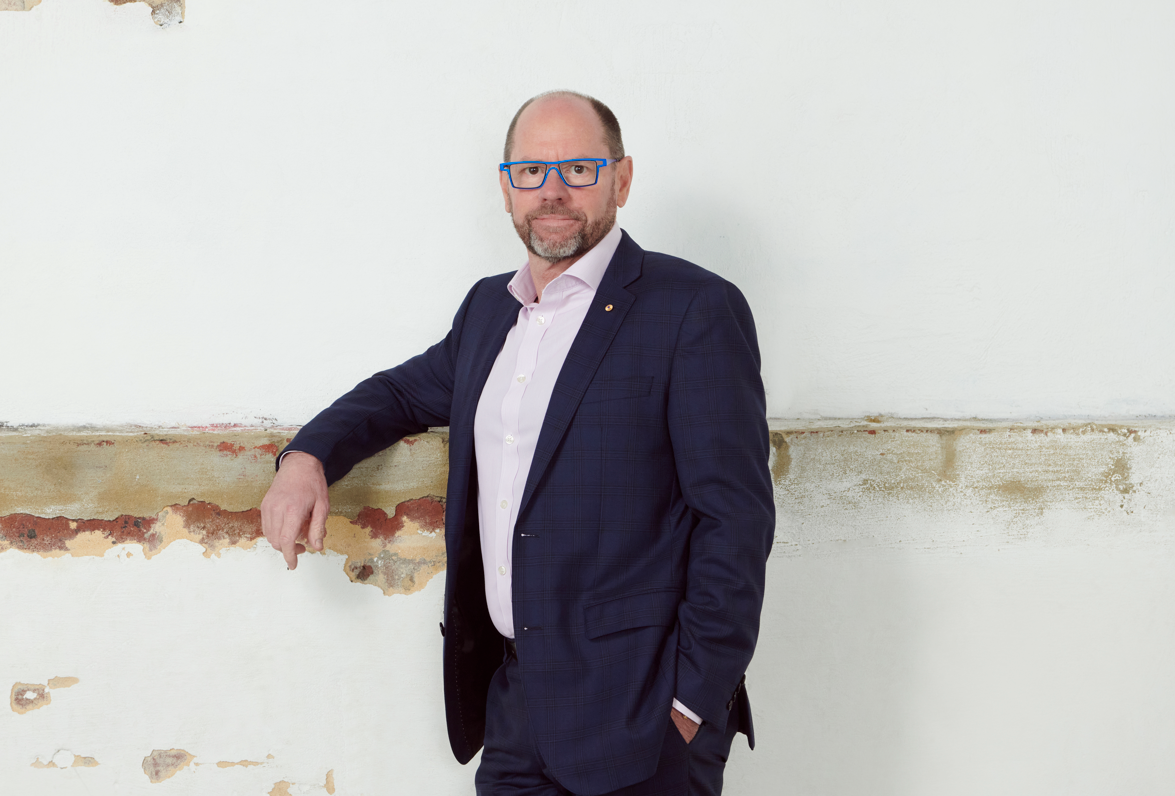
John Barrington has a background in both technology and the arts.
Harnessing technology for good
Artrya, a medtech start-up deploying artificial intelligence (AI) for the early detection of coronary artery disease, was born when Barrington and co-founder John Konstantopoulos put their heads together to come up with a healthcare idea that would harness the exponential power of technology.
Barrington had spent more than a decade in the technology space and written about it extensively. “AI is at the core of a wide range of the technologies of the future,” he says. “The question then is where do you best deploy this to benefit people?
“In the early 1990s, the late business philosopher Peter Drucker said that technology would benefit two industries above all – education and health,” Barrington says. “We haven’t seen that uptake thus far, and now is the opportunity for us to exploit tech to the benefit of humanity.
“We met a clinician, Professor Girish Dwivedi, whose area of research was vulnerable heart plaque and he was able to lend his expertise – it came together very well.
“We saw an opportunity to make a difference in the world, to exploit technology to address a problem that has been around for generations and hasn’t been solved.”
Combating a very common problem
Coronary artery disease is the largest cause of death in the world – accounting for a staggering one in every three deaths annually – and outcomes haven’t significantly improved in decades.
Within coronary arteries there is a soft plaque that is vulnerable to rupture. It’s difficult to see with the naked eye and yet highly susceptible, and can kill within minutes.
Diagnosis has thus far been tricky and often comes too late to save lives.
Enter Artrya’s flagship asset, Salix – a non-invasive, cloud-based software diagnostic for early detection of coronary artery disease.
The AI used by Salix can examine imaging at a pixel level and rapidly detect and report the plaque.
The technology draws on thousands of computed tomography coronary angiography (CTCA) scans within minutes to detect stenosis (a narrowing or restriction of a blood vessel or valve) and other biomarkers in a patient’s cardiovascular system, all within minutes.
Salix has received Therapeutic Goods Administration (TGA) approval in Australia and Artrya is now in the process of trialling software at sites around Australia.
A clinical partnership in the US was recently signed and the company is exploring avenues to move the technology into commercial use.
Over in the UK, Salix is the only such product to have been appointed to a more than two-year agreement with the NHS, making the cost-efficient technology available to 1,250 NHS trust hospitals across the UK.
The company needs the final chips to fall into place – FDA (US) and UKCA (UK) approval – but it is working on securing these with its wholly-owned subsidiary in the US, and a clinical advisory board consisting of prominent cardiologists.
Addressing the anti-AI bias
There has always been a certain scepticism holding society back from embracing AI wholeheartedly. People are reticent to yield to the machines, particularly in an area as sensitive as healthcare.
Barrington sees this pushback in his work – not only with Artrya but previously as chairman of Anglicare working to provide solutions for disadvantaged people – but he believes that a certain willingness to accept the risk is necessary if we are to move towards genuine gains in the health sector at scale.
He points to a disability leader who told him it was important to allow people with disability the “dignity of risk”, saying there was so much potential for technology to improve lives.
“I hold in my mind that AI develops exponentially, so we need to harness it to the benefit of humans,” Barrington says. “We can’t afford to let it get away from us.”
“There’s a massive shortage of clinicians, increasing expectations of an ageing and educated population, and rising costs of healthcare,” he says. “This is not sustainable in the long term – we need to use AI to address some of these issues.”
Cost is a huge factor in diagnostics: “We are able to assess coronary blood flows off a single CT scan, which would otherwise require an invasive hospital visit, 58% of which are not necessary. Of course, in the US, this means exponential costs.”
Human endeavour is inspiring
Barrington says that the innovative people and the exhilarating pace of change in his line of work inspire him each day.
Creating something that hasn’t been created before, using technology, is an aspirational endeavour.
These same things make the work high stakes and high risk, and require leaders to be fleet of foot because there is a constant balance between taking appropriate risks with shareholder capital while deploying new technology – it’s all about managing that risk appropriately.
“The space is rapidly changing – it’s important for leaders to move with high velocity while having appropriate risk management in place.
“With every decision you make you’re weighing up upside potential and downside risks in what is a risky environment.”
Barrington believes there are several key ingredients to a successful small-cap company.
The first is delivery: “Do what you say you will.”
“Make sure you are addressing a real problem with a differentiated solution, and always continue to innovate.
“With a start-up environment you’re creating as you proceed – it’s a complex system with a lot of interdependencies.
“It’s important to have a strategy, but the other part of it is prioritising and reprioritising accordingly because it is such a dynamic world.”