
As central banks continue to push up the cash rate and inflation rises, recession talk is now all the rage. But for every affirmation that, yes, we are heading into a recession, there's a more positive economic outlook.
So, who is right and who is wrong? Are we heading into a recession or not? Or is it stagflation we need to be concerned about?
All good questions.
What we do know is there is a sustained economic downturn to deal with, but at this stage, it is too hard to tell whether we will enter a recession or not. What we’ll do then is look at both sides of the argument and continue to closely watch the global economic slowdown.
To kick things off, let’s have a listen to AustralianSuper boss Mark Delaney’s take on the economy and market expectations:
Here's a breakdown of what we'll look at today:
- Recession: what is it?
- Is Australia (and the rest of the world) set for a recession?
- How does the current economic situation affect commodities and the broader markets?
- Who’s for a recession occurring
- Against a recession occurring
- The jury is out
Recession: what is it?
Before we get into the ayes and nays, let’s quickly discuss the myriad recession definitions.
There is no single definition of what a recession is – however, what is common is a period of reduced economic output and increased unemployment. In Australia, it is standard patter to suggest a technical recession is taking place.
This is defined by two consecutive quarters of negative growth in real GDP.
Yet this is a very basic determination.
According to the Reserve Bank of Australia, this definition has several shortcomings.
- GDP growth can be weak – but not negative – and still be associated with significant increases in the unemployment rate and hardship for households.
- Some components of GDP are volatile. Consequently, two consecutive quarters of negative growth in GDP can give a false signal about the underlying pace of economic growth.
- Measurement of the components of GDP is subject to revision as more data become available. Consequently, a negative quarterly growth figure can be revised away or a positive one can become negative, also increasing the possibility of a false signal about the underlying pace of economic growth.
Let’s speak in general terms then.
A recession can be defined as a sustained period of weak or negative growth in real GDP (output), accompanied by a significant rise in the unemployment rate. It is also takes into account other weak economic activity indicators including levels of household spending, retail sales and low business investment. Business and household loans that are unable to be paid are also cause for concern.
Here’s a video explainer:
And for something different …
The National Bureau of Economic Research (NBER) in the United States – a leading research institution recognised for its work on business cycles – defines a recession as a period between a peak and a trough in the business cycle where there is a significant decline in economic activity spread across the economy that can last from a few months to more than a year.
Note, the NBER considers a broad range of economic indicators in addition to GDP. However, the judgements made by the NBER regarding a recession come slowly and there is no readily available formula for identifying recessions that can be applied to other economies.
Is Australia (and the rest of the world) set for a recession?
There are certainly mixed messages when it comes to whether Australia is heading for a recession.
Just this week, RBA governor Phillip Lowe said a recession in Australia was unlikely.
"I don't see a recession on the horizon," Lowe said.
"If the last two years has taught us anything, it's that you can't rule anything out. But our fundamentals are strong, the position of the household sector is strong, and firms are wanting to hire people at record rates.
"It doesn't feel like a precursor to a recession," he said.
He also noted that Australia’s unemployment rate was at a 50-year low, job vacancies were at a record high and households had strong balance sheets.
Terms of trade (prices for exports versus payment for imports) were also at the highest level ever.
"When we had the resources boom a decade ago I used to say, 'This is the highest since 1848, when we had the gold rushes in the British colonies' and, yet, here we are today, in 2022, having a higher terms of trade, which is really boosting our national income," he said.
"So, there are a lot of positives."
While the governor doesn’t see a recession coming, the battle against inflation is a major one and is affecting households. It is predicted underlying inflation won’t contract back to the targeted 2-3% range for a couple of years.
The RBA’s approach to curbing inflation, which has in part been caused by its response to the pandemic, is not without its critics and financial commentator Alan Kohler was quite scathing of its approach, highlighting Australia’s past fights against inflation and recession.
Kohler’s criticism is food for thought but won’t change the tide.
T. Rowe Price head of Australian Equities Randal Jenneke is another who is critical of the response to inflationary pressures. He said, “The key to understanding global equity markets in 2022 is that after unprecedented fiscal and monetary stimulus to counter the pandemic- induced recession of 2020, central banks and investors are faced with rising inflation that is at multi-decade highs. With hindsight, the stimulus and liquidity provision by central banks over the past two years has proved excessive and must now be curtailed.”
The problem is the same the world over and even when inflation starts to fall, the regulators will continue on their current path.
According to London-based independent economic research consultancy Capital Economics, falling inflation won’t stop central banks tightening the screws.
“The global economy is on course for weaker growth, high inflation, and tighter monetary conditions. The world’s largest economies will all suffer for different reasons – policy restraint in China will preclude anything more than a muted recovery from its recent Omicron wave, higher interest rates will weigh on interest-rate-sensitive spending in the US, and the cost-of-living squeeze will take its toll in Europe, where recession risks are highest,” it writes.
“Inflation still seems set to fall, albeit from a higher level than envisaged before the war in Ukraine. Indeed, we expect commodity prices to fall, goods price pressures to ease, and base effects to cause big falls in headline rates by the turn of the year. But tight labour markets and strong underlying price pressures will be enough to keep central banks on track to deliver the most aggressive tightening cycle in three decades. This should cause growth to slow to below trend, rather than trigger a deep downturn. But the risk is that inflation stays higher for much longer, causing policymakers to hike rates well beyond neutral levels to quash it.”
How does the current economic situation affect commodities and the broader markets?
Let’s look at copper.
The recent sell-off highlights broader issues.
City Index market analyst Tony Sycamore said, “One of the traditional measures of global economic health and recession is the price of copper. Demand for copper increases during an expansionary economic cycle, while demand for copper drops when global growth is slowing.
“Overnight (June 22) the price of copper futures fell to a 15-month low, almost 25% below its $5.0395 per pound high of just four months ago. As viewed on the chart below, copper has extended its break lower during today’s session in Asia.
“Providing copper remains below $4.00/$4.15 formerly support, now resistance the pullback has room to extend back towards weekly support at $3.50.”
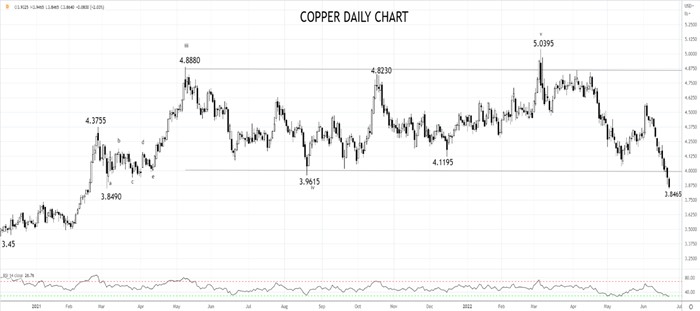
Source Tradingview. The figures stated are as of June 23, 2022. Past performance is not a reliable indicator of future performance.
From copper to growth stocks
Growth stocks were hurt during the pandemic and have taken a battering as banks have raised cash rates, but any turnaround could be a sign that a recession isn’t on the cards and that economic sentiments including energy prices work in their favour.
Head of Multi-Asset Solutions APAC at T. Rowe Price, Thomas Poullaouec, said, “After more than a decade of outperformance versus value amid years of low economic growth, growth stocks went nearly parabolic during COVID lockdowns as many large-cap technology companies disproportionately benefited from stay-at-home trends, sending valuations to record levels.
“That trend abruptly ended at the end of last year and has continued amid a spike higher in interest rates and threats of aggressive Fed tightening to battle multi-decade high inflation. The sharp drawdown in growth stocks has led to more reasonable valuations and the move higher in rates appears to be largely priced in as expectations for economic growth are moderating – historically a time when growth stocks have tended to outperform.
“While time will tell if this is a pivotal inflection in style back toward growth stocks, they still face near-term challenges on upcoming earnings comparisons and uncertainty around the path of Fed policy. But, for now growth could be due for a spurt higher as many of the tailwinds for value – higher energy prices and rates – may be peaking.”
From growth stocks to the general nature of things
The economy runs in a cycle:
- Peak: The economy is full steam ahead, with employment high and GDP healthy.
- Recession: See above
- Trough: Output and employment bottom out before making a recovery.
- Recovery and expansion: The economy begins to grow again.
In a recession all is not lost for investors. Bear markets can be taken advantage of by sophisticated investors, while bargains can be found among declining share prices – known as value investing. A long-term buy-and-hold strategy can also work for investors during an economic downturn. Any investment strategy should be undertaken with a knowledge of risk appetite and strategy, and those unsure of how to approach investing during a recession should seek professional financial advice.
In the general nature of things, a recession will impact broader markets, but if you are savvy and have the right advice, you will survive.
Who’s for a recession occurring
There are many differing opinions as to whether the world will sink into a recession.
Here’s a few on the aye side.
Deutsche Bank
“The Fed has "never been able to correct" even smaller overshoots of inflation and employment "without pushing the economy into a significant recession", according to Deutsche Bank, which is forecasting a major recession for the US.
Bloomberg journalists
“When central bankers try this hard to slow the economy down,” Bloomberg journalists write in reference to the recent interest rate rises, “they often end up tipping it into outright reverse”.
David Llewellyn-Smith, chief strategist at the MB Fund and MB Super
“Will there be an offset this time, such as in mining? No. Although Australia’s commodity prices are through the roof, it is all in commodities where no follow-on investment will take place: iron ore, coal and LNG.
“In short, the RBA is tightening into a global inflation surge and business cycle that is already very long in the tooth and the risk of policy error is high. It will not get far.”
AMP Ltd economist Diana Mousina
“Usually bear markets — when shares fall by 20% and keep falling — tend to be accompanied by recessions.
“The odds of a recession are larger in 2023 than in 2022 because central banks will need to take interest rates higher (and potentially too high) to get on top of elevated inflation which could cause the downturn.”
Against a recession occurring
Head of Multi-Asset Solutions APAC at T. Rowe Price, Thomas Poullaouec
“With inflation at multi-decade highs and growth already slowing, investors were rightfully sceptical about the Fed’s ability to aggressively tackle inflation without sending the economy into recession having waited too long. Now two hikes in and messaging frontloading future hikes with 50 basis point moves, recent data suggests the broader economy is largely holding up.
“Although first-quarter gross domestic product showed the economy surprisingly contracted by 1.5%, it appeared an anomaly due to temporary disruptions in trade and inventories, masking underlying support from consumer and capex spending. And while expected to slow, full year 2022 growth estimates still expect a 2.6% expansion, near pre-covid averages. Inflation too is showing some early signs of cooperating, with recent data suggesting easing in producer prices and wages, giving Fed officials a sigh of relief. While far from out of the woods, with top-line CPI still expected to be near 6% levels at year-end, so far it seems like maybe, just maybe a Fed- driven recession or stagflation are not inevitable.”
AMP Capital chief economist Shane Oliver
"We remain of the view that a global recession can be avoided. But with central banks now hiking rates aggressively, the risks have increased to the point that it's now close to 50-50. Either way, it’s still too early to say that shares have bottomed."
The jury is out
The jury really is out on this one. Every economist, market analyst and his or her dog has a differing opinion about whether a global recession is coming.
What we do know is economic activity is slowing. Prices are rising. Share markets are falling. Investors are selling or holding.
And it’s cold in Melbourne in winter.