
Havilah Resources Ltd (ASX:HAV) has been offered Accelerated Discovery Initiative (ADI) funding from the South Australian Government to explore the highly prospective Benagerie Dyke in the state’s northeast.
The funding of $175,000 on a matching basis is for the company’s ‘Exploration Drilling – Benagerie Dyke’ project.
This will involve Havilah undertaking geophysical surveying and follow-up drill testing of a major linear magnetic anomaly informally termed the Benagerie Dyke that may be caused by a mafic/ultramafic intrusive complex within the prolific Curnamona Province.
New ideas and techniques
In a media release, South Australia's Minister for Energy and Mining Tom Koutsantonis said the ADI funding “will allow companies to use innovative technologies and concepts to fast-track new exploration ideas and techniques across South Australia”.
Havilah’s technical director Dr Chris Giles said: “Havilah is most grateful to the Government of South Australia for its support via this ADI funding, demonstrating its ongoing commitment to fostering mineral exploration in the State.”
“Testimony to quality”
“The proposal was assessed and ranked against certain merit criteria by an independent expert review panel and is testimony to the quality of Havilah’s exploration project that it was selected for ADI funding,” Giles said.
“A major new PGE-nickel-copper-cobalt-gold discovery would be a first for South Australia, just as the Julimar discovery was for Western Australia.
“Such a discovery would contribute significantly to mineral development in South Australia and also provide an impetus for further exploration of similar style mineralisation.”
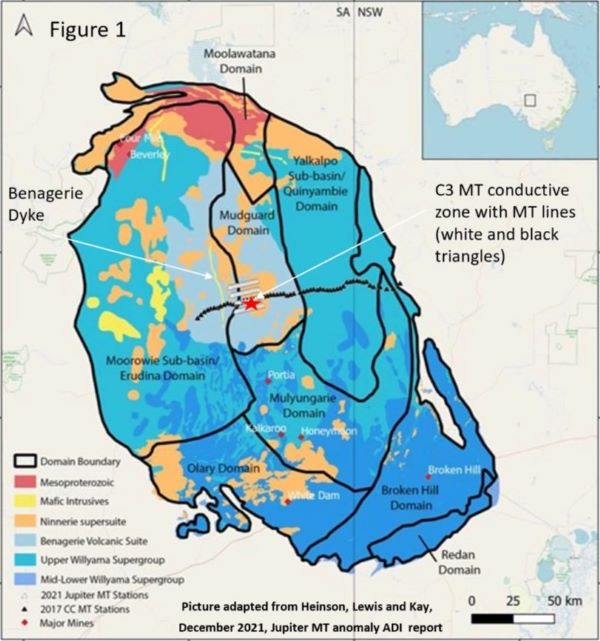
Regional geological summary of Curnamona Province, showing the Benagerie Dyke near the western rifted margin of the Benagerie Ridge in relation to the Jupiter MT anomaly (indicated by red star showing C3 MT conductive zone).
ADI proposal
Havilah’s successful ADI proposal highlights the scope of the ‘Exploration Drilling – Benagerie Dyke’ project:
“A prominent linear aeromagnetic feature, termed the Benagerie Dyke, extends for at least 28 kilometres along the interpreted western rifted margin of the Benagerie Ridge.
"The origin is unknown as it has never been drilled, but the geometry suggests that it could be a mafic/ultramafic intrusive complex. If so, it could be prospective for the Julimar style PGE-nickel-copper-cobalt-gold mineralisation that was discovered during March 2020 near Perth.
"The Benagerie Dyke coincides with the C2 magnetotelluric (MT) conductive feature, which lies above the major deep crustal C1 conductor that was defined by a previous ADI collaborative study with the University of Adelaide (Jupiter MT Anomaly Definition Study). It is also marked by a deep-seated magnetic susceptibility feature.
"One drill hole at the southern end of the aeromagnetic anomaly, namely LNM10-1 drilled during August 1981, intersected amygdaloidal basalt at 231.5 metres vertical depth beneath a thin cover sequence of Adelaidean shelf sediments. The causative body was likely not intersected, although the basalt may in part explain the broader aeromagnetic feature here.
"Initially it is proposed to carry out moving loop ground EM to detect the presence of sulphide mineralisation and to drill promising targets identified. This program will determine the origin of the Benagerie Dyke and its mineralisation potential.”