
Galileo Mining Ltd (ASX:GAL) is warming to the potential of its Callisto discovery, which is part of the Norseman project in southern WA, returning more multiple sulphide hits during a new drilling campaign.
The company’s first four reverse circulation (RC) drill holes have each intersected wide zones of disseminated nickel and copper sulphide mineralisation.
Portable XRF analysis has already confirmed the presence of nickel and copper sulphides, and Galileo now believes Callisto’s mineralised sulphide zone extends at least 250 metres along strike.
What’s more, the program encountered disseminated sulphide zones up to 28 metres drilled thickness in two holes, while every hole hit sulphide zones over 20 metres drilled thickness.
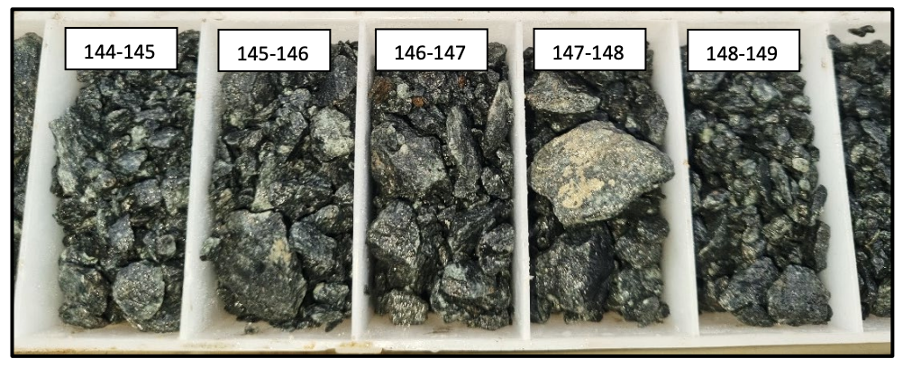
RC chips with disseminated sulphides (1%-5%) in NRC274.
Past, present, future
Galileo’s RC drilling comes after explorer uncovered Callisto’s potential in May, when a drill program intersected 33 metres at 2.05 g/t palladium, platinum, gold and rhodium, 0.32% copper and 0.30% nickel from 144 metres.
Fast forward to today, and Galileo has intersected disseminated sulphide mineralisation that is geologically consistent with the first round of drilling.
Samples from the first four RC drill holes have been submitted for lab analysis, with results expected in late July.
In the meantime, however, Galileo’s drilling campaign has been impacted by high rainfall.
As a result, the company plans to mobilise a second rig to increase production rates.
More to come
Galileo managing director Brad Underwood said: “Drilling at our Callisto discovery is continuing and we are very pleased to report that all drill holes completed to date have successfully hit more sulphide mineralisation.
“The results confirm the consistency of the geology over the target area and the drill samples have been sent to the laboratory for analysis.

“Drilling is ongoing with another 16 holes planned over the next three to four weeks.
“Additional Program of Work applications are awaiting approval with the Department of Mines, which will allow further drilling along strike to the north.
“Presently, we have shown mineralisation occurs over 250 metres across strike and, with five kilometres of prospective strike to the north, we have a lot more drilling to come.”