
Kingfisher Mining Ltd (ASX:KFM) traded higher on encountering up to 21% total rare earth oxides (TREO) during rock chip sampling at its Mick Well Project in WA’s Gascoyne region.
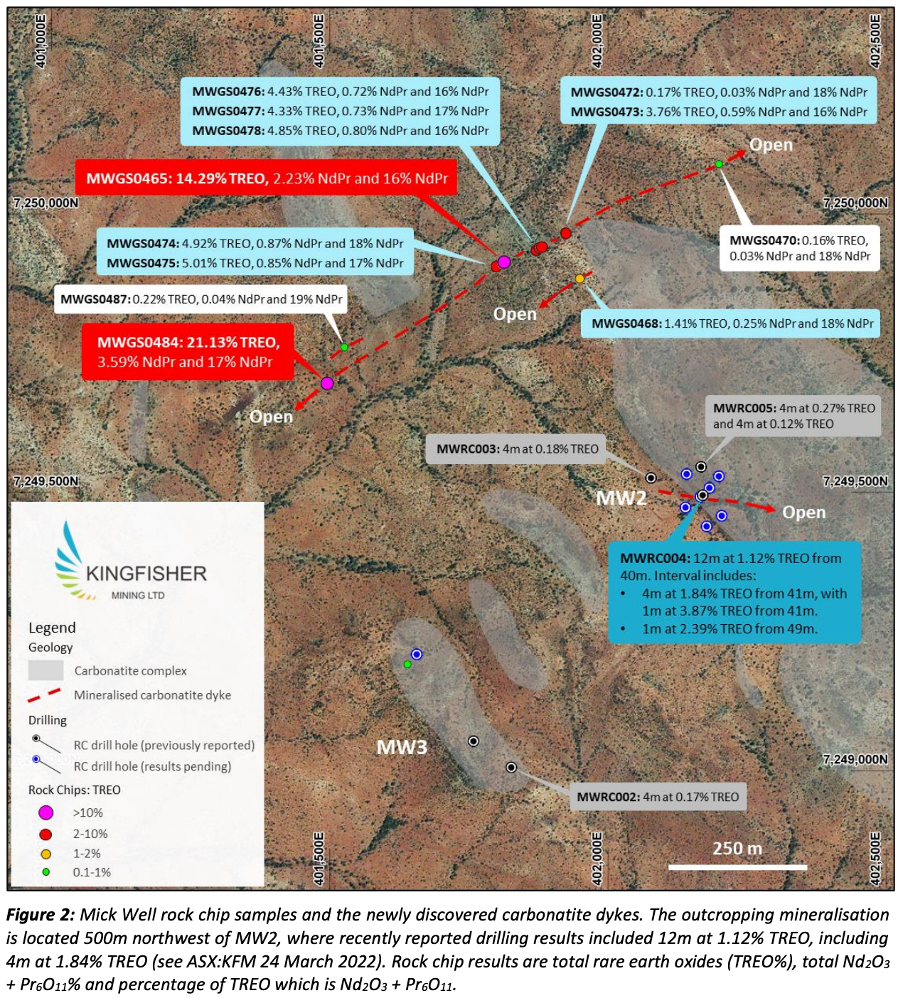
The latest results have defined another 800 metres of outcropping mineralisation at Mick Well, confirming the project’s regional-scale potential.
Some of the best hits from sampling at the project’s carbonatite dykes include 21.13% TREO with 3.59% neodymium and praseodymium oxide, as well as 14.29% TREO with 2.23% neodymium and praseodymium oxide.

Shares up
The mineralised hits are 500 metres northwest of the MW2 discovery, where previous work hit 12 metres at 1.12% TREO, including 4 metres at 1.84% TREO.
Securities were as much as 46% higher intraday to $0.35, approaching the 12-month high of $0.36.
Notably, all three mineralised dykes at Mick Well remain open in all directions, and the newly discovered mineralisation is drill-ready.
As a result, Kingfisher plans to hit the soil with drill programs later this year, while more results from the drilling at the MW2, Kingfisher and other targets are expected throughout winter.
High-grade results “exceed expectations”
Commenting on the findings, Kingfisher executive director and CEO James Farrell said: “The discovery of the additional rare earth element mineralisation in three parallel dykes just 500 metres from MW2 is a very exciting development for the company.
“The high-grade assay results exceed our expectations and have led to the further identification of numerous new targets over a large area at Mick Well.
“As our work expands along our 54-kilometre target corridor, the new targets will be progressively assessed as we continue to increase our fieldwork over the coming months.”
Other key results the define the 800 metres of surface strike include:
- 5.01% TREO with 0.85% neodymium and praseodymium oxide;
- 4.92% TREO with 0.87% neodymium and praseodymium oxide;
- 4.85% TREO with 0.80% neodymium and praseodymium oxide;
- 4.43% TREO with 0.72% neodymium and praseodymium oxide;
- 4.33% TREO with 0.73% neodymium and praseodymium oxide;
- 3.76% TREO with 0.59% neodymium and praseodymium oxide; and
- 1.41% TREO with 0.25% neodymium and praseodymium oxide.
Based on the findings, a large number of high-priority geophysical targets have been identified in a broad zone which extends 10 kilometres west-northwest from MW2 within the company’s 54-kilometre target corridor.
The new targets will be mapped and sampled as part of upcoming fieldwork.
2022 Gascoyne exploration program
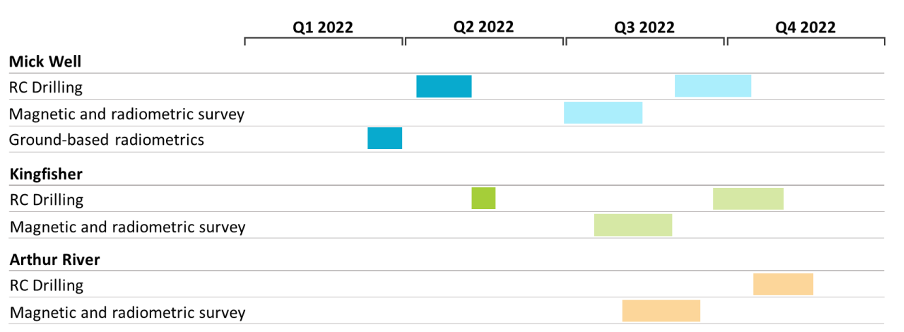
Kingfisher is progressing a number of targeted exploration campaigns over its Gascoyne project portfolio this year.
Based on a series of fieldwork strategies, the company hopes to develop and test drill targets from ground-based mapping and rock sampling.
Simultaneously, Kingfisher is out to develop a pipeline of exploration opportunities by integrating tenement-scale, airborne geophysical surveys with geological knowledge from its rare earth element discovery at Mick Well.
The company’s strategy is outlined below:
Farrell continued: “We are eagerly awaiting the results from our follow-up drilling at the discovery target, MW2.
“The geological logging of the drill holes from the recent drilling program was a key factor in the discovery of this additional mineralisation, with the outcrop being very similar to the geology logged in the drilling.
“The newly identified mineralisation is now drill-ready and will be added to drill programs that have already been planned and contracted for later in the year.”