Everyone loves a good comeback story. Sport is littered with them: Michael Jordan, Michael Phelps, Muhammad Ali. There are too many individuals to list. Or teams for that matter.
The same goes for business comeback stories.
Business may not have the same mythos or legend driving it, but there have been just as spectacular turnarounds in business as there have been in the ring, pool, athletics track or stadium.
Great, long-standing businesses have had to adapt to succeed.
I don’t draw your attention to the companies or sports stars above to compare them to the company or the man driving change at the business we turn the spotlight on today.
However, if you are looking for a little inspiration on a local level and with a small cap company, the turnaround of Hawsons Iron Ltd (ASX:HIO) and the Hawsons Iron Project – widely considered the world’s leading undeveloped high-quality iron ore concentrate and pellet feed project – is inspiring indeed.
The man behind the transformation is Bryan Granzien, whose list of achievements since he took the reins is long and distinguished.
They are:
- Stabilising the Board of Directors, removing legacy impediments;
- Launching the new Hawsons Iron brand and transitioning from the legacy of Carpentaria Resources;
- Raising the necessary capital to progress the Bankable Feasibility Study (BFS) for the project;
- Recruiting key personnel and consultants to accelerate the project’s development;
- Securing 100% ownership and control of the Hawsons Iron Project;
- Extending the BFS to include a 20 million tonnes per annum option that potentially offers significantly lower operating costs, improved Environment, Social and Governance (ESG) outcomes and increased project value; and
- Expanding the board’s representation with the appointment of non-executive chairman Dave Woodall.
The BFS for the Hawsons Iron Project is now underway and scheduled to be completed by the end of 2022.
As a significant magnetite resource development that will deliver local jobs and business investment opportunities while also reducing emissions in steelmaking, the project has been declared a NSW State Significant Development, has Commonwealth Government Major Project status and has an application lodged for impact assessed development with the South Australian Government.
Hawsons Iron is on track to become a leading producer of low-cost, premium-quality iron ore products that will meet the growing need for high-grade products essential to decarbonising the steel industry.
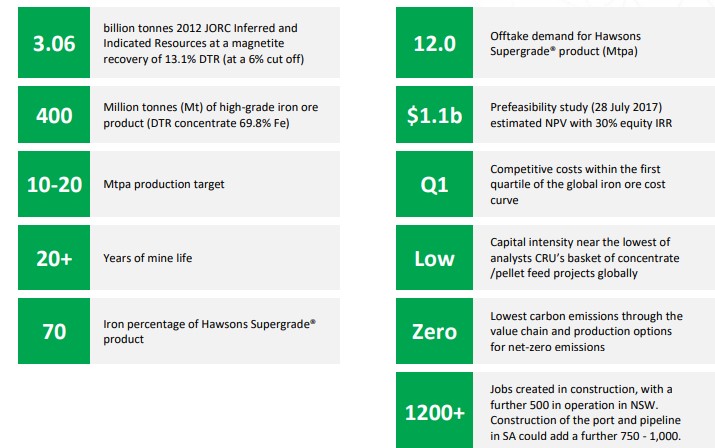
Hawsons Iron Project boasts JORC 2012 indicated and inferred resources of 3.06 billion tonnes at a magnetite recovery of 13.1% Davis Tube Recovery (DTR) for 400 million tonnes of high-quality, trademarked Hawsons Supergrade® 69.8% Fe concentrate.
The 2017 pre-feasibility study had compelling economics at a 10 million tonnes per annum project size. With Hawsons now looking to scale up to a 20 million tonnes option, the economics are substantially better and the project’s environment, social and governance outcomes are appreciably enhanced.
The Hawsons Supergrade® high-grade magnetite product is the ideal feedstock for lower emission ‘green steel’ with demand increasing as steelmakers, responsible for seven per cent of global carbon emissions transition to decarbonising steelmaking.
Hawsons Iron has secured non-binding letters of intent for 12 million tonnes per annum of offtake from Asia and the Middle East, with price premiums expected for Hawsons Supergrade® 70% Fe, low impurity (<3% silica + alumina) product.
The numbers speak for themselves.
“We are an iron ore miner, building a world-class mine in a mining heartland (Broken Hill), with a uniquely soft ore, that allows low emission steel making and we’re ready to go,” said Bryan Granzien.
To understand the gravity of these achievements and the related numbers, let’s examine where the company was before Granzien entered the picture.
An impressive project
Hawsons’ predecessor Carpentaria Resources had a solid project, with strong fundamentals but was weighed by operational and governance challenges. Granzien had been impressed with Carpentaria’s fundamentals way back in 2012, when he was CEO of Tata Steel.
Granzien, the highly motivated, big picture purveyor has a long list of achievements as an ex-senior executive with MIM Holdings and Grainco Australia, as well as the ex-general manager of Neumann Steel and NatSteel Australia, so he knows a good project when he sees one and even back then Hawsons was a good project.
Tata Steel had a look at the project as a potential acquisition but at the time it didn’t quite fit with the company’s strategy.
“There are all these linkages to the project dating back to 2012, when I looked at it in my role as CEO of Tata Steel Australia,” Granzien said.
“We were looking at investments in iron ore and coal and it was a good project back then. I felt it had a lot of the things you look for in a good project. It didn't suit our requirements at the time as we were looking more for feed for Tata’s European mills, but it was a good project.”
The next time Granzien and Carpentaria crossed paths was when he was running his own consulting company and was asked, through his connections at MIM, to look at the project and assist the board and its executives.
Again, Granzien saw enormous potential and was surprised the project hadn’t progressed.
“I was asked to come in and help deal with concerted attempts by foreign interests to secure control through board composition,” he said.
“For me, it really started from there. We got in front of that power struggle and if it wouldn't have been for a couple of people, it would not be a listed company today. It would be privately controlled.”
For Granzien, the fundamentals outweighed the challenges. The Hawsons Iron Project had the four key pillars on which any business is built:
- Low operating cost to get a company through the good times and bad;
- Great location (in the mining heartland of Broken Hill, surrounded by infrastructure);
- Quality assets and product; and
- Scale.
Add to that the opportunities which have emerged since the discovery of the resource over a decade ago, prompted by the steel industry’s decarbonisation imperatives and steel’s critical role in the transition to a low-carbon economy.
The entirety of the project features looks impressive:
Granzien, who thrives on a challenge, believes it is rare to find a project with all four qualities and he was determined to bring his experience to the fore to turn the business around and over time deliver its true worth to shareholders.
Building a new legacy
“I have been privileged to have the opportunity to work with some very good companies, some very good people and learn a lot along the way across the many aspects of a project like this,” he said.
Granzien sees that accumulation of knowledge as crucial to his ability to turn Hawsons around, saying the wisdom he has gained over the years made Hawsons the right project at the right time.
“That's the way I felt. That I could bring that wisdom, experience, contacts, and knowledge to Hawsons to polish this beautiful diamond. The bonus on top is now developing one of the world's purest concentrates.”
A goal that aligns with growing green consciousness.
Granzien believes the quality of Hawsons product can help the industry take a step forward in decarbonising the world.
Its aim is to be a leader towards net-zero emissions mining, by working with global mining specialists and embedding sustainability principles in its designs to maximise Environmental, Social and Governance (ESG) outcomes.
As the website states: Steelmakers understand the benefits of producing ‘green steel’. Today steel making is responsible for around 7% of global carbon emissions and increasing. Our high-quality product is the new source for steel that can meet the climate change challenge to reduce carbon emissions. The world can’t get by without steel, but green steel making, using new technologies, renewables and less to no fossil fuels, becomes possible with our high-quality, Hawsons Supergrade®.
Blue-chip companies from Asia and the Middle East are lining up to secure the Hawsons Supergrade® product, which at 70% Fe offers the highest iron content available on the seaborne market.
A vindication of what Granzien and his team have been working towards.
“It's in our DNA now,” Granzien says. “We want to be a company that leads the way in sustainable mining that contributes to the world. Now we've got a product that is top of the tree as the ideal feedstock to make green steel. There is no doubt anymore that to do this you need magnetite iron ore, not hematite.”
The following video explains just how crucial magnetite is to the growing demand for green steel (click the image below to watch the video):
“If we're going to reduce our carbon emissions, we have to do better. Hematite is diminishing in both grade and availability. So, magnetite is the new king.”
The thing is magnetite is crucial to steel and steel is a critical material for daily life. Imagine what green steel would do in tandem with the rise of hydrogen?
While Granzien can’t give an answer as to how long the transition to a full green economy will take, (“if I could answer that, I'd make a lot of money,”) he does stress that when something is urgent, money is directed at it (much like a COVID vaccine) and comparable companies begin to collaborate.
“I'm expecting the same to happen with hydrogen and green steel and converting those blast furnaces into newer technology, like DRI and electric art technology.
“It’s a big and very expensive transition and these things don't happen overnight, but the main thing is to focus on the end goals. You know, humans are pretty creative,” he said.
A good sport
Granzien is a self-confessed sporting nut. He was involved with rugby league, athletics and cricket. He represented North Queensland in rugby league and cricket.
He played senior rugby league for Mount Isa, as part of the winning Foley Shield Team three years in a row.
It’s safe to say he doesn’t do things by half.
That sport background, the camaraderie of team and the notion of building something big together and seeing the big picture has played an enormous role in the carefully crafted strategy to reset the Hawsons’ vision.
Granzien is indeed a big picture person.
“Seeing the big picture really helped me to break down complex situations into processes. At the end of the day, people and processes are everything in business and life and you want to be involved with good performers in both,” he said.
Granzien has also always had a commercial bent and can do the numbers on a good deal in his head quickly.
“Again, I was lucky enough to work for some very good companies and good mentors and they train you quite well on things like problem-solving, negotiating skills and strategy. Seeing this project from the get-go very early on, I had an image in my head of what needed to happen. I had colleagues that I got together with, and we spoke about that.
“What we've executed, was envisaged right back at the beginning, including changing the name.
“That doesn’t sound much, but it's quite a process raising the capital and then strategising how we are going to do things moving forward versus how it was done in the past. How are we going to sell this project?” he said.
Essentially, Granzien brought two fundamental business beliefs to Hawsons: people and processes and quality is important in both areas.
“Fundamentally a lot of the things don't change in business. From the grain industry to the resources industry, to the steel manufacturing industry, you need systems and ERP (enterprise resource planning), and you need a good team, good information and intelligence.
“You need a strategic plan that everyone buys into. And you need to put in place the processes to execute that. So, to me it doesn't change too much in complexity. There are challenges from 100 people to 300 people to 1,000 people, but fundamentally it's the same structure and things that you must focus on to get right. The rest of it takes care of itself.”
Granzien has brought his philosophy and experience, including that of the sporting arena to a project he calls, “the best project I've seen in my lifetime”.
“I've been in and around the mining industry for probably more years than I'm going to tell you right now and it's the best project I've seen. Not just for those four things named earlier, but for all the other things we've spoken about including being part of leading the way in a new transition.
“We've got a great opportunity to do that.”
Footnote – From BFS to Production
A few weeks ago, Hawsons Iron engaged leading engineering group Australian Mine Design and Development Pty Ltd (AMDAD) as mining consultant to help advance its bankable feasibility study (BFS).
It followed the awarding of other key contracts to global specialists earlier this year to examine optimum infrastructure pathways, process engineering design and decarbonisation opportunities for the iron ore project.
AMDAD has been tasked with preparing a complete mine plan, including final pit design, mining sequence, implementation schedules, fleet composition, mine power requirements, costings and pathways to net-zero emissions.
A comprehensive decarbonisation and sustainability assessment was also carried out.
The BFS has been built off a strong foundation: a PFS completed in 2017 that showed Hawsons is capable of producing one of the world’s highest-grade iron products (70% iron).
Leading the company through the development of its high-grade project will be newly appointed managing director Dave Woodall.
Read: Hawsons Iron appoints new chairman to lead its transition into production
The BFS is scheduled to be completed by the end of the year.
The scope of the BFS was expanded to incorporate the assessment of a 20 million tonnes per annum option which potentially offers significantly lower operating costs and improved ESG outcomes.
Incorporating an underground slurry pipeline to a new port in the eastern Spencer Gulf, this transport option will generate a further 750-1,000 construction jobs along the export pathway in South Australia.
Granzien said he would leave no stone unturned, examining every part of this project to deliver a best practice development and best shareholder value.
“We've looked at processing, we’ve looked at water, we've looked at power, we've looked at transport corridors and engagement with stakeholders and landholders. This is a large-scale project, but the process is well proven and while sustainable with a key focus on ESG, our mine operation is conventional.”