
Elementos Ltd (ASX:ELT, OTC:ELTLF) has confirmed major extensions to the Battery Tin-Copper Lode and deeper Foley’s Tungsten Zone at its Cleveland Tin Project in Tasmania.
The company has received pleasing assay results from a recently completed reconnaissance diamond drill hole program, including a tungsten intersection of 14.2 metres at 0.36% tungsten trioxide from 221 metres, and a tin-copper find of 3.85 metres at 1.05% tin and 0.28% copper from 64.25 metres.
Battery Lode and Foley’s Zone are known deposits at Cleveland contributing to the project’s mineral resource.
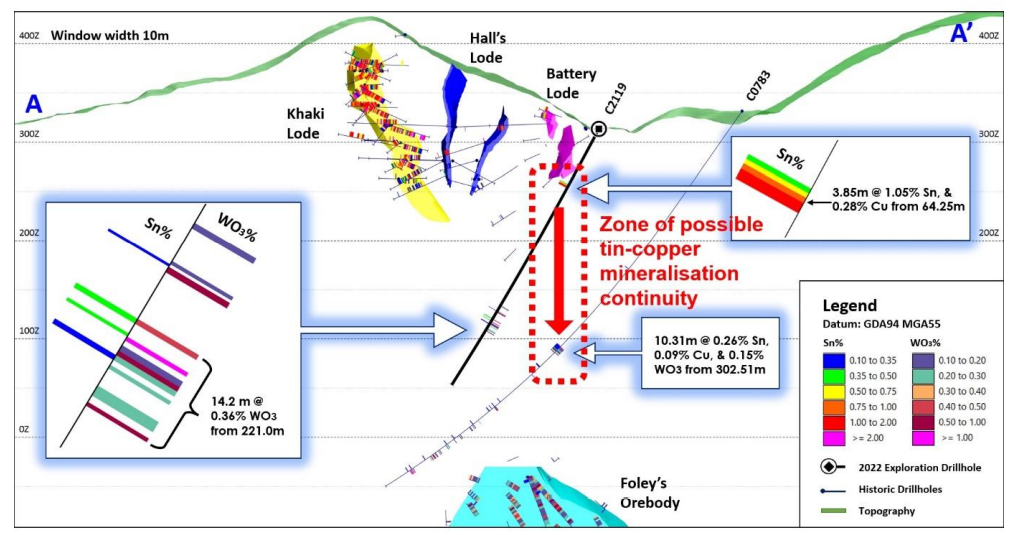
Possible Battery Tin-Copper Lode continuity.
Untested zone near old underground mine
Drilled to a depth of 300 metres, drill hole C2119 targeted an untested zone between northeast dipping and southwest dipping limbs of old underground mine workings at Cleveland and its current JORC 2012-compliant mineral resource.
Following these assays, an additional 59 samples have been taken from the C2119 core and sent for additional assays.
Elementos managing director Joe David said two separate intersections from a single reconnaissance hole was a rewarding return for the program thus far.
New tungsten mineralisation
“In just one hole, in an area with very little historical exploration, the company has made a significant development at the Cleveland Project, extending both the Battery Tin-Copper Lode and identifying new tungsten mineralisation 150 metres above the existing Foley’s Zone,” David said.
“This is firm evidence that the current Cleveland mineral resource and geological model does not fully encapsulate the immense potential of the deposit. We’ve shown further mineralisation exists, close to the current resource, closer to the surface and in very close proximity to historical underground mine production drives.
“Our four-hole drill campaign is now complete ahead of more assays to follow. We will now proceed with downhole geophysical surveys and further geological interpretation before designing a targeted follow-up drill program.”