
Frontier Energy Ltd (ASX:FHE) has released preliminary results from a Green Hydrogen Study, which indicate green hydrogen production could be achieved significantly earlier than originally anticipated at the flagship Bristol Springs Solar Project.

The project’s unique location near Waroona, Western Australia, on freehold land, right near existing grid (SWIS), gas and water infrastructure, reduces its overall costs compared to projects in more remote areas.
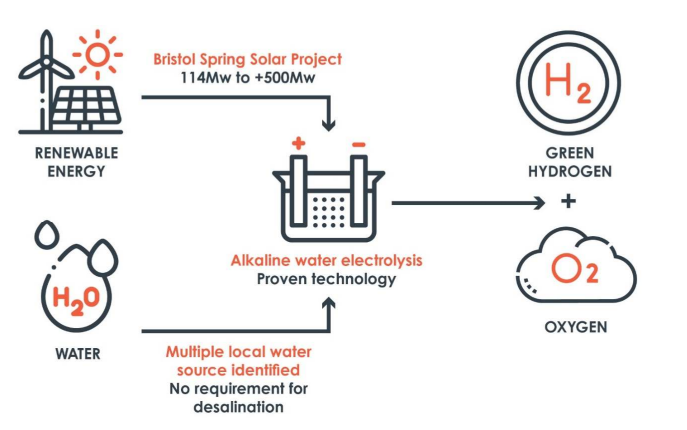
Pathway to green hydrogen
Proximity to an existing and emerging green hydrogen domestic market also provides a pathway to hydrogen sales.
Findings from the ongoing Green Hydrogen Study indicate that commercial quantities of green hydrogen can be produced from the 114-megawatt dc (MWdc) stage one solar operation significantly earlier than originally anticipated.
The company thinks that the economics of hydrogen production are enhanced by the surrounding existing infrastructure and the fully-owned renewable nature of the energy asset.
Early adopters of the transition to green hydrogen include the users of the Dampier Bunbury Pipeline (natural gas) as well as the long-haul transportation industry (diesel).
Dovetails with WA Government initiative
A key initiative of the West Australian Government is for hydrogen to replace diesel. WA currently imports 6.7 billion litres of diesel per annum.
On a direct comparison basis, today’s diesel price, at around $2 per litre, equates to a hydrogen price of $8 per kilogram – one kilogram of hydrogen is equivalent to four litres of diesel.
The Australian Government has allocated A$1.3 billion in its 2022-23 budget for energy security funding, including for hydrogen.
FHE’s Renewable Expansion Study and Green Hydrogen Study are being finalised and will be released in the coming months.
Solid returns in clean energy market
Managing director Mike Young said: “The stage one solar project is an excellent foundation for the company to move into the renewable energy sector, as we believe it will generate solid returns over at least a 30-year operating period, in a market environment of ever-increasing clean energy demand.
“As part of the Green Hydrogen Study, the Xodus Group was asked to determine what size solar production, as a minimum, would be required to be able to commence green hydrogen production. We originally anticipated this would be larger than the Stage One Project (114MWdc) to justify the additional capital costs associated with hydrogen production.
“The BSS Project is, however, uniquely located around significant existing infrastructure, which is critical for the hydrogen industry, meaning our initial capital costs will be significantly less compared to more remote projects for first production.
Built-in customer base
“Our ability to service the most likely first adopters of hydrogen (gas pipeline and long-haul transportation) means we are also likely to have customers for our product. Given the industry remains in its infancy, the ability to target these specific customers is somewhat more important than after more widespread adoption.
“As I recently saw in Rotterdam at the World Hydrogen Conference, the global market for green hydrogen is rapidly growing,” Young continued.
“It is clear hydrogen fuel cell electric vehicles (FCEV), which have actually been around since the 1960s, will be a major part of global decarbonisation, especially in the long- and heavy haulage transport industry. Given expectations for diesel prices, on a direct comparison, we believe hydrogen use in the long-haul transport industry is already an economically viable alternative.”